
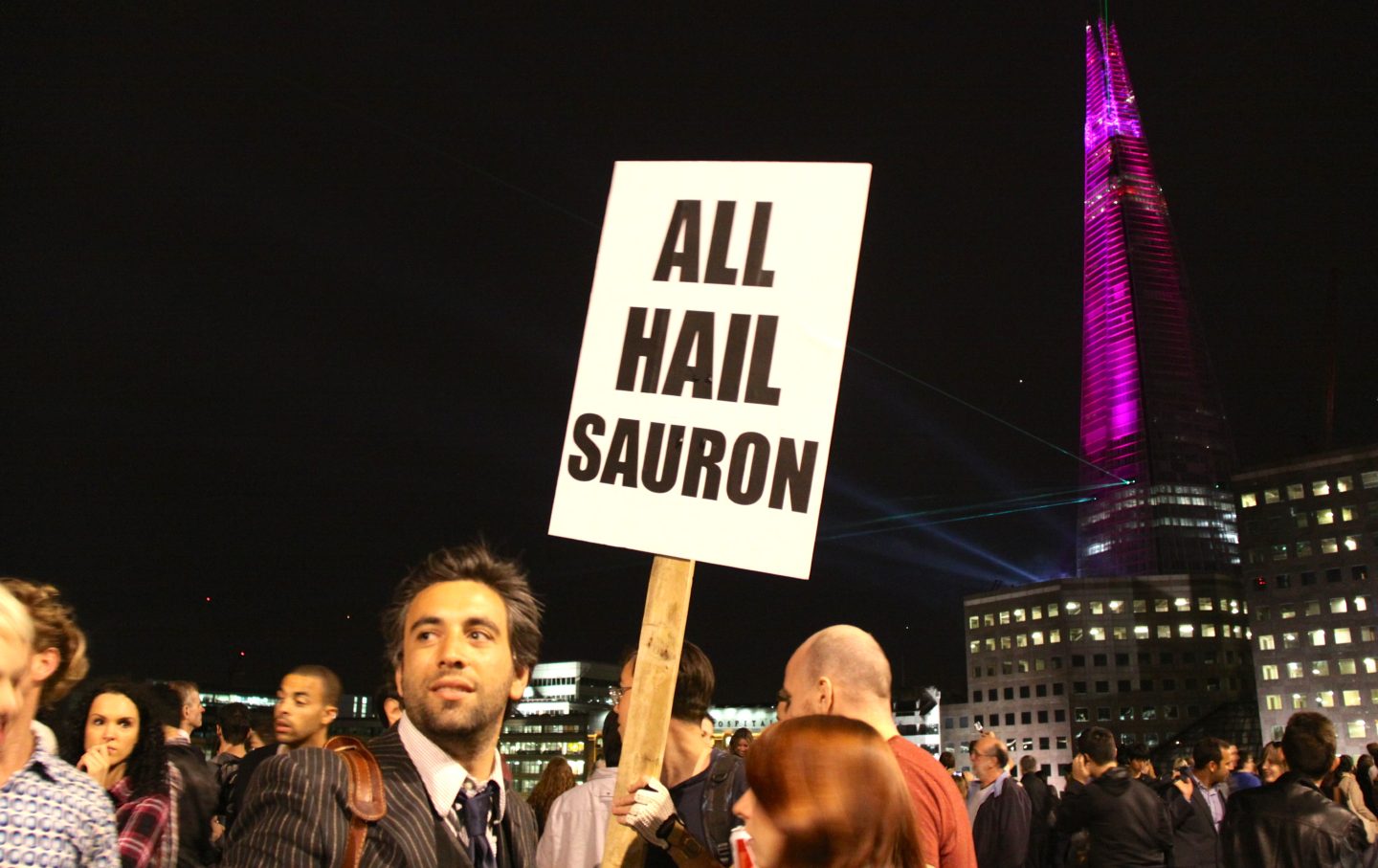
J.R.R. Tolkien has a message for us: Don’t give in to Trump.
To many Middle-earth politicos, Sauron’s victory once seemed beyond doubt.
(Michael Reeve / Getty Images)
When I started rereading The Lord of the Rings, I wasn’t looking for spiritual takeaways. I was after a bit of escapism—a chance to decamp from the escalating nightmares of our reality to the fantasy stomping grounds of my childhood.
But Middle-earth is not a light holiday destination. It’s a world being overrun by forces of evil. The same can be said of lots of fantasy worlds; that’s the thing about a genre-defining piece of literature—it sets the conventions for the stories to come. But J.R.R. Tolkien remains unique in the degree to which his great work focuses not just on the overwhelming threat of a powerful villain but also on the despair that such a threat generates.
Having not read the books in well over a decade, I was surprised by how the choice whether or not to give up hopes operates as the central organizing principle in Tolkien’s universe and the fulcrum around which the entire story pivots.
Current Issue
In The Lord of the Rings, Sauron, the story’s Big Bad, does not want to destroy all the peoples of Middle-earth. Rather, he is seeking to break their will to resist him (as he had done to the men of the East and the oliphaunt-riding Haradrim of the South). To this end, despair is his most effective weapon. Sauron’s chief lieutenants, the Nazgûl, are not very powerful in a physical sense; as Tolkien describes, “Their peril is almost entirely due to the unreasoning fear which they inspire.” Sauron’s priority when he launches his assault on Gondor is to send a “great cloud stream[ing] slowly westward from the Black Land, devouring light” to ensure “all hearts in the City were oppressed.” And when Sauron finds a way to communicate with the steward of Gondor, Denethor, through a palantir (yes, Peter Thiel associates himself with Middle-earth’s forces of corruption, which certainly qualifies as one of those escalating nightmares mentioned above), Sauron’s strategy is to convince him that “against the Power that now arises there is no victory,” a despair in Denethor’s mind that soon leads to the self-immolation of his body.
So, yes, there’s profound despair in the world of Tolkien, who was, after all, a World War I veteran who lost nearly all his boyhood friends at the Somme. And yet, to anyone struggling in this moment, I would strongly recommend picking up these books. Because inherent to any discussion of despair is a discussion of its opposite, hope. And rereading The Lord of the Rings has helped to renew my commitment to the practice of hope in what often feels like a relentlessly hopeless age.
The universe of Tolkien’s Middle-earth is composed of both a Seen (material) world and an Unseen (spiritual) world. In the Seen world, the regular laws of physics mostly apply. But in the Unseen world, it is primarily the moral value of our decisions that act on and cause consequences to the universe. Between the two, it is the Unseen world that is the truer and more fundamental; in Tolkien’s legendarium, spiritual power always has the last word. In The Lord of the Rings, therefore, a person’s choice to do the right thing, to continue fighting for good, to resist evil despite seemingly insurmountable odds—in a word, to hope—affects the material results of their struggle.
As one example, we can contrast the end of Denethor, despairing and alone, with that of Theoden, king of the Rohirim. As Theoden leads his men to relieve the siege of Minis Tirith, there is a moment—as the riders of Rohan, seemingly too late, come upon the vast armies of Mordor breaking through the gates of the city. Merry, a hobbit, watches Theoden wage this internal battle. Tolkien writes:
The king sat motionless, gazing upon the agony of Minis Tirith, as if stricken suddenly by anguish, or by dread. He seemed to shrink down, cowed by age. Merry himself felt as if a great weight of horror and doubt had settled on him.… Perhaps Theoden would quail, bow his old head, turn, slink away to hide in the hills. Then suddenly Merry felt it at last, beyond doubt: a change. Wind was in his face! Light was glimmering.… The bent shape of the king sprang suddenly erect. Tall and proud he seemed again.… He seized a great horn from Guthlaf his banner-bearer, and he blew such a blast upon it that it burst asunder. And straightway all the horns in the host were lifted up in music.
Unlike Denethor, Theoden overcame his despair, inspired his men to do the same, and led them in a victorious charge that in turn instilled terror among the forces of Mordor. Sauron’s host—who based on their numbers would have carried the day had they just continued fighting—fled, handing victory on the Pelannor Fields to the good guys. The side that held onto hope won; the side that gave in to fear lost.
Of course, there’s an obvious response to any attempt to draw life lessons from The Lord of the Rings, which I posed to myself upon realizing, with some embarrassment, that I was starting to absorb the internal logic of a fantasy series: We don’t live in a magical universe; we live in this garbage fire of a real world, where making the choice to hope very much does not guarantee victory.
The longer I’ve reflected on this, however, the more it’s occurred to me that this connection—between one’s spiritual choice to fight and the physical results of that fight—actually does exist in our world. Just like in The Lord of the Rings, war in the real world often comes down to will; how many times—in Vietnam, Afghanistan, Ukraine—have we seen weaker forces beat back far stronger ones simply because they maintained a greater will to keep fighting? This happens in politics, too. Indeed, it’s arguably the story of Trump. After he lost the 2020 election, he should have been broken, defeated, with no chance of returning to the White House. But he refused to give up, and—like Sauron reentering Mordor to rebuild his power—essentially willed his horrifying comeback into existence.
This connection also helps explain why Trump’s second term has been so disastrous—because unlike during his first term, most elite institutions are choosing not to fight. Whereas Theoden overcame his fear and led his men to victory, Big Law firms, elite universities, major media companies, and far too often the leadership of the ostensible opposition party have slunk away to hide in the hills or pulled a Saruman and outright joined the forces of darkness. Trump’s greatest triumphs lie in these preemptive capitulations, because—like in Tolkien’s moral universe, where one’s spiritual choices often matter more than the physical results those choices produce—every time these cowards give in to Trump’s authoritarian advances, it actualizes a more authoritarian reality by strengthening Trump’s perceived power and ratcheting up the despair experienced by the rest of us.
Popular
“swipe left below to view more authors”Swipe →
In contrast, when Americans have chosen to fight back, we’ve regularly succeeded, at least to some degree, in weakening the regime by making its ultimate victory seem that much less inevitable. We saw this most recently with Jimmy Kimmel’s return to ABC following massive and sustained public outcry. We saw it with the pink-shirt sandwich guy and the DC grand jury’s refusal to indict him. And we’ve seen it on the unfortunately too-rare occasions when Democrats have taken clear, courageous stands—like, for example, when Senator Chris Van Hollen’s mid-April trip to El Salvador to visit Kilmar Ábrego García (who remains imprisoned in an ICE detention center) was immediately followed by a major drop in Trump’s approval rating on immigration.
If the only way Trump can conclusively win is by convincing us not to fight back in the first place, then every act of resistance matters. It sounds trite, but that doesn’t make it less true. Every time we choose hope over despair, and put that choice into practice, our decision echoes out across the Unseen world with real consequences for the Seen one. (Or, if you’re not yet Rings-pilled and want a more materialist translation: Every time you contribute to the opposition in visible ways, you make it easier and more likely that others will join in next time.)
In this age of nightmares, the siren song of despair is tempting, and resisting it takes work. But The Lord of the Rings reminds us that in every way, the case for hope—the maintenance of which is a necessary (if not sufficient) victory in and of itself—is the more pragmatic option.
So let’s end the debate, just as my favorite Lord of the Rings character—and, I strongly suspect, Tolkien’s favorite, too—Sam Gamgee did during his and Frodo’s last, desperate push through the depths of Mordor to the cracks of Mount Doom.
Sam could not sleep and he held a debate with himself.… ‘It’s all quite useless. You are the fool, going on hoping and toiling. You could have lain down and gone to sleep together days ago, if you hadn’t been so dogged. But you’ll die just the same, or worse. You might just as well lie down now and give it up. You’ll never get to the top anyway.’
‘I’ll get there, if I leave everything but my bones behind,’ said Sam. ‘And I’ll carry Mr. Frodo up myself, if it breaks my back and heart. So stop arguing!’…
No more debates disturbed his mind. He knew all the arguments of despair and would not listen to them. His will was set, and only death would break it.
We may have some dark years ahead of us. And whether we allow them to also be despairing years is a choice—our choice. We must set our wills.