
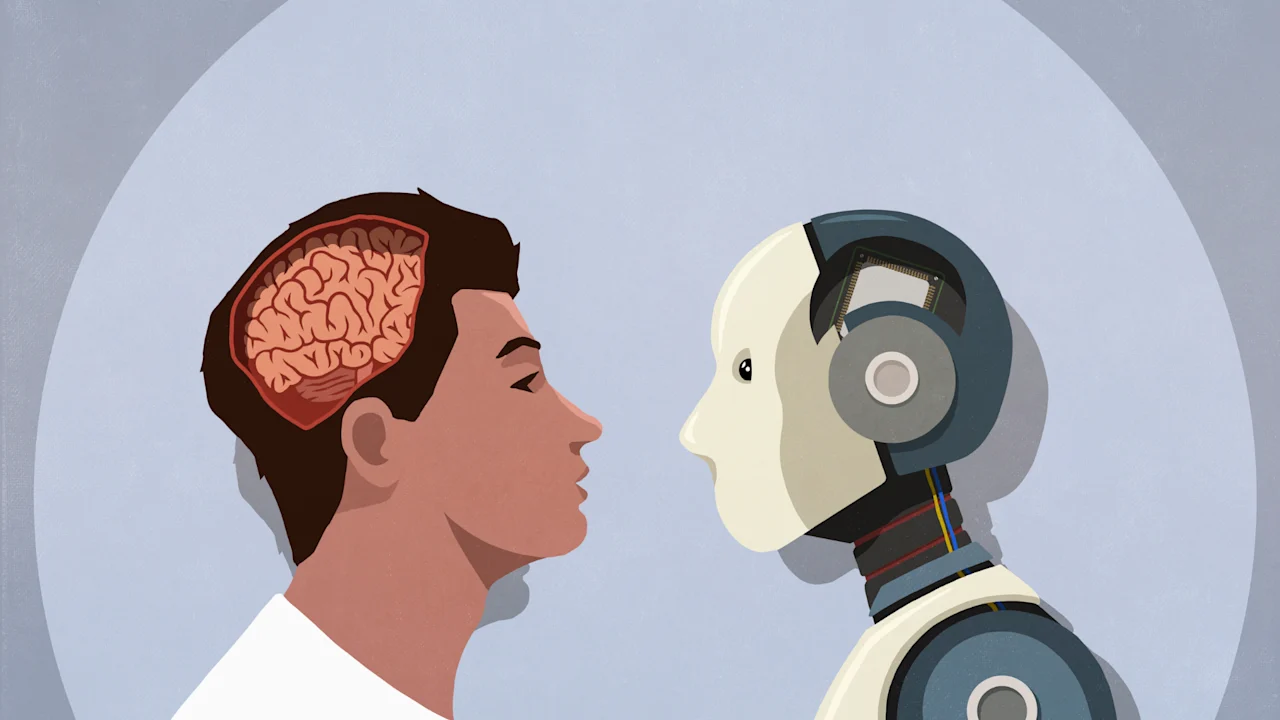
The challenges with AI adoption have little to do with the technology itself. In the work environment, the hardest part is bringing together a new orchestration model that fully integrates AI tools while ensuring teams both adopt and master new behaviors to deliver tangible results.
As Steve Lucas recently wrote in Fast Company, we have entered the era of the “AI natives and the AI nots.” This delta will become vividly apparent this year.
At the center of the AI revolution: a fundamental reevaluation of organizational design. Roles are evolving because the skills, intelligence, and processes we have relied on are being upended and redefined.
OLD PROCESSES AND NEW ONES
What we see broadly in knowledge work is two kinds of behavioral ecosystems operating in tandem. The first is our old processes and systems. At the administrative level, individual job descriptions and responsibilities require certain tasks to go through certain people. However, setting up an AI agent can replace some of this administrative work.
The blocker is the transition from the old to the new and how to get there without disrupting the business. Most of us are not pulling off the Band-Aid and replacing people with AI agents because there are not enough people in organizations that can reliably vet, learn, set up, train, and adopt AI platforms and agents without disruption and also while guaranteeing a better outcome.
This means that for many organizations, a fundamentally new way of running a business and doing certain kinds of knowledge work means leveraging AI along with human roles and activities. The challenge is that it can be hard for businesses to quickly and easily integrate AI. The short-term disruption is too great and the ROI is unclear from the start.
MANUAL VERSUS MACHINE
I like to think of this as the John Henry stage of AI. As folklore has it, John Henry used his human might to manually hammer a hole into the rock faster than a steam drill, only to die victorious with a hammer in his hand as his heart and body gave out.
Similarly, we see AI outpace humans in certain work while some people continue using old methods. Ironically, transitioning to a new method requires individuals to meet and discuss how to do it. So the largest hurdle to surmount is the process to get from strategy to adoption and behavior change, so that execution preserves both speed and craft.
PEOPLE ARE THE PROBLEM
What is the problem at the center of all orchestration redesign problems? People. There is a common adage born from Price’s Law that about 10% of the people in an organization (technically, the square root of the total number of participants) do 50% of the work. When you layer AI tools into the mix, the few AI superusers become increasingly indispensable while the rest of your knowledge workers become less valuable and more inclined to hold onto their old methods.
In Dan Davies’ 2024 book, The Unaccountability Machine, he coins the term accountability sinks and argues that since World War II, modern businesses have over-indexed on process, resulting in diffused decision-making. This obscures and deflects responsibility and consequences. The result is a difficulty in identifying mistakes and fixing them.
AI orchestration promises to reorient the accountability sink paradigm. When you incrementally interrogate most business processes, no individual aspect appears inherently confusing or unclear. But when layering in human delegation without articulating the skills and steps to achieve a goal, things go awry.
ACCOUNTABILITY OBFUSCATION
I would argue that to some degree, all administrative knowledge work has built-in accountability obfuscation. If a job requires delegation as a primary job function, you open the door to deflect accountability. If you replace administrative functions that rely on delegation with AI agents, these functions hypothetically become more bilateral. They either work or they don’t.
To move beyond the problem with AI adoption, I’d place my bets on an internal innovator over a John Henry in your organization. A full stack worker that has a success- and outcome-focused mindset may fumble and make mistakes. But they will be driven because their “if you’re not first, you’re last” outlook will spark real progress to break free of accountability sinks. Find the individuals inside and outside your organization with the passion, curiosity, and talent to build new methods of AI orchestration. It will be messy and imperfect, but the alternative is to die with a proverbial hammer in your hand. For me, the choice is clear.
Matt Owens is chief design and innovation officer at Athletics.