

By redefining the meaning of “harm” in the Endangered Species Act, the administration is giving big corporations a gift they have long demanded.
In an attempt by the National Park Service to protect endangered desert tortoises, signs advise drivers to “drive like a tortoise” in the Mojave National Preserve in California. Between 2001 and 2020, the number of Mojave desert tortoises fell by 54 percent.
(David McNew / Getty Images)
When wildfires destroy homes in California, or climate change reduces waterfront properties in Florida to flotsam, or unscrupulous scammers using “deed theft”—a type of paperwork fraud—evict rightful owners from their New York City brownstones, most of us intuitively understand that the loss of those homes was harmful to the people who lived in there. Even putting aside capitalistic human concerns like lost equity, and even for families who weren’t physically injured, we all recognize that displacement from the places we call home—our habitats—is pretty much the definition of “harm.” But the Trump administration is trying to redefine “harm” so that it excludes the destruction of homes. At least, when those homes belong to the country’s most vulnerable species.
In July, the Trump administration announced that it will scrap the long-standing meaning of the word “harm” as defined under the Endangered Species Act. Since 1975, the law has labeled “modification or degradation” of endangered species’ habitats as a form of “harm”—recognizing that encroachments on an animals’ home can disrupt all sorts of life-sustaining behaviors, including “breeding, feeding or sheltering.” But under the administration’s new rule “harm” occurs only when you directly kill endangered animals—making it otherwise totally legal to destroy that animal’s habitat, even if the long-term result is the species’ extinction. Considering driving a steamroller right through the North Carolina forest dwellings of the red wolf—nearly driven extinct in the 1980s, with fewer than 40 living in the wild today? As long as you don’t actually steamroller a wolf to death, that’s totally legal now! Fancy building your eighth vacation home amid the Texas Gulf Wetlands where the whooping crane—once reduced to just 21 birds—spends every winter it has left before climate change destroys us all? Go ahead and undertake construction during the summer. According to this administration, it doesn’t count as “harmful” if the crane flies home to nothing.
This very on-brand callous indifference comes as many scientists warn that we are now entering the Sixth Mass Extinction, a period in which humans are “wiping out vertebrate animal species hundreds of times faster than they would otherwise disappear,” to quote a Stanford University report. In 2019, the United Nations released a study—conducted over three years with contributions from 145 experts in 50 countries analyzing 15,000 scientific and government sources—finding “1 million animal and plant species are now threatened with extinction, many within decades, more than ever before in human history.” That same year, Conservation Science and Practice published a study finding that, for animals added to the endangered list between 1975 to 2017, more than 80 percent were threatened by habitat destruction—while just 17 percent were endangered because of hunting and poaching. That simply corroborated long-standing recognition by scientific organizations, including the National Academies of Sciences, Engineering, and Medicine, that habitat destruction is the single greatest threat to animal survival and continued biodiversity.
Maybe the most cynical aspect of the Trump administration’s supposed case against the old definition of “harm”—captured in its press release about the change—is its claim that it was “outdated,” resulted in “federal overreach,” and insistence that this new rule “returns the interpretation of the ESA back to its actual text and original intent.” But, like, none of that is remotely true? The bipartisan Endangered Species Act, which passed the Senate unanimously, became law in 1973. Under the legislation, it is illegal to “take” any endangered species—a term it statutorily defines as “harass, harm, pursue, hunt, shoot, wound, kill, trap, capture, or collect.” In 1975, the Federal Wildlife Service extended definition of “harm” to include habitats of endangered species; in 1981, that language was further refined—with the act of refinement serving as ipso facto attention to both intent and effect—to explicitly include “significant habitat modification or degradation which actually kills or injures fish or wildlife by significantly impairing essential behavioral patterns, including, breeding, spawning, rearing, migrating, feeding or sheltering.” That definition of “harm”—and its protections over habitat—was upheld 6–3 by the Supreme Court in 1995 when the timber industry and other powerful business interests tried to change it. The late Justice Antonin Scalia, who would’ve absolutely loved SCOTUS’s current hyperpartisan conservative supermajority, wrote in his dissent that “harm” should only cover “affirmative conduct intentionally directed against a particular animal or animals.” (He was joined by Thomas.) The Trump administration writes in its new rule that “we adopt Justice Scalia’s rationale”—resting its case on the losing dissent in a 30-year-old court case. Incredible.
Of course, an administration that’s anti-science, anti-environment, and ideologically committed to deregulation was going to dismantle the Endangered Species Act. But exactly who will benefit has never been more obvious. In the lead-up to the 2024 presidential elections, Donald Trump feted 20 Big Oil leaders at his private Mar-a-Lago golf club. He announced to the group—which included CEOs from Exxon Mobil, Chevron, ConocoPhillips and the American Petroleum Institute—that if they collectively contributed $1 billion to his campaign, he would overturn President Biden’s environmental rules and, as president, keep new ones from being implemented. Oil and gas companies ultimately contributed an estimated $75 million to Trump’s reelection—at least, on the books. But a study by the environmental group Climate Power found a collection of “mine operators, shipbuilders, engineering firms, hedge funds and little-known oil producers” donated about half a billion to Trump and Republicans “throughout the 2024 election cycle” in the form of “direct donations, lobbying, and advertising.” That’s not counting dark money, which the Brennan Center reports hit “a record high” ahead of the 2024 general. (The outlet reports that money kept flowing even after Trump’s win, with oil and gas titans giving nearly $12 million to his inauguration fund and $25 million to the MAGA, Inc. super PAC.) The American Petroleum Institute and the National Mining Association have showered praise on the Trump administration for its “harm” rule change, after years spent lobbying for exactly that sort of deregulation.
Here’s a more specific example. In March, the Trump administration convened the Endangered Species Committee, an interagency cabinet committee established in 1978 under the Endangered Species Act. It’s not a standing panel, instead meeting only to consider requests for exemptions from the Endangered Species Act—a condition so extraordinary that the panel had previously only met three times in its existence, most recently in 1992. Often called the “God Squad”—an unironic reference to its power to protect a species or doom it to extinction—it is chaired by the secretary of the interior and comprises the heads of five other agencies, including the secretary of agriculture and the administrator of the Environmental Protection Agency. Under this administration, that membership essentially consists of six high-ranking Trump loyalists.
Current Issue

The God Squad’s most recent meeting—held “without the legally required notice, review, or application process,” as several environmental groups noted—was convened by Secretary of Defense Pete Hegseth. He would call the need for lifting endangered species protections “a matter of urgent national security,” citing litigation filed under the law. “These legal battles waste critical government resources,” Hegseth claimed, “and make it impossible for energy companies to plan and invest in new projects.” It took just 15 minutes for the God Squad to sign off waiving the Endangered Species Act’s prohibitions across the whole of the Gulf. That area is home to more than 20 endangered and threatened species, from sea turtles to coral to dolphins. At last tally, there were literally just 51 Rice’s whales—also dubbed America’s whale, because it’s the only whale species only found in US water bodies—still swimming in the Gulf. But America needs more gas because of its endless wars, so good luck, whales!
Perhaps there’s nothing here explicitly tying the ESA rollback to the AI data center boom, but with more than 1,600 planned for the next year—many in rural areas that likely border the habitats of threatened species—it seems like a valid cause for concern. In August, the Trump EPA announced plans to scrap a federal rule requiring public announcements of data centers before construction can begin. That came just weeks after the agency exempted power plants that mostly serve data centers from pollution limits under the Clean Air Act, specifically those to prevent acid rain. Those actions are among at least 30 others identified in a report this month by the Environmental Protection Network, a nonprofit representing more than 800 former EPA employees. “The Hidden Health Costs of AI Data Centers” ticks off a series of Trump administration policies “since January 2025 that could increase pollution-related health risks, weaken protections that would otherwise reduce those risks, or shift more costs onto families and communities.” And while those policies are not evidence of a quid pro quo with Big Tech over data centers, they certainly do fit with a pattern of putting profits over every form of life.
All of this comes on the heels of the administration’s lifting restrictions on hunting and fishing in National Parks. It has also chosen to throw out protections on more than 86 million acres of public land, which is over 70 Grand Canyons or 38 Yellowstone National Parks.
And, in keeping with its topsy-turvy redefinition of how the ESA defines “harm,” an internal Fish and Wildlife Service memo dated September 14 and obtained by The New York Times states that the unintentional killings of endangered animals is no longer illegal. Per the new directive, companies and individuals will only be held liable for an endangered animal’s death under the ESA if they intended to kill it—but not if the death occurred by accident. If a corporation’s seagoing vessel mows down a pod of endangered whales, killing mothers and their calves, it’s really no big deal because—as the new policy states—“the vessel’s course was not set against the whale.” Similarly, if “the bats roosting in” a tree all die when that tree is felled by a logging entity, it’s only illegal if the logging company declares it felled the tree “for the purpose of killing or capturing them.”
Corporations, which are famously as honest as the current administration, definitely won’t use the rule change to do whatever they want in the pursuit of profits and at the cost of everything else, including a planet where that money might actually be worth something.
Environmental groups have already filed numerous lawsuits to stop the administration from redefining “harm,” but there’s little reason for confidence should they reach the Supreme Court, which in 2024 overturned the Chevron doctrine, a legal rule that protected against this kind of arbitrary redefining of statutory language by nonexpert actors. In the meantime, the administration isn’t waiting for courts to rule on its actions. It’s putting its policy changes and legislative rewrites into effect now, chipping away at long-standing protections, and doing all kinds of real-world damage before anyone stops them.
The ESA has, historically, been one of our nation’s most effective laws. A 2019 study by the Centers for Biological Diversity found that it “has prevented the extinction of roughly 291 species since passage in 1973, and has to date saved more than 99 percent of species under its protection.” So many animals we regard as quintessential symbols of America—the bald eagle, grizzly bears, humpback whales, California condor—all of these have been brought back from the edge of extinction thanks to the protections provided by the ESA. And more specifically, the protections the law provides to the habitats of those animals, which are necessary to their survival. It was always obvious that an administration that cares nothing for the air its people breathe or the food its people eat would show the same disregard for the animals that hold our ecosystems together. The bald eagle came back once. Whether our other most imperiled species ever will depends on our paying attention.
Between the reemergence of right-wing red-baiting and Donald Trump’s use of the chilling National Security Presidential Memorandum–7 to criminalize left political organizing, we’re seeing McCarthyism reborn before our eyes.
This assault on democracy cannot be ignored or wished away. Resisting it requires bravery in the face of threats and repression, a steadfast commitment to the truth, and the unwavering belief that we can—and will—overcome this darkness.
We must have an independent media that sets the record straight, unearths corruption and abuses of power, and advances a politics of justice and dignity for all if we’re to win this fight.
That’s why I’m writing to you today. This September, The Nation needs to add 100 monthly donors to sustain our progressive journalism. Your contribution makes the next investigative report, the next truth-speaking column, and the next pathbreaking essay all possible.
I hope you’ll support our work with a recurring donation today. If you donate $10 or more a month, we’ll send you a brand new “Hands Off the Free Press!” sticker to recognise your commitment to our cause. Please, donate today.
Onward,
Katrina vanden Heuvel
Editor and Publisher, The Nation
More from The Nation
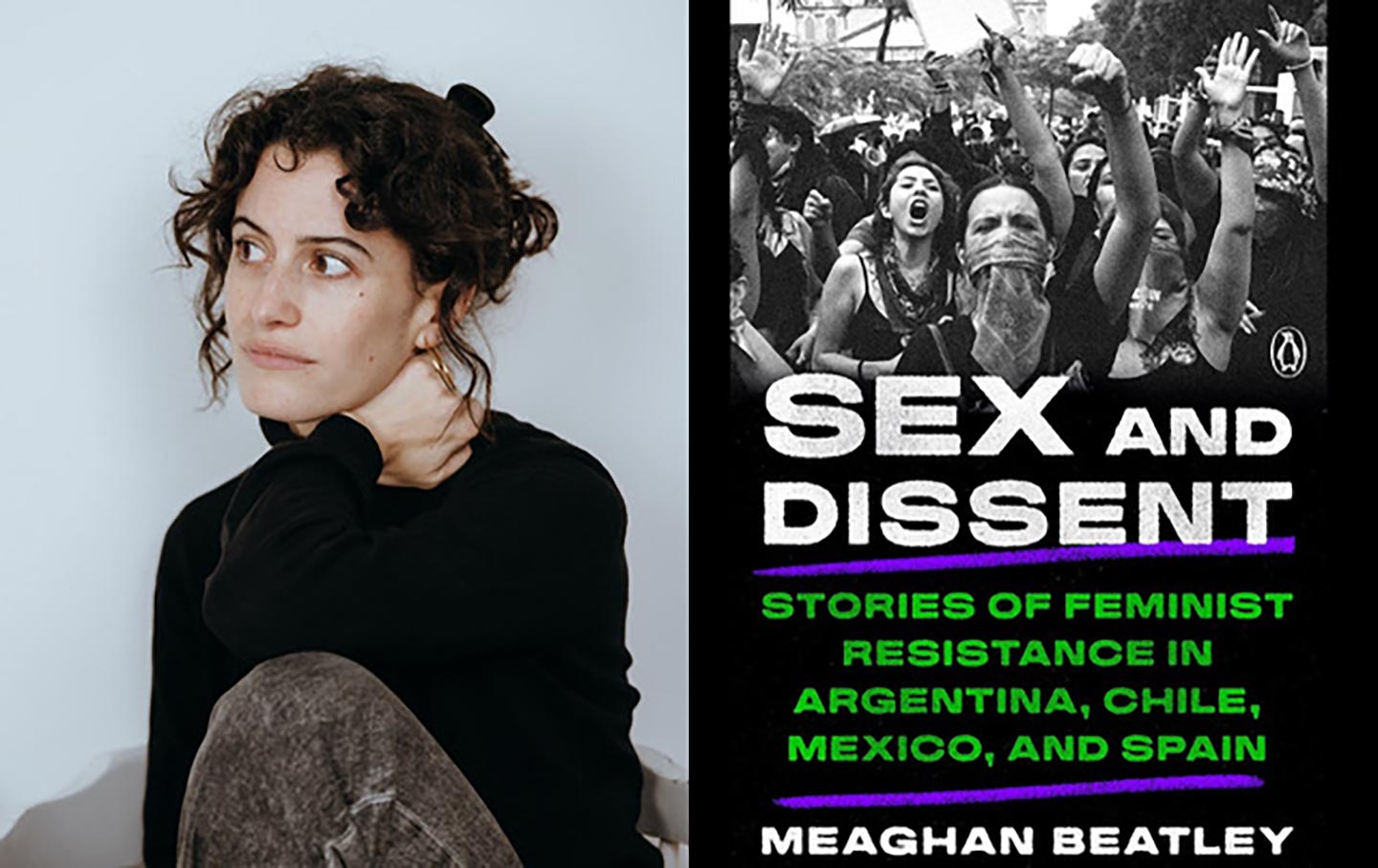
A conversation with the author of Sex and Dissent about what American feminists can learn from the Green Wave movement.

A new lawsuit alleging that a former student was drugged and gang-raped by Chi Phi fraternity members is sparking outrage in the Cornell community.

Bazunu’s decision raises the perennial question: Why is a country that is currently committing a genocide allowed to compete in the first place?

I grew up in a neighborhood manufactured by the University of California, Irvine. It felt like a utopia for academics—until the university forsook its mission of serving the publi…