
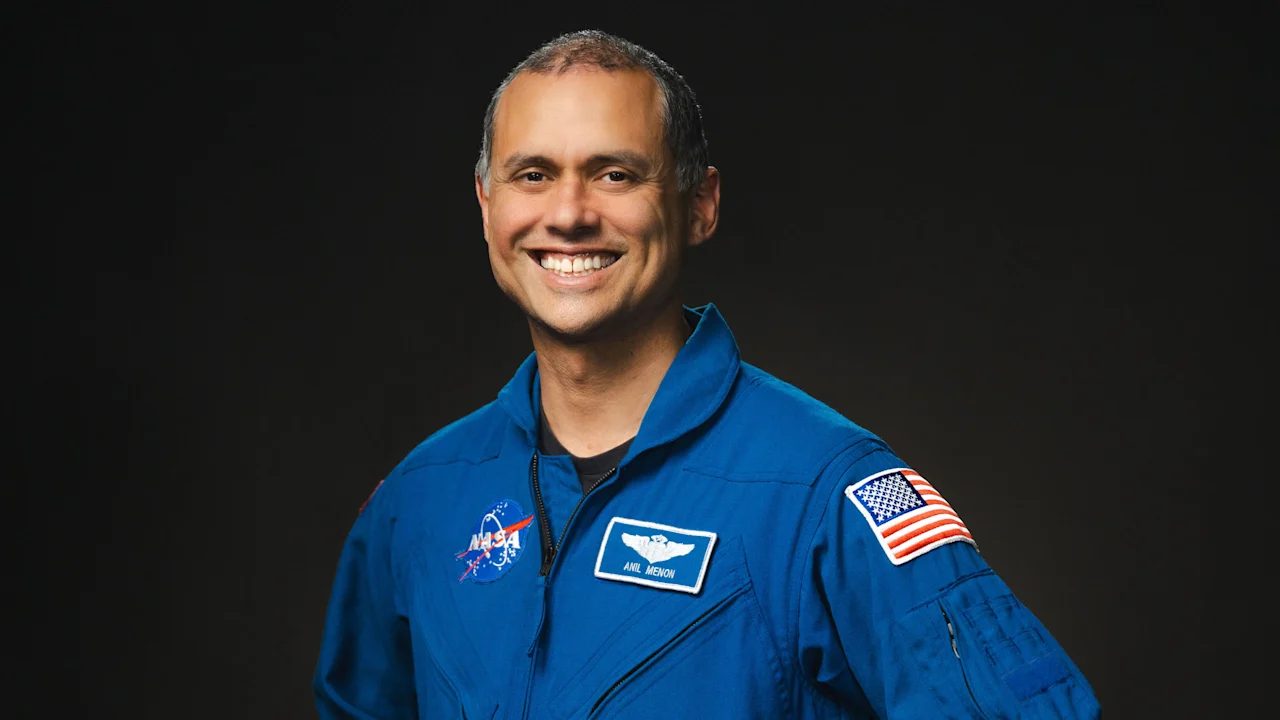
Anil Menon might have the world’s spaciest resume. After several years as a NASA flight surgeon, he became SpaceX’s medical director in 2018, where he authored research on the effects of space on the human body. In 2021, he was selected as a NASA astronaut and has spent the past several years training for his own journey to space. Along the way, he also supported his wife, Anna Menon, who traveled to space on a private mission in 2024 and was herself selected as a NASA astronaut last year.
Somewhere in the margins, Menon has also served as an Air Force Reserve member and emergency room doctor.
Now, he’s finally heading to space himself. This July, Menon will travel to Kazakhstan, where Russia’s space program conducts launches, and join two cosmonauts on the next mission to the International Space Station. He’ll fly aboard the storied Russian Soyuz crew vehicle, which has been used successfully for decades, and is expected to spend eight months aboard the station.
For years, NASA and Roscosmos, Russia’s space agency, have maintained the practice of placing astronauts and cosmonauts on one another’s missions. One side effect of that arrangement, and of the modern space age more broadly, is that Menon brings an unusually expansive perspective on life in space, with experience spanning NASA, Russia’s space program, and SpaceX, as well as a firsthand view of NASA’s distinct institutional role.
“NASA kind of bridges the gap between some of these different cultures and synthesizes it,” he says. “As we look at the moon, everyone is going to pursue that as well. I think that NASA is this great synergy for all of that.”
Fast Company spoke with Menon about his upcoming mission, the future of commercial space stations, and the biggest unanswered questions surrounding microgravity’s effects on the human body. This interview has been edited for clarity and length.
Can you talk a little bit about the differences between the Soyuz and the Crew Dragon?
The Soyuz was developed for some of the first space flights and it’s got this long heritage tracing back to what we consider the space race. They’ve tried to keep things that work and just keep them working for high-reliability reasons. Some of the computers and screen layouts are things that are push-button… They work.
The same goes for engines and some of the seats and comfort level. Most of the astronauts during the early Russian space program were shorter in stature, so someone who’s 6’1’’ like me doesn’t fit as well, but I fit… It works, and that’s the interesting thing. The spacesuit has a rubber pressure seal, and you twist it … and then you put a band around it to seal it—two bands—and that’s how you create your seal. It isn’t a zipper. It isn’t some locking mechanism, but it works. And it’s always worked.
SpaceX, born in this era, is really pushing the frontiers of engineering and developing things. You’ll see more touch displays. It’s automated procedure sequences….you hit a button, and you get that procedure popping up for you with a lot of data flowing in, as you’d see in a sci-fi movie. It also works, and it’s a different way to tackle the problem, and it’s got some advantages.
The suits: you zip them around and put them on… They look really cool, and they work really well. There are different sorts of engines —[where] the rocket itself lands—which adds usability. I’d say it’s pushing the frontiers of where we want to go with things, which is uniquely cultural to us in terms of the way we look at things.
As a physician, what do you see as the biggest open questions about, like, the impact of space on the human body? We’ve done a lot of studies on through the International Space Station, but what open questions intrigue you as we think about going to the moon, and maybe Mars?
I’ll answer that in a nebulous way and a very specific way. The more general answer is that there’s just so much new stuff. We’ve been flying healthy astronauts to space for a long time. We are going to be flying—and we are starting to fly—the whole spread of humans to space. You know, on Inspiration 4, Hayley Arceneaux had an osteosarcoma [bone cancer]. How does that change things? So there’s just a lot of unknown.
At this point in time, in medicine, it’s not often you see totally new diseases, but we’re seeing new things in space. I think in the future, we’ll continue to see new things, and that’s probably like the biggest thing.
If I were to just pick a specific thing for a concrete example, we’re seeing clotting happen in space in unexpected ways. You take a really healthy person, put them in space, there’s three things that increase your chance of a clot: One is injury, and that’s when your body, like closes the wound—[and] that’s normal. The other is stasis, which means if you just keep blood in a static spot, it’s going to clot. The other is like some element of hypercoagulability. If you take oral contraceptives for women, it makes you a little more prone to clotting. In space, what you’re getting is stasis on some level, so blood isn’t moving the same. You’re getting one cornerstone of that clotting triangle, and it just takes a little bit more to see something else.
As you send more people up there, a lot of these diseases that are related to that [and] you’re just going to see more of them. That could be deep vein thrombosis, pulmonary embolism, strokes, things like that. We’ll have to figure out, like, what do we do about it?
On the flip side, is there any promise or hope that there are health metrics that seem to improve in space compared to on Earth?
You always see this in sci-fi, but if you have disabilities on Earth, maybe that goes away in space, right? You don’t need your legs in space, and so you can do a lot of things that you couldn’t do on Earth, which opens up the doors for a lot of people for whom that’s an issue. And I watch enough sci-fi movies that I’m hoping that I get a mutant gene while I’m up there and have some new superpower. I’m just kidding!
We’re preparing for the next generation of commercial space stations that will eventually replace the ISS. What do you have in mind for what we could do differently or change?
ISS is a great stepping stone to leverage to learn about our next step. I think the next step, a commercial space station, will also be a stepping stone to the future. So what are the things we do on ISS that we could do better on those would be really important science. Increase the throughput and make it easier for people to do science. On the ISS, that’s great, but you can always do things better.
Letting people do real-time feedback on some of the science that they’re doing there. Experimenting with things that could open up the door to going to Mars and staying on the Moon.
Looking at those things that kick off the orbital economy, like printing and developing those manufacturing processes. They want to make new chips up there, and that stimulates more jobs in space and doing stuff. Focusing on the high-yield things and then kicking them off are going to be transformative…Think about all the things that need to go into a data center that’s in space. Some of these future stations can lean into that and help carry out or fix that technology until it’s like something that you can just deliver and launch.