
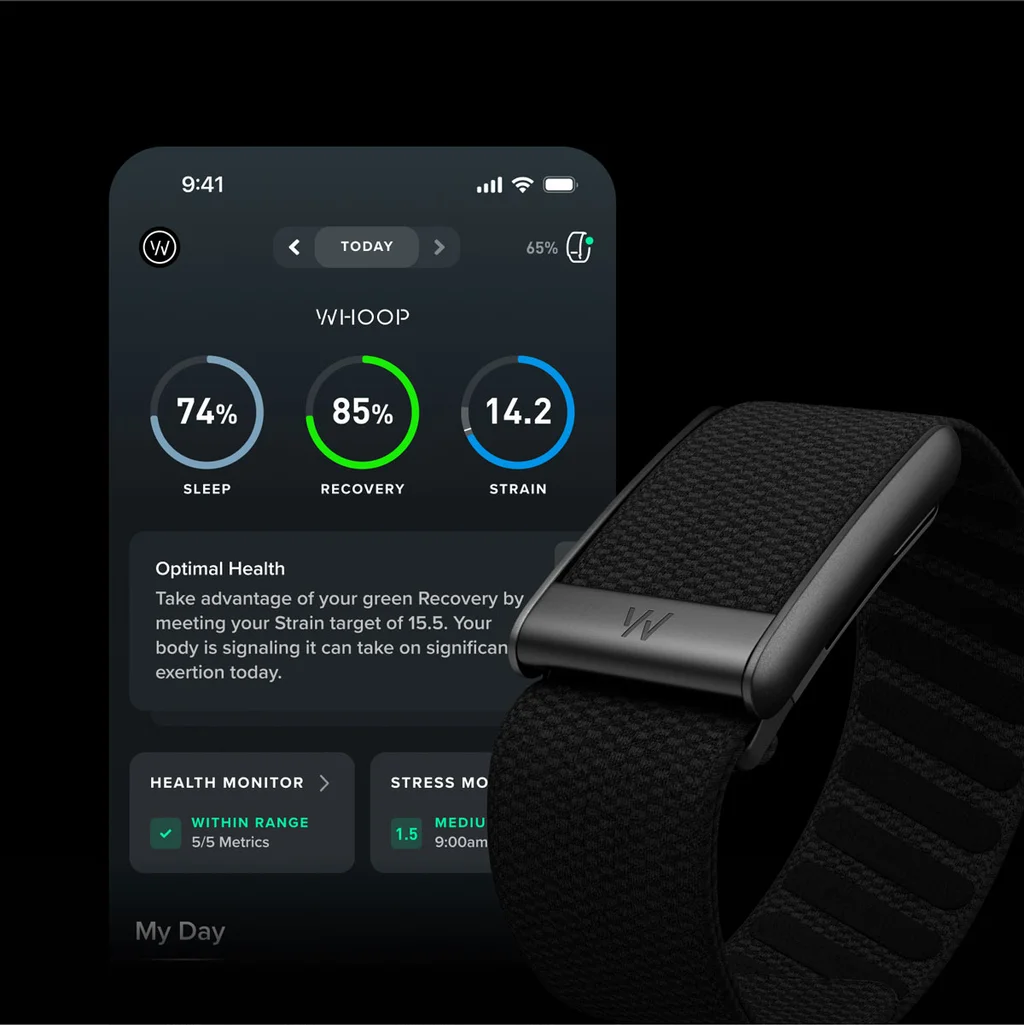
When former Harvard squash cocaptain Will Ahmed developed the idea for wearable company Whoop in the early 2010s, he was focused on helping serious athletes like himself optimize their performance. The wristband he designed tracks activity, sleep, and recovery. But in August, the Whoop founder and CEO turned his attention to a very different audience: Medicare recipients.
The Whoop Connected Care offering—which includes a Whoop membership, a Whoop device, and a third-party blood pressure monitor and cuff—is now a pilot program available to Medicare beneficiaries 65 and older who have been diagnosed with hypertension, prediabetes, high cholesterol, or obesity. “Continuous data matters,” says Dr. Ami Bhatt, a board-certified cardiologist who joined Whoop as chief medical officer over the summer. “People want to perform and age well, and that’s what we’re aiming for.”
Bhatt acknowledges that at first glance, American seniors appear to have little in common with the athlete ambassadors—like international soccer star Cristiano Ronaldo and Super Bowl-winning NFL quarterback Patrick Mahomes—most closely associated with the Whoop brand. But women older than 60 are one of Whoop’s fastest-growing customer segments. They’re bellwethers of a broader shift as consumers’ pursuit of wellness morphs into a deeper interest in preventive healthcare. Wearable companies, looking to cash in on the trend, are hiring doctors like Bhatt and courting clinical partners.
Whoop and Oura, among the buzziest wearables on the market, are already multibillion-dollar businesses. Whoop was valued at $10.1 billion in March, when it raised $575 million in Series G funding. Oura was valued at $11 billion at the time of its $900 million Series E round last year.
But there are only so many weekend warriors and wellness hobbyists willing to pay hundreds of dollars a year to track their steps and minutes of deep sleep. The key to attracting bigger audiences and keeping them engaged, wearable companies posit, is to connect the devices’ data to meaningful medical insights. And if that also allows a company like Whoop to tap into Medicare’s $1.2 trillion budget, all the better.
Bhatt, who previously served as inaugural chair of the Food and Drug Administration’s Digital Health Advisory Committee and chief innovation officer at the American College of Cardiology, says wearable companies shouldn’t position themselves to replace clinical care. But they can certainly supplement it. “What we need to be doing is helping people understand their baseline and helping clinicians understand what’s happening in between visits,” she says. “I want them to get a comprehensive addition and context to the story since they last saw that patient.”
Silicon Valley is home to a graveyard of abandoned hardware devices, left behind as consumer tastes change. Whoop and Oura plan to escape that fate by embedding themselves more deeply in healthcare.
Not-quite medical devices
The backdrop to this expanding mandate for wearables is a simmering debate over regulation. Historically, the FDA has clearly delineated between general wellness devices and medical devices. Medical devices, which are subject to stringent rules and approvals, are designed to diagnose and treat specific diseases and conditions. Wellness devices, in contrast, are designed to support healthy lifestyles more broadly. Wearables like Whoop and Oura are deliberately upending that distinction.
“The latest generation of wearables delivers clinical-grade insights,” Oura CEO Tom Hale wrote in a Wall Street Journal op-ed last December calling for a change in federal policy.
Whoop, for its part, stood its ground when the FDA sent a warning letter last summer questioning a feature the company had built to track blood pressure. The company edited its app interface to clarify that the feature was not diagnostic, but otherwise refused to compromise.
In January, the FDA capitulated. It issued new guidance that gives wellness devices far greater leeway to measure the physiology associated with chronic conditions. Six months later, the agency dropped its enforcement action against Whoop’s blood pressure feature.
The companies have been racing to take advantage of the friendlier rules and solidify their positioning as healthcare solutions. In May, Oura unveiled a partnership with virtual care provider Counsel Health. When a user’s biometrics show what Oura describes as “major signs of strain,” based on measures like body temperature and resting heart rate, the device maker now sends an email suggesting that it’s time to “Connect with a Doctor who has context.”
As for Whoop, members can upload their medical records; complete blood work with partner Quest Diagnostics to evaluate more than 100 biomarkers; and connect with doctors on-demand. Whoop’s top-tier device is named the Whoop MG, short for “medical grade”—even though it’s not an FDA-approved medical device.
Data meets reality
Researchers and clinicians caution that a gap remains between the products as they exist today and the practical realities of delivering care.
Sandeep Kishore, a physician-scientist and associate professor at the University of California, San Francisco, is part of an effort to reimagine care for chronic conditions with the help of digital tools. Wearables have “potential,” he says, but at the moment we’re in what he describes as a “twilight zone.” Devices are generating reams of data, but the algorithms behind that data are typically proprietary and difficult to independently validate.
For example, Whoop offers a feature called Blood Pressure Insights, and Oura offers what it calls NighttimeBP. Because the companies say they have designed these data insights for wellness purposes, and not for the purposes of clinical diagnosis, the features are exempt from the rules that govern traditional blood pressure cuffs.
“Nighttime BP does not display mmHg values,” Oura explains in its FAQs, referencing millimeters of mercury, the standard unit of measurement for blood pressure. “It shows dipping patterns and trends, not absolute blood pressure measurements.”
But that isn’t stopping patients—er, wellness consumers—from bringing these measurements and others to their doctors. “I’m having a bunch of unvalidated data coming in to me, and I’m being asked to react to that,” Kishore says.
Emerging research suggests that even more established wearables still suffer from accuracy problems. A paper published in Nature this past January found that Apple Watch excels in some physiological and behavioral measurements, like heart rate at rest, but fails in others, like energy expenditure.
Chronic conditions and more
Despite such shortcomings, device makers are finding that some healthcare providers are willing to experiment. After all, three in four American adults lives with a chronic condition. “The current system isn’t working,” Chris Curry, an ob-gyn and clinical director of women’s health at Oura, says of the refrain that she hears from Oura’s clinical partners. “Let’s try something new.”
Oura has built a feature for users taking GLP-1 medications, for example. “We’re not trying to replace the doctor prescribing the GLP-1,” she says. “But the physicians who are in that world have a hard time keeping track of all their patients. And so we built the GLP-1 experience to be part of the solution. ‘My body’s changing really quickly—is everything okay?’”
Curry can imagine Oura playing a deeper role in the future. “The literature suggests that not every med is perfect for every person,” she says. “We don’t know why yet. I think [Oura] is well positioned to ask questions, and then ideally find the answers. Are there optimal dosings for certain categories of people? Are there things that are happening under the hood to your cardiovascular system or your metabolic system that are differentiated from weight loss, and we should also be tracking or managing in different ways? We want to be part of the scientific literature that lets physicians more smartly prescribe.”
Bhatt, meanwhile, has been seeking collaborators in specialties she sees as priorities for Whoop, including cardiometabolic health, women’s health, and neurology. The company is also teaming up with the National Council on Aging and AARP to tailor its user experience for older audiences.
“They say 80 is the new 50, right?” Bhatt says. Or it could be, if Whoop can prove that its devices can improve health outcomes. Deliver on that promise, and everyone—consumers, doctors, insurers—will be knocking on her door.