
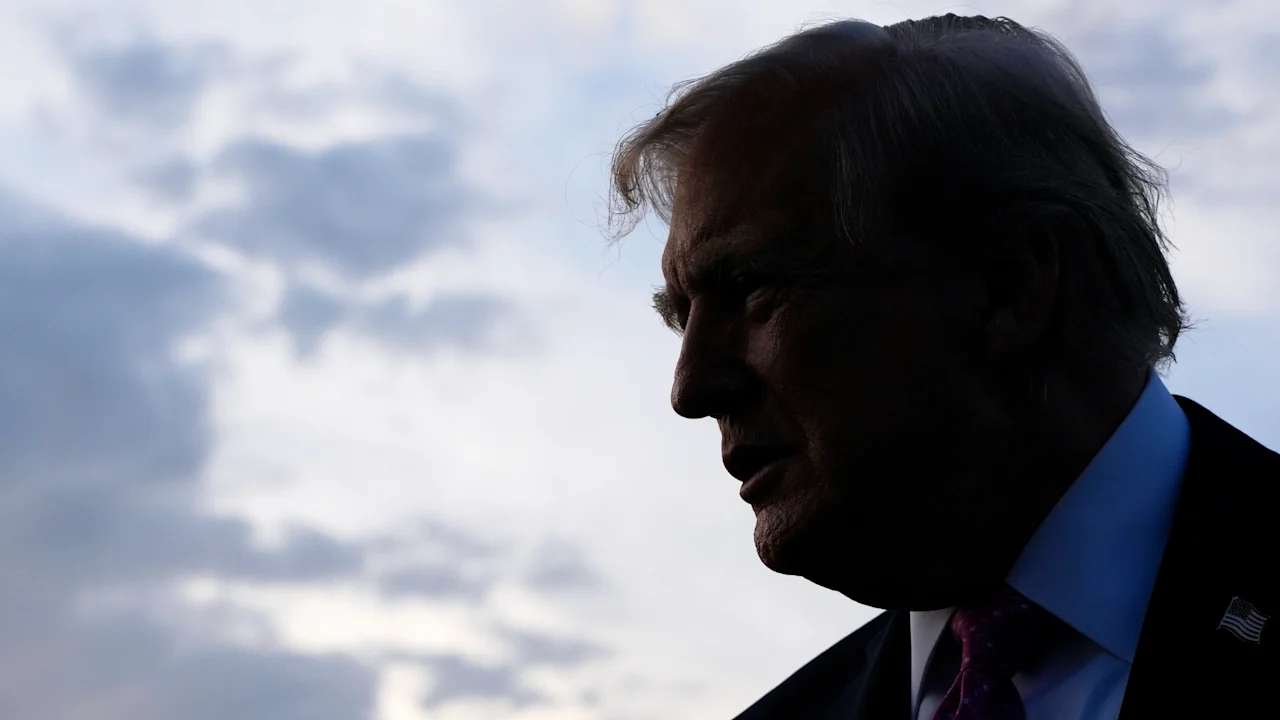
Here he is, depicted at six months in office, chiseled and brawny, as mighty as the very nation. Here he is as a Star Wars Jedi wielding a patriot-red lightsaber, rescuing our galaxy from the forces of evil. Here he is taking over Gaza, transforming the strip into a luxury resort complete with a golden effigy of himself.
You can be anything, perhaps you were told growing up. Doctor. Astronaut. Maybe, one day, the president. But even the chief executive of the United States, the free world’s leader, frames himself as something more epic — as someone not entirely himself.
On the social media accounts of Donald Trump and his second-term administration, a new, less official image of the president is emerging bit by bit: one generated artificially.
A sign of the times, certainly — when the appeal of reimagining yourself with artificial intelligence has trickled up from us everyday citizens. Bored with your selfies? Join a viral trend: There’s an image generator or a chatbot that can turn you into a Renaissance-style painting, a Studio Ghibli character, or an action figure with box art and accessories.
Artificial imagery isn’t new for Trump, an early target of AI-generated simulacra who later exploited the technology during his 2024 campaign for the presidency. “It works both ways,” the Republican president said of AI-generated content at a news conference earlier this month. “If something happens that’s really bad, maybe I’ll have to just blame AI.”
The AI images of Trump posted by him and his team opt for the alternative — not deceptive but self-evident in their fictitiousness. Pope Francis dies, and Trump jokes to reporters that he’d like to be pope. A week later, he is, but in an AI-generated image that he posts, reposted by the White House. Trump likens himself to a king in a Truth Social post in February, and AI makes him one in an X post by the White House less than an hour later.
The artifice arrives in Trump’s usual style — brassy, unabashed, attention-grabbing — and squares with his social media team’s heavy meme posting, which it has promised to continue. The administration’s official social media accounts have grown by more than 16 million new followers across platforms since Inauguration Day, a White House official told NBC News.
The White House recognizes the appeal. In July, it posted to its X account: “Nowhere in the Constitution does it say we can’t post banger memes.” Attached to the post, a photo of a sign on the White House lawn parodying the naysayers: “oMg, diD tHe wHiTE hOuSE reALLy PosT tHis?”
Behind the commander in chief’s desire to craft an AI self — not itself uncommon — an infantry of official communications channels stands at his ready. And we, the people, can’t help but tune in.
Feelings don’t care about your facts
Like so much on the internet these days, Trump’s AI portraits are primed for people to react, says Evan Cornog, a political historian and author of “The Power and the Story: How the Crafted Presidential Narrative Has Determined Political Success from George Washington to George W. Bush.”
“By the time you’ve seen it, you’ve understood it. And that’s, of course, the efficacy,” Cornog said. “It requires no effort, either for the person generating it, but particularly for the person consuming it.”
The expressive power of political imagery, regardless of the truth of its message, has long been understood by politicians and their detractors.
President William Henry Harrison’s log cabin and hard cider campaign symbols, representing him as a “man of the people,” helped him win the election of 1840. Thirty years later, political cartoonist Thomas Nast would turn public opinion against William Marcy “Boss” Tweed with his scathing portrayals of the politician, whom he depicted satirically overweight from greed. “Let’s stop those damned pictures!” Tweed once said, or so the story goes.
The decades since witnessed the birth of photo, film, TV, the internet, computer printers, image-editing software and digital screens that shrank until they could fit in our pockets, making it increasingly easy to create and disseminate — and manipulate — imagery.
By contrast, today’s generative AI technology offers greater realism, functionality and accessibility to content creation than ever before, says AI expert Henry Ajder. Not to mention, of course, a capacity for endless automated possibility.
Past presidents “had to actually have fought in a war to run as a war hero,” Cornog says. Now, they can just generate an image of themselves as one. On a horse — or no, a battlefield. With an American flag waving behind him and an eagle soaring.
The AI images of Trump shared by him and his administration chase a similarly heroic vision of the president. Potency — his and the country’s — is a consistent theme, Cornog added.
Indeed, generative AI allows for an exposure of perhaps uncomfortably intimate inner worlds as people use such technology to illustrate and communicate their “fantasy lives” or cartoonish versions of themselves, says Mitchell Stephens, author of “The Rise of the Image, the Fall of the Word.”
But it can just as easily fulfill an inverse desire: to depict or reinforce a subjective concept of reality.
“Quite a lot of people are sharing AI-generated content, which is clearly fake but is almost seen as a revelatory kind of representation of someone,” Ajder said. This content feeds a mentality that mutters, “We all know they’re really like this.”
“And so, even if people know it’s fake,” Ajder said, “they still see it as kind of reflecting and satisfying a kind of truth — their truth about what the world is like.”
Commenters take up the mantle
The lack of subtlety in Trump’s AI images of himself helps explain their consistent virality.
Commenters can be found lamenting the demise of presidential decorum (“I never thought I’d see the day when the White House is just a joke. This is so embarrassing.”) or relishing those very reactions (“Watching the left explode over this has been a treat.”).
Other responses, even from the president’s base, remain unconvinced (as one X user griped under the White House post of Trump as pope: “I voted for you, but this is weird and creepy. More mass deportations and less of whatever this is.”).
But that is tradition for Trump, who finds no trouble cashing the currency of our attention economy: Whether you cracked a smile or clutched your pearls, he still made you look.
“In his first administration, he used Twitter in a way no president had,” said Martha Joynt Kumar, director of the White House Transition Project, an organization that facilitates the transition between presidents. “What they do in this administration is taking it further, as you’ve had an increase in what can be done online.” Or, as one Reddit user referred to the president: “Troll in Chief.”
Does Trump really think he should be pope? Does the White House really think him a king? Accuracy isn’t the point, not for a man who frequently arbitrates what counts as truth. Trump’s use of AI sticks to a familiar recipe for bait: crude comedy sprinkled with wishful thinking.
“It’s fine,” Trump said in May, when asked whether the AI-generated post of him as pope diminished the substance of the official White House account.
“Have to have a little fun, don’t you?”
—Luena Rodriguez-Feo Vileira, Associated Press