
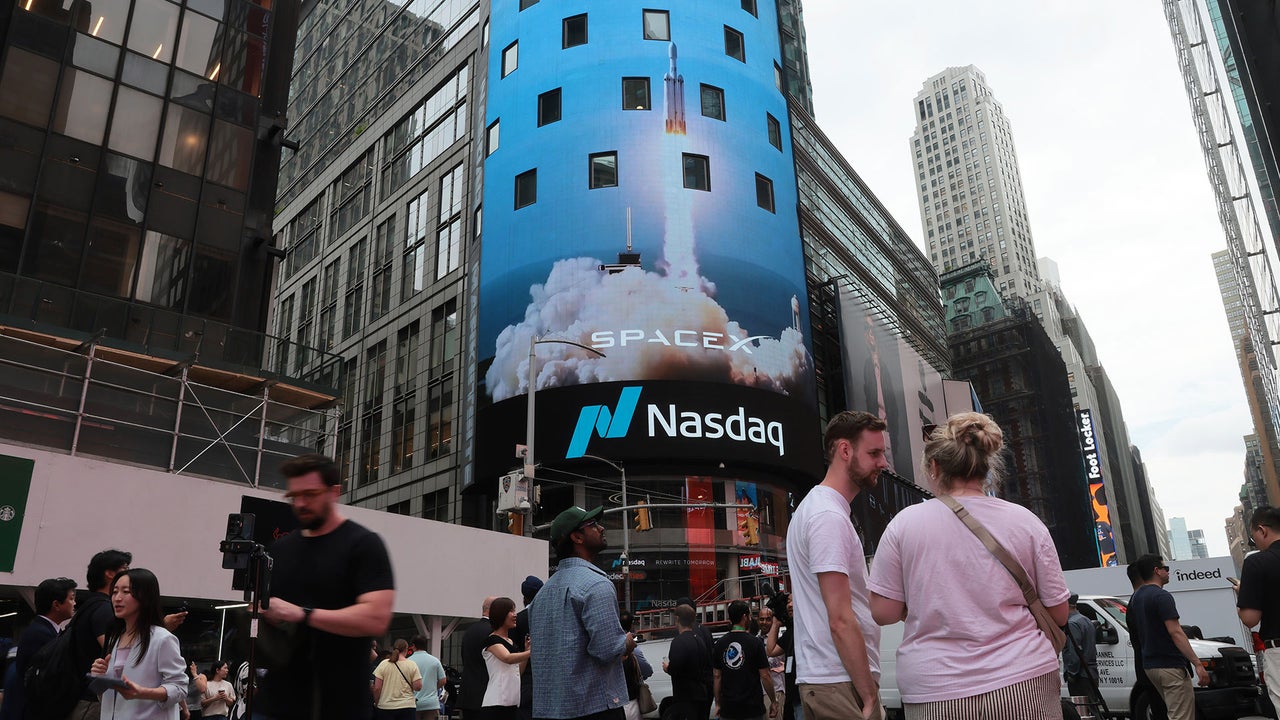
Last month, Elon Musk’s Space Exploration Technologies Corporation, better known as SpaceX, transitioned from a private entity to a publicly traded company. It entered the stock market on June 12 with the largest initial public offering (IPO) in stock market history.
Yet on Wednesday, SpaceX shares (Nasdaq: SPCX) dropped below their starting IPO, after just a month on the market.
Originally priced at $135, the stock dropped to $132.62, with shares dropping 2.2% in intraday trading. If these prices hold or decrease, investors who bought the stock at its original share price will begin to lose money on investments.
SpaceX stock closed at $135.27 on Wednesday and shares were relatively flat in premarket trading on Thursday as of this writing.
Lost in space
SpaceX originally aimed to accumulate $75 billion from its IPO sales in new capital. However, due to high demand last month, it ended up raising $85.7 billion.
After its debut, the space and AI company rocketed to a market capitalization of more than $2 trillion.
Now with this drop, its market capitalization sits at roughly $1.78 trillion.
Although there are likely a number of reasons why SpaceX has dropped, analysts are pointing to a few specific ones. One in particular may be due to China, which has successfully completed its first-ever controlled recovery of an orbital-class rocket booster.
This achievement indicates that other companies may also be building reusable rockets, which could potentially threaten SpaceX’s dominance in the industry.
Meanwhile, investors have begun trimming positions in SpaceX due to the fear that the additional supply of the stock after lockup periods expire may put more downward pressure on shares, as the New York Times reported.
Finally, SpaceX shares have also have been weighed down by headwinds in the broader market, including uncertainty over Federal Reserve’s interest-rate trajectory.
There are also growing questions surrounding the durability of the rally in AI-linked stocks.