
Technology Reporter

 Astrolight
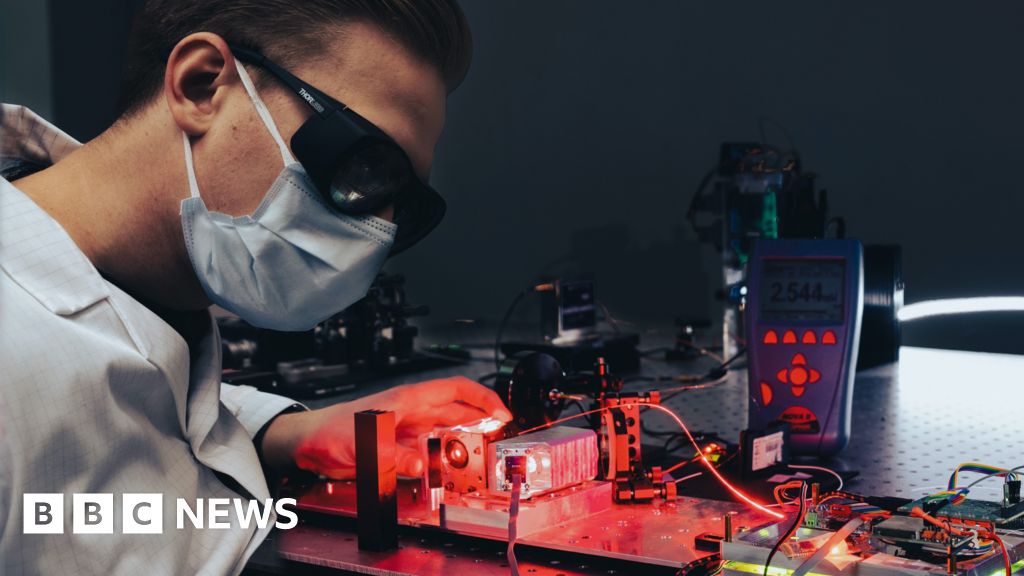
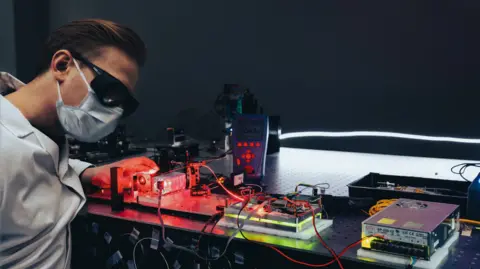
I’m led through a series of concrete corridors at Vilnius Tech University, Lithuania; the murals give a Soviet-era vibe, and it seems an unlikely location for a high-tech lab working on a laser communication system.
But that’s where you’ll find the headquarters of Astrolight, a six-year-old Lithuanian space-tech start-up that has just raised €2.8m ($3.3m; £2.4m) to build what it calls an “optical data highway”.
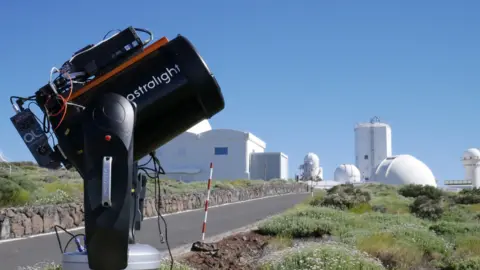
You could think of the tech as invisible internet cables, designed to link up satellites with Earth.
With 70,000 satellites expected to launch in the next five years, it’s a market with a lot of potential.
The company hopes to be part of a shift from traditional radio frequency-based communication, to faster, more secure and higher-bandwidth laser technology.
Astrolight’s space laser technology could have defence applications as well, which is timely given Russia’s current aggressive attitude towards its neighbours.
Astrolight is already part of Nato’s Diana project (Defence Innovation Accelerator for the North Atlantic), an incubator, set up in 2023 to apply civilian technology to defence challenges.
In Astrolight’s case, Nato is keen to leverage its fast, hack-proof laser communications to transmit crucial intelligence in defence operations – something the Lithuanian Navy is already doing.
It approached Astrolight three years ago looking for a laser that would allow ships to communicate during radio silence.
“So we said, ‘all right – we know how to do it for space. It looks like we can do it also for terrestrial applications’,” recalls Astrolight co-founder and CEO Laurynas Maciulis, who’s based in Lithuania’s capital, Vilnius.
For the military his company’s tech is attractive, as the laser system is difficult to intercept or jam.
It’s also about “low detectability”, Mr Maciulis adds:
“If you turn on your radio transmitter in Ukraine, you’re immediately becoming a target, because it’s easy to track. So with this technology, because the information travels in a very narrow laser beam, it’s very difficult to detect.”
 Astrolight
Worth about £2.5bn, Lithuania’s defence budget is small when you compare it to larger countries like the UK, which spends around £54bn a year.
But if you look at defence spending as a percentage of GDP, then Lithuania is spending more than many bigger countries.
Around 3% of its GDP is spent on defence, and that’s set to rise to 5.5%. By comparison, UK defence spending is worth 2.5% of GDP.
Recognised for its strength in niche technologies like Astrolight’s lasers, 30% of Lithuania’s space projects have received EU funding, compared with the EU national average of 17%.
“Space technology is rapidly becoming an increasingly integrated element of Lithuania’s broader defence and resilience strategy,” says Invest Lithuania’s Šarūnas Genys, who is the body’s head of manufacturing sector, and defence sector expert.
Space tech can often have civilian and military uses.
Mr Genys gives the example of Lithuanian life sciences firm Delta Biosciences, which is preparing a mission to the International Space Station to test radiation-resistant medical compounds.
“While developed for spaceflight, these innovations could also support special operations forces operating in high-radiation environments,” he says.
He adds that Vilnius-based Kongsberg NanoAvionics has secured a major contract to manufacture hundreds of satellites.
“While primarily commercial, such infrastructure has inherent dual-use potential supporting encrypted communications and real-time intelligence, surveillance, and reconnaissance across NATO’s eastern flank,” says Mr Genys.
 BlackSwan Space
Going hand in hand with Astrolight’s laser technology is the autonomous satellite navigation system fellow Lithuanian space-tech start-up Blackswan Space has developed.
Blackswan Space’s “vision based navigation system” allows satellites to be programmed and repositioned independently of a human based at a ground control centre who, its founders say, won’t be able to keep up with the sheer volume of satellites launching in the coming years.
In a defence environment, the same technology can be used to remotely destroy an enemy satellite, as well as to train soldiers by creating battle simulations.
But the sales pitch to the Lithuanian military hasn’t necessarily been straightforward, acknowledges Tomas Malinauskas, Blackswan Space’s chief commercial officer.
He’s also concerned that government funding for the sector isn’t matching the level of innovation coming out of it.
He points out that instead of spending $300m on a US-made drone, the government could invest in a constellation of small satellites.
“Build your own capability for communication and intelligence gathering of enemy countries, rather than a drone that is going to be shot down in the first two hours of a conflict,” argues Mr Malinauskas, also based in Vilnius.
“It would be a big boost for our small space community, but as well, it would be a long-term, sustainable value-add for the future of the Lithuanian military.”
 Space Hub LT
Eglė Elena Šataitė is the head of Space Hub LT, a Vilnius-based agency supporting space companies as part of Lithuania’s government-funded Innovation Agency.
“Our government is, of course, aware of the reality of where we live, and that we have to invest more in security and defence – and we have to admit that space technologies are the ones that are enabling defence technologies,” says Ms Šataitė.
The country’s Minister for Economy and Innovation, Lukas Savickas, says he understands Mr Malinauskas’ concern and is looking at government spending on developing space tech.
“Space technology is one of the highest added-value creating sectors, as it is known for its horizontality; many space-based solutions go in line with biotech, AI, new materials, optics, ICT and other fields of innovation,” says Mr Savickas.
Whatever happens with government funding, the Lithuanian appetite for innovation remains strong.
“We always have to prove to others that we belong on the global stage,” says Dominykas Milasius, co-founder of Delta Biosciences.
“And everything we do is also geopolitical… we have to build up critical value offerings, sciences and other critical technologies, to make our allies understand that it’s probably good to protect Lithuania.”