
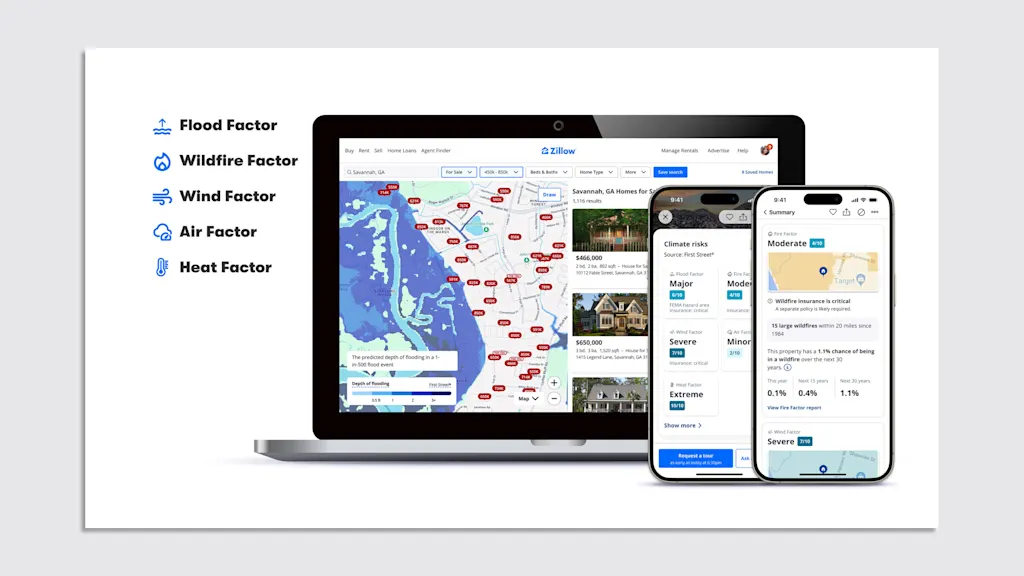
Until recently, when you looked at a house for sale on Zillow, you could see property-specific scores for the risk of flooding, wildfires, wind from storms and hurricanes, extreme heat, and air quality. The numbers came from First Street, a nonprofit that uses peer-reviewed methodologies to calculate “climate risk.” But Zillow recently removed those scores after pressure from CRMLS, one of the large real-estate listing services that supplies its data.
“The reality is these models have been around for over five years,” says Matthew Eby, CEO of First Street, which also provides its data to sites like Realtor.com and Redfin. (Zillow started displaying the information in 2024, but Realtor.com incorporated First Street’s “Flood Scores” in 2020.) “And what’s happened is the market’s gotten very tight. And now they’re looking for ways to try and make it easier to sell homes at the expense of homebuyers.”
The California Regional MLS, like others across the country, controls the database that feeds real estate listings to sites like Zillow. The organization said in a statement to the New York Times that it was “suspicious” after seeing predictions of high flood risk in areas that hadn’t flooded in the past. When Fast Company asked for an example of a location, they pointed to a neighborhood in Huntington Beach—but that area actually just flooded last week.
In a statement, First Street said that it stands behind the accuracy of its scores. “Our models are built on transparent, peer-reviewed science and are continuously validated against real-world outcomes. In the CRMLS coverage area, during the Los Angeles wildfires, our maps identified over 90% of the homes that ultimately burned as being at severe or extreme risk—our highest risk rating—and 100% as having some level of risk, significantly outperforming CalFire’s official state hazard maps. So when claims are made that our models are inaccurate, we ask for evidence. To date, all the empirical validation shows our science is working as designed and providing better risk insight than the tools the industry has relied on historically.”
Zillow’s trust in the data has not changed, and that data is important to consumers: In one survey, it saw that more than 80% of buyers considered the data when shopping for a house. But the company said in a statement that it updated its “climate risk product experience to adhere to varying MLS requirements.”
It’s not clear exactly what happened: In response to questions for this story, CRMLS now says it only asked Zillow to remove “predictive numbers” and flood map layers on listings, while Zillow says the MLS board voted to demand they block all of the data. It’s also not clear what would have happened if Zillow hadn’t made any changes, though in theory, the MLS could have stopped giving the site access to its listings.
Zillow still links to First Street’s website in each listing, so homebuyers can access the information, but it’s less easy to find. The site also still includes a map that consumers can use to view overall neighborhood risk, if they take the extra step to click on checkboxes for flooding, fire, or other hazards. But the main scores are gone.
Obviously, seeing that a particular house has a high flood risk or fire risk can hurt sales. Nevertheless, after First Street first launched, the National Association of Realtors put out guidance saying that the information was useful—and that since realtors aren’t experts in things like flood risk, they shouldn’t try to tell buyers themselves that a particular house is safe, even if it hasn’t flooded in the past.
First Street’s flood data goes further than that of the Federal Emergency Management Agency, which uses outdated flood maps. It also incorporates more climate predictions, along with the risk of flooding from heavy rainfall and surface runoff, not just flooding from rivers or the coast. And it includes predictions of small amounts of flooding (for example, whether an inch of water is likely to reach the property). Buyers can dig deeper to figure out how much that amount of flooding might affect a particular house.
It’s not surprising that some high risk scores have upset home sellers who haven’t experienced flooding or other problems in the past. But as the climate changes, past experiences don’t guarantee what a property will be like for the next 30 years. Take the example of North Carolina, where some residents hadn’t ever experienced flooding until Hurricane Helene dumped unprecedented rainfall on their neighborhoods.
Redfin, another site that uses the data, plans to continue providing it, though sellers have the option to ask for it to be removed from a particular home if they believe it’s inaccurate. (First Street also allows homeowners to ask for their data to be revised if there’s a problem, and then reviews the accuracy.)
“Redfin will continue to provide the best-possible estimates of the risks of fires, floods, and storms,” Redfin chief economist Daryl Fairweather said in a statement. “Homebuyers want to know, because losing a home in a catastrophe is heartbreaking, and insuring against these risks is getting more and more expensive.”
Realtor.com is working with CRMLS and data providers to look into the issues raised by the MLS over the scores. “We aim to balance transparency about the evolving environmental risks to what is often a family’s biggest investment, with an understanding that the available data can sometimes be limited,” the company said in a statement. “For this reason we always encourage consumers to consult a local real estate professional for guidance or to learn more. When issues are raised, we work with our data partners to review them and make updates when appropriate.”
If more real estate sites take down the scores, it’s likely that some buyers won’t see the information at all. First Street says that while it’s good that Zillow still includes a link to its site, the impact is real. “Whenever you add friction into something, it just is used less,” Eby says. “And so not having that information at the tip of your fingers is definitely going to have an impact on the millions of people that go to Zillow every day to see it.”