

More and more leftists are concluding that statehood for the island is not enough.
A video of New York congressional candidate Darializa Avila Chevalier advocating for Puerto Rican independence.
(Instagram)
Something is changing in the political conversation about Puerto Rico. In recent months, major leaders and organizations on the American left have explicitly signaled their support for the island’s independence.
On September 23, to mark the 158th anniversary of the Grito de Lares freedom revolt, future congressman Chris Rabb joined his Puerto Rican constituents in Philadelphia and declared, “I support Puerto Rican independence. Puerto Rico has the right to be a free, sovereign, and independent nation.”
Rabb, who will almost certainly get elected to the US House of Representatives from Pennsylvania’s 3rd district, joined other influential progressives who have come out for Puerto Rico’s freedom. Earlier this year another general election shoo-in, Darializa Avila Chevalier in New York, called for an inclusive Puerto Rican self-determination process. She added: “I also support independence for the Puerto Rican people. Because after 128 years, it’s the least the people on the island deserve.”
New York City Mayor Zohran Mamdani has also weighed in. In June, on the eve of the National Puerto Rican Day Parade, Mamdani gave Puerto Rican independence a poetic shoutout:
“This weekend, the boricuas of our city will don bright colors, sing songs of freedom, and wave a flag that was once made illegal by the United States government. There will be joy…as well as the bittersweet knowledge of an independence that has too long been denied.”
Notably, support for sovereignty is rising among political leaders outside of Puerto Rican bastions like New York and Pennsylvania. Former Missouri representative Cori Bush and fellow Missouri Democratic primary candidate Hartzell Gray came out in support for Puerto Rican sovereignty. So did Julie Gonzales, who gave John Hickenlooper a scare in the Democratic primary for US Senate in Colorado. (Full disclosure: My organization, Boricuas Unidos en la Diáspora, which advocates for Puerto Rican independence, endorsed all three of those candidates.)
Current Issue

Some of these candidates are adopting the institutional position of the Democratic Socialists of America (DSA), which recently reaffirmed its long-standing commitment to Puerto Rico’s decolonization and independence.
The explicit support for independence is a welcome change from the American progressive movement, which has historically been far too silent on Puerto Rico’s colonial status. But it is not without controversy. Avila Chevalier’s statement, for example, was celebrated in some corners but panned in others—not just by centrist liberals but also by more than a few fellow leftists.
Some insist that Puerto Rico should instead be granted statehood as a matter of inclusion and equality. But that amounts to an endorsement of annexation. Puerto Rico is a nation that was invaded by the United States in a war of expansion and has been held as a colony for over a century. Statehood would reward the US for its imperialist misadventures by allowing it to permanently keep a land it took by force. Colonies should be liberated, not subsumed by the empire that claimed them. Statehood would also accelerate the assimilation of the Puerto Rican people and the displacement from our homeland, as American remote workers and retirees flock to their new warm-weather state.
Other progressives contend none of that matters because Puerto Ricans don’t seem to want independence, and have instead consistently voted for statehood. The full picture is not so simple. While Puerto Rican sovereignty was historically a hyper-minority position, that’s no longer the case. In the 2024 Puerto Rican status plebiscite, more than 40 percent of voters chose one of the two sovereign options for Puerto Rico: full independence or sovereignty in free association with the United States. The latter would make Puerto Rico an independent country that has a bilateral compact with the US.
Moreover, because Congress has never made these votes legally binding or acted on their results, the plebiscites have served as informal polls more than actual elections. And because the last six plebiscites have been held by the ruling pro-statehood party on the island, which decides what’s on the ballot and gets to put its thumb on the scale, hundreds of thousands of Puerto Ricans boycott the votes.
In short, these local plebiscites have not been legitimate instruments of Puerto Rican “self-determination,” which is a foundational tenet of international law that demands “an informed democratic process, impartially conducted.” No Puerto Rico status vote has met that standard.
That said, there is no denying that statehood has significant support among Puerto Ricans—perhaps more than sovereignty. That is to be expected after more than 125 years of political repression that once heavily targeted the Puerto Rican independence movement, and of colonial economic dependence that has led many Puerto Ricans to believe they have no choice but to rely on the United States.
But progressives should be well used to taking political positions on ideological grounds regardless of how well they poll. The history of liberation and justice for oppressed peoples is the history of once unpopular ideas that, in time, came to be seen as obviously righteous. Americans should support Puerto Rican independence not because it is popular, but because it is just.
A New Approach to an Old Problem
Popular
“swipe left below to view more authors”Swipe →
By far, however, the most common rebuttal to support for independence is that Americans shouldn’t take a position at all. This has been the tried-and-true talking point of the political establishment for decades: that it’s “up to the Puerto Rican people” and therefore inappropriate—even outright imperialist—for anyone outside the island to have a say.
That is a noble sentiment that seeks to center the voices of Puerto Ricans. But it is both morally incongruous and divorced from American political reality. First, the duty to decolonize Puerto Rico should rightfully fall on the colonizer, not on the colonized. Saying that it’s all up to Puerto Ricans passes the buck, and it implicitly blames a colonized people for their continued subordination.
Second, there are already plenty of non–Puerto Ricans deciding the island’s future: the members of the United States Congress—and, by extension, their voters and constituents in the United States.
It is Congress that has declined to make any Puerto Rican status plebiscite legally binding. It is Congress that has failed to act on the results, year after year, even when statehood has won admittedly controversial victories at the ballot box. It is Congress that has neglected to establish some other decolonization process by which Puerto Ricans might change the status quo; and Congress that must ultimately legislate to either admit Puerto Rico as a state or initiate a transition to sovereignty.
Why has none of that happened? Because as long as Puerto Ricans might choose statehood, Congress won’t let us choose at all. Republicans are convinced that Puerto Ricans would reliably elect Democrats, so they’re viciously opposed to it. These days, President Trump can’t go two days without asserting that Puerto Rican statehood would “destroy” the United States. And Democrats are too divided or disinterested in statehood to expend the massive political capital it would take to overcome GOP opposition.
As with the statehood movement for Washington, DC, there is no way for Puerto Rican statehood to get 60 votes in the US Senate. In theory, Democrats could end the filibuster and ram through statehood on a party line. But there is a reason they haven’t already: Eliminating the filibuster would enable the next Republican-controlled Senate to enact a nightmarish right-wing agenda.
And if the island becomes the 51st state through a wholly partisan Democratic effort, its people are likely to be treated with dangerous disdain by MAGA Republicans who would see Puerto Ricans as illegitimate Americans
The strident opposition to statehood doesn’t just sink the prospects of adding Puerto Rico to the Union. It acts as a poison pill in every legislative proposal to address the island’s status. Any effort to “let the Puerto Rican people decide” is ultimately undone by the fact that Congress will not approve any bill that includes all potential status options and might therefore force US lawmakers to admit the island as the 51st state. Puerto Rican self-determination dies on the floor of the US Senate.
In the face of that political reality, progressives must offer Puerto Ricans more than a nod at “the will of the people” and a shrug when, decade after decade, those people remain colonized. We must build a movement around a political future for Puerto Rico that is both just and viable in Washington, DC.
And we need not fear that it will result in Americans’ unilaterally imposing their views on the Puerto Rican people. There is near-universal agreement that Puerto Ricans deserve a just, democratic, and inclusive decolonization process, and that the final choice will ultimately be ratified in a binding vote. But we won’t even get that far if we keep pretending that statehood might be on the table.
Leaders at the DSA, and politicians like Chris Rabb and Darializa Avila Chevalier, are stepping up to support the movement for Puerto Rico’s sovereignty. They must be joined by more candidates and elected officials who are committed to decolonization, and by millions of progressives who want their country to stop being an imperial power. Only by advocating for freedom can Puerto Ricans and Americans, together, end a colonial relationship that has lasted for more than a century.
More from The Nation
The conflict that Donald Trump has repeatedly proclaimed an unequivocal American victory keeps spiraling out of control.
But the autumn budget to be released at the end of October will offer needed details.
She believes that human rights and international law are universal principles that must be enforced regardless of violator’s ideology, ethnicity, or geostrategic alignment.
While the Israeli government launched a well-orchestrated offensive of disinformation and hyperbole that would make the illegal permissible in the war on Gaza.
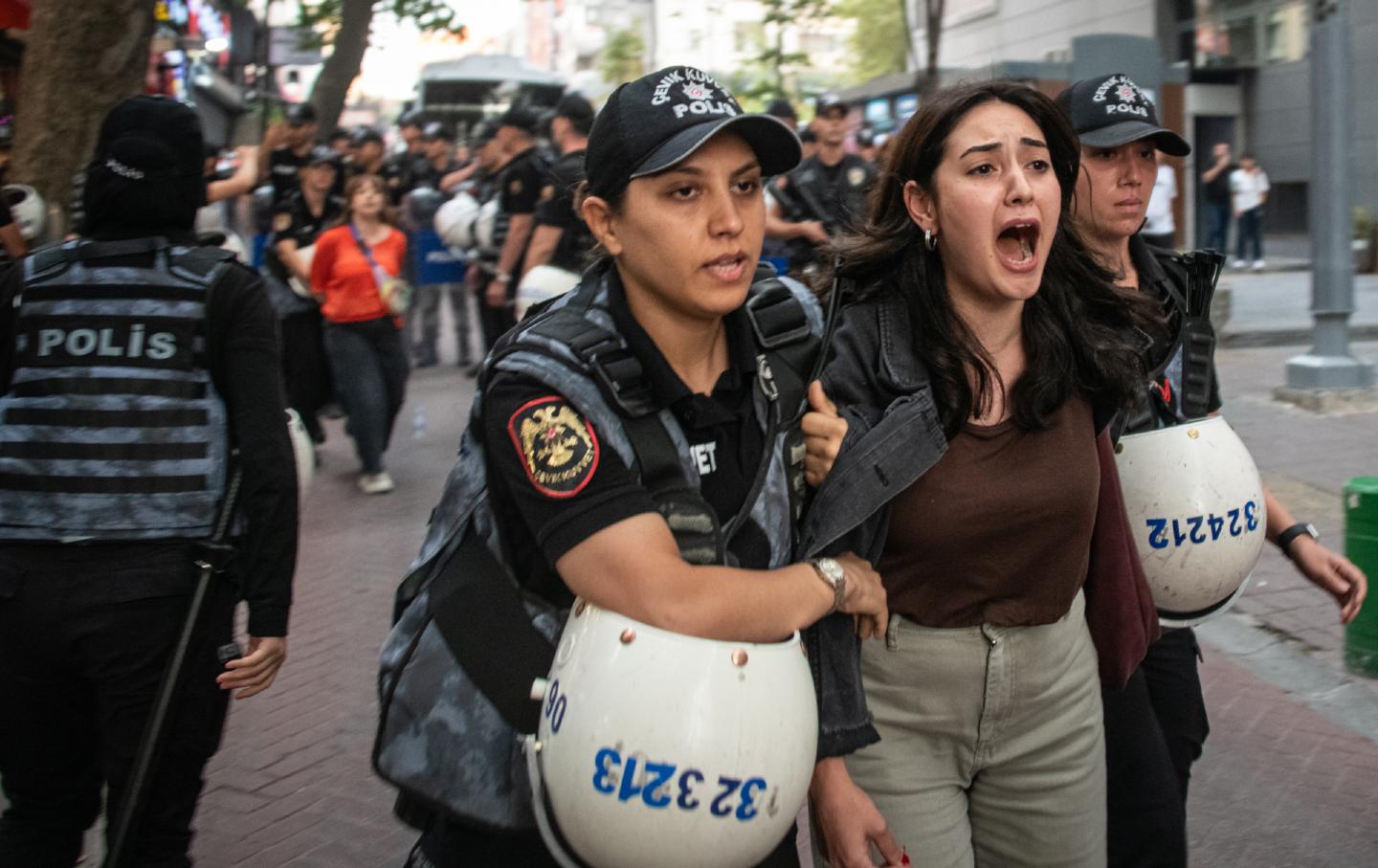
The government’s sweeping crackdown on the LGBTQ community is an escalation of a decades-long pattern.