
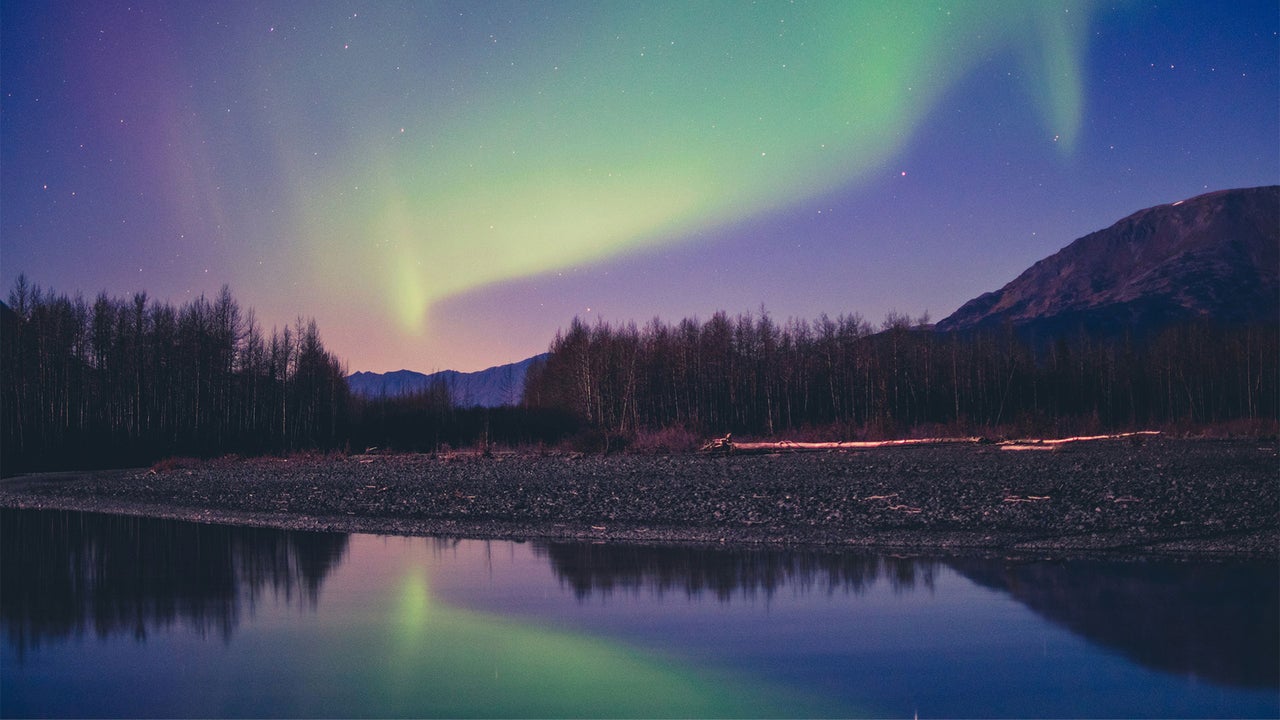
Fireworks may not be the only dazzling thing you see this week. If you’re living in Alaska or any one of the U.S. states bordering Canada, you have the best chance of glimpsing the northern lights, or aurora borealis, starting tonight.
According to a forecast from the National Oceanic and Atmospheric Administration’s Space Weather Prediction Center, the natural light display may be visible over some northern and upper Midwest states on July 2 and 3.
The NOAA predicts Thursday and Friday’s forecast to have a K-index, or KP, of 5, meaning the aurora will be visible and bright. The KP is used to characterize the magnitude of geomagnetic storms, and is a good indicator of disturbances to Earth’s magnetic field.
When and where to see the northern lights
The NOAA advises people to go out at night to witness the aurora at its most visible; the best viewing is usually between 10 p.m. and 2 a.m. local time.
On July 2 and 3, there is a likelihood the northern lights will appear visible in parts of Alaska, Washington, Idaho, Montana, North Dakota, and South Dakota, as well as in Minnesota, Wisconsin, and Michigan.
Check the NOAA Aurora Dashboard for updates.
What’s causing the aurora borealis?
The incoming aurora is caused by a coronal mass ejection (CME) associated with a solar flare.
A CME is an eruption of solar material and magnetic fields, and is one type of solar event that can create a geomagnetic storm linked to auroras. The NOAA describes it as a “billion tons of plasma ejected from the sun, traveling at a million miles per hour.” When a CME reaches Earth, it can produce a big geomagnetic storm, causing a bright and active aurora.