
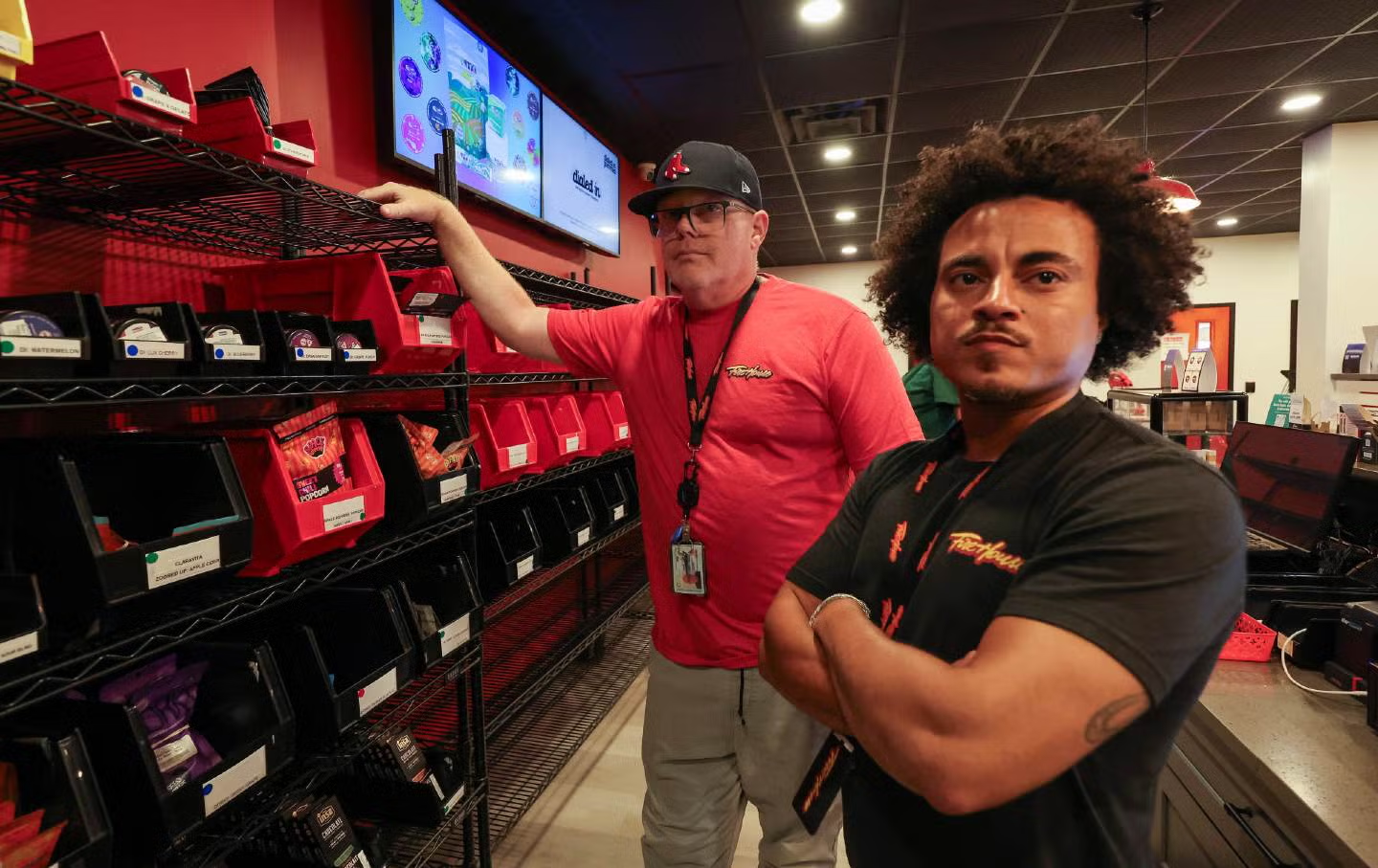
It’s not only weed at stake. The whole legal apparatus that supports social equity marijuana businesses would disappear if ballot question 8 passes.
Sean Berte and Armani White were arrested for weed, then became cannabis entrepreneurs through Massachusetts’s social equity program.
(Barry Chin / The Boston Globe via Getty Images)
Mike Marinaro was a passenger in his friend’s car in Lowell, Massachusetts, in 2008 when a cop ran the vehicle’s plates. Police officers then pulled Marinaro out of the car, searched it, and found weed. He took the rap.
Even though the charges against him were eventually dropped, his troubles were only starting. His infuriated parents kicked him out, leaving him homeless. He was arrested several more times for public intoxication “because it was like, well, you know, I guess I was arrested once. What does it matter?”
But for all the difficulty it caused him, that first marijuana-related arrest also made him eligible years later for a fast track to a commercial weed license through a Massachusetts program that offers resources to entrepreneurs who had run afoul of the pre-legalization law.
Marinaro was accepted into the program in 2020. And though he has raised $3.6 million to build a bespoke cannabis growing facility, he needs to raise more funds to get his business across the finish line. But now, as Massachusetts voters are tasked with a ballot question that would repeal the legalization of recreational cannabis, finding investors has become tough.
“It made it impossible,” Marinaro said. “I have three or four people right now that are like, ‘Yeah, we’re not touching it until after [ballot question] 8 passes.’”
Massachusetts question 8 would reverse the legalization of recreational marijuana, which passed by ballot question in 2016. Massachusetts would be the first state in the country to repeal recreational weed.
Current Issue

But it’s not only weed that’s at stake. The whole legal apparatus that supports business owners like Marinaro would disappear if the question passed.
The state’s social equity program is designed to offer free training and support for those involved in the illicit market before 2016 who were in some way “impacted by the War on Drugs” to enter the legal marijuana industry.
Massachusetts grants licenses for marijuana delivery solely to social equity applicants that own a majority stake of their business. Effectively, they have the state’s entire market to themselves.
For Devin Alexander, who was arrested in Quincy, Massachusetts, in 2011 for possessing a small amount of cannabis, this exclusive licensing seemed like a golden ticket. He decided to start a cannabis delivery company, Rolling ReLeaf, around the pandemic.
“I went from being a bartender to a CEO overnight, which was a huge leap,” Alexander said. “Covid really placed an emphasis on delivery, and you could get anything delivered to you besides cannabis at that time,so we saw it, you know, as the pathway.”
By 2024, the state sweetened the deal even more for applicants like Alexander, offering the first grants from its “social equity trust fund,” which collects revenue from Massachusetts’s marijuana tax and redistributes it to social equity marijuana businesses. The first three rounds of payments distributed $57.7 million through 425 grants.
Alexander said the first grant he received changed his life.
“The first one we got was for $500,000, and I, like, cried my eyes out,” Alexander said. “I was like, ‘Holy shit!’ Because it was just so fucking hard raising capital.”
Popular
“swipe left below to view more authors”Swipe →
If question 8 were to pass, the trust fund would go away with it.
“All of the resources going to social equity businesses are going to disappear, and then we’re not going to have an opportunity to undo many of the harms of the war on drugs,” said Ryan Dominguez, the executive director of the trade group Massachusetts Cannabis Coalition.
The federal rules around marijuana make the picture even more complex for business owners. The Trump administration implemented a partial rescheduling order that moved FDA-approved and state-licensed medical marijuana products from Schedule I to Schedule III. But the broader rescheduling effort remains tied up in federal administrative hearings and court challenges.
If full rescheduling were to happen, the federally recognized medical trade would expand at a time that the recreational market in Massachusetts would be contracting.
But a wider medical market wouldn’t recoup the financial losses that the recreational industry would suffer under repeal, according to Travis Ahern, who leads the cannabis regulatory agency in Massachusetts, the Cannabis Control Commission (CCC).
“We would not see that medical just takes over for adult use. There would be a significant revenue loss to the state of Massachusetts if the adult use simply went away,” Ahern said. “We would see impacts in those folks who are in our [social equity program].”
The question before voters makes it all the more important for the government to clear the air on the legality of weed.
“I think there are a lot of people waiting for a directive from the federal government right now, and that is not just the CCC,” Ahern said. “That is every law firm that represents these businesses. It’s every CPA who does the taxes for these businesses. It’s a lot of the municipalities as well.”
The main group backing the ballot question is the Coalition for a Healthy Massachusetts, which has raised $3.6 million over the past two years to repeal cannabis, most of which was raised by a Virginia based anti-drug advocacy group called Smart Approaches to Marijuana (SAM), according to political finance records.
The organization describes itself as “the science-based alliance holding Big Marijuana accountable in Congress, the courts, and communities across the country.” SAM did not respond to an e-mail request for an interview.
On the other side of the question, the Committee to Protect Cannabis Regulation has raised a total of $2.6 million. Dominguez said a lot of that money is likely coming from people with stakes in the marijuana industry.
“There’s a lot on the line for business owners as well as for the employees, so to try to save themselves, they have to invest in our ballot question,” Dominguez said.
And he’s confident about the industry’s odds of success. A UMass poll published on October 19 showed that 61 percent of voters would either “probably” or “definitely” vote no on the repeal.
Ulysses Youngblood, who owns a social equity cannabis company called Major Bloom in Worcester, Massachusetts, said he’s not worried about passage.
“I just don’t see it having a clear chance, so I’m still not losing sleep over it,” Youngblood said.
Dominguez worries, though, that if the repeal effort succeeds in Massachusetts, or even comes close, it would send a nationwide message.
“SAM is using Massachusetts as a training ground for other states,” Dominguez said. “It is the first battleground for potential repeal of a legalized cannabis market, and this is going to continue if we’re not able to defeat it here.”
More from The Nation
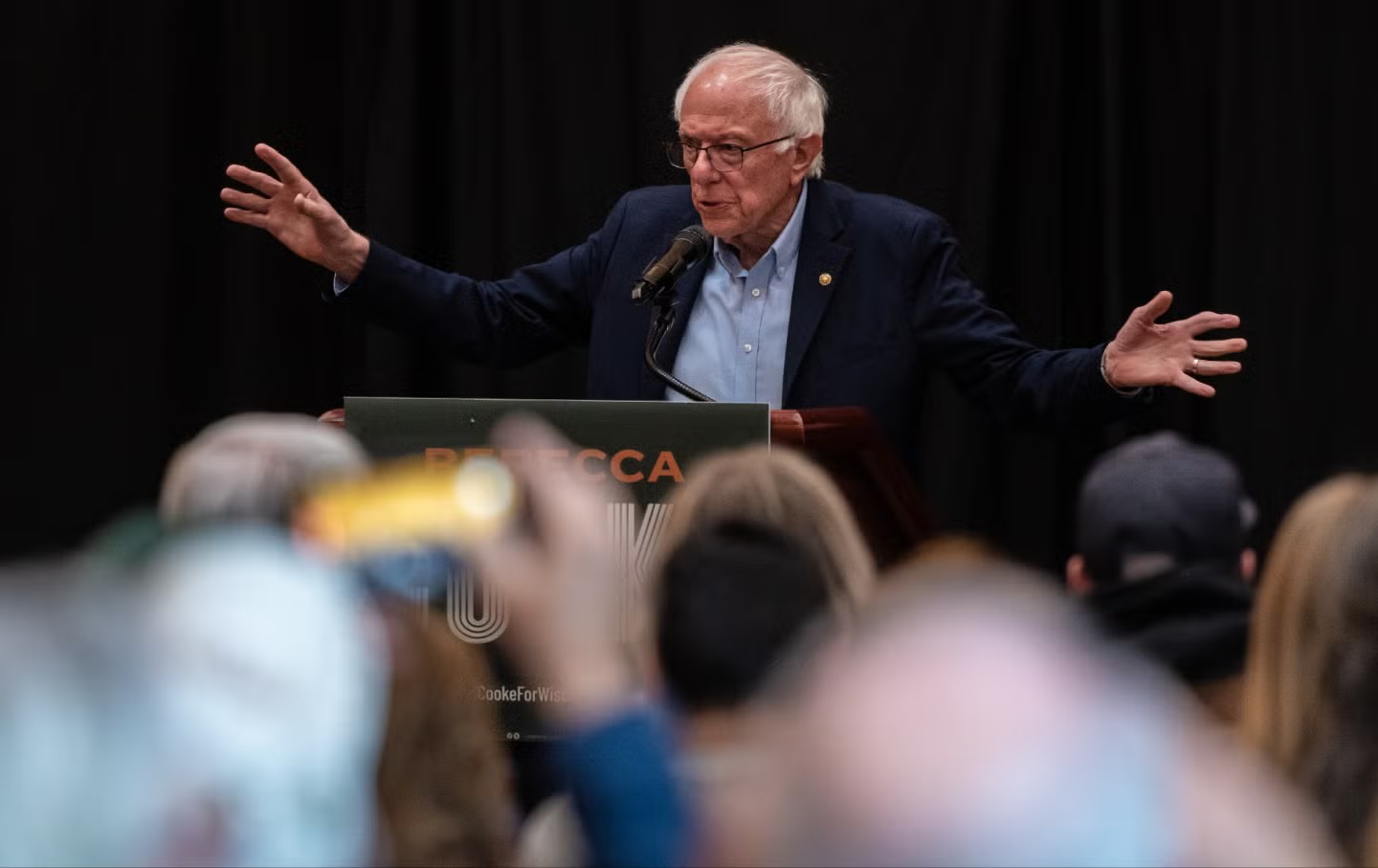
The senator is mounting a relentless, urgent campaign to stop Trump, elect progressives, and transform US politics.
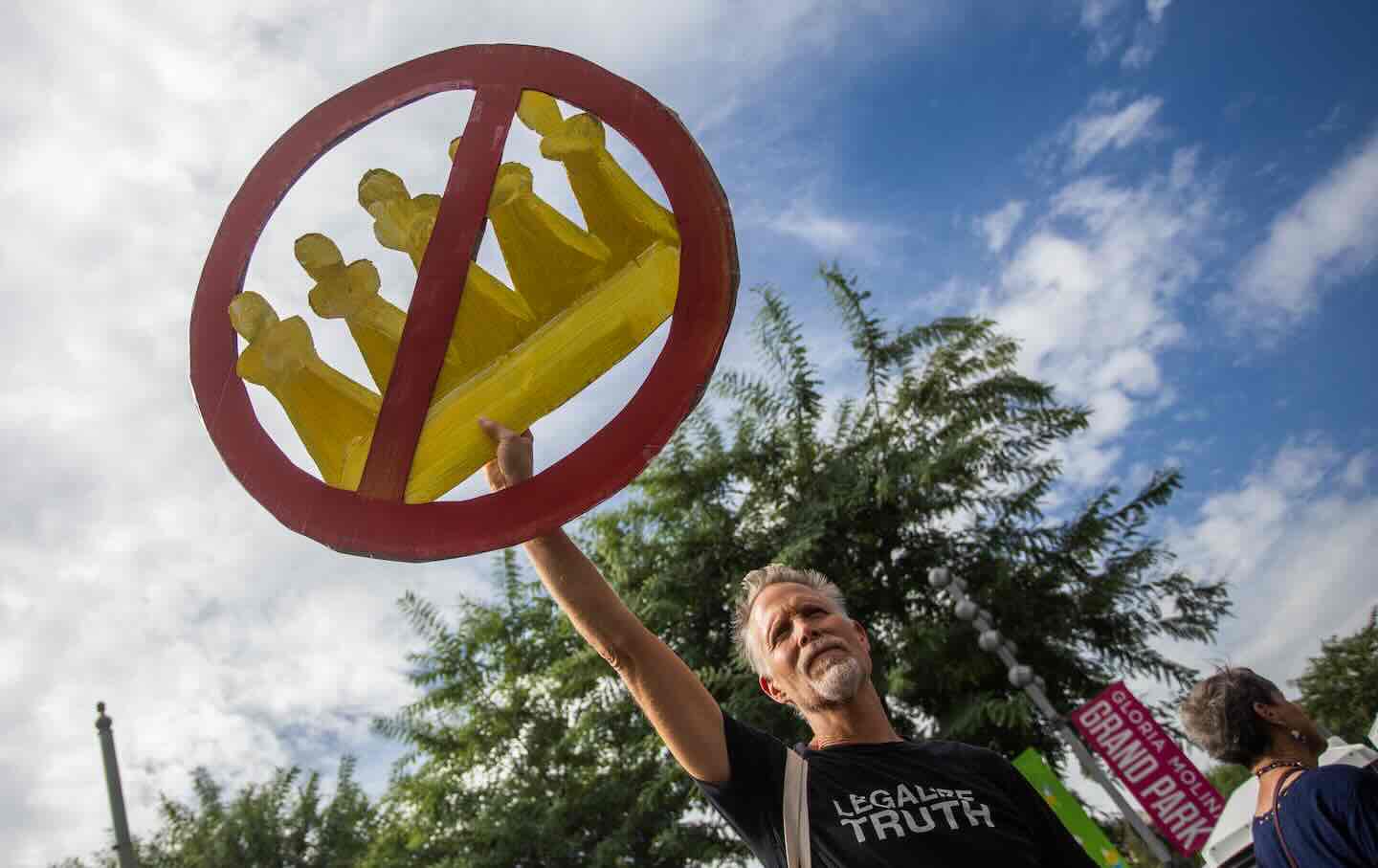
It is a once-in-a-generation opportunity for voters to turn things around for American democracy.
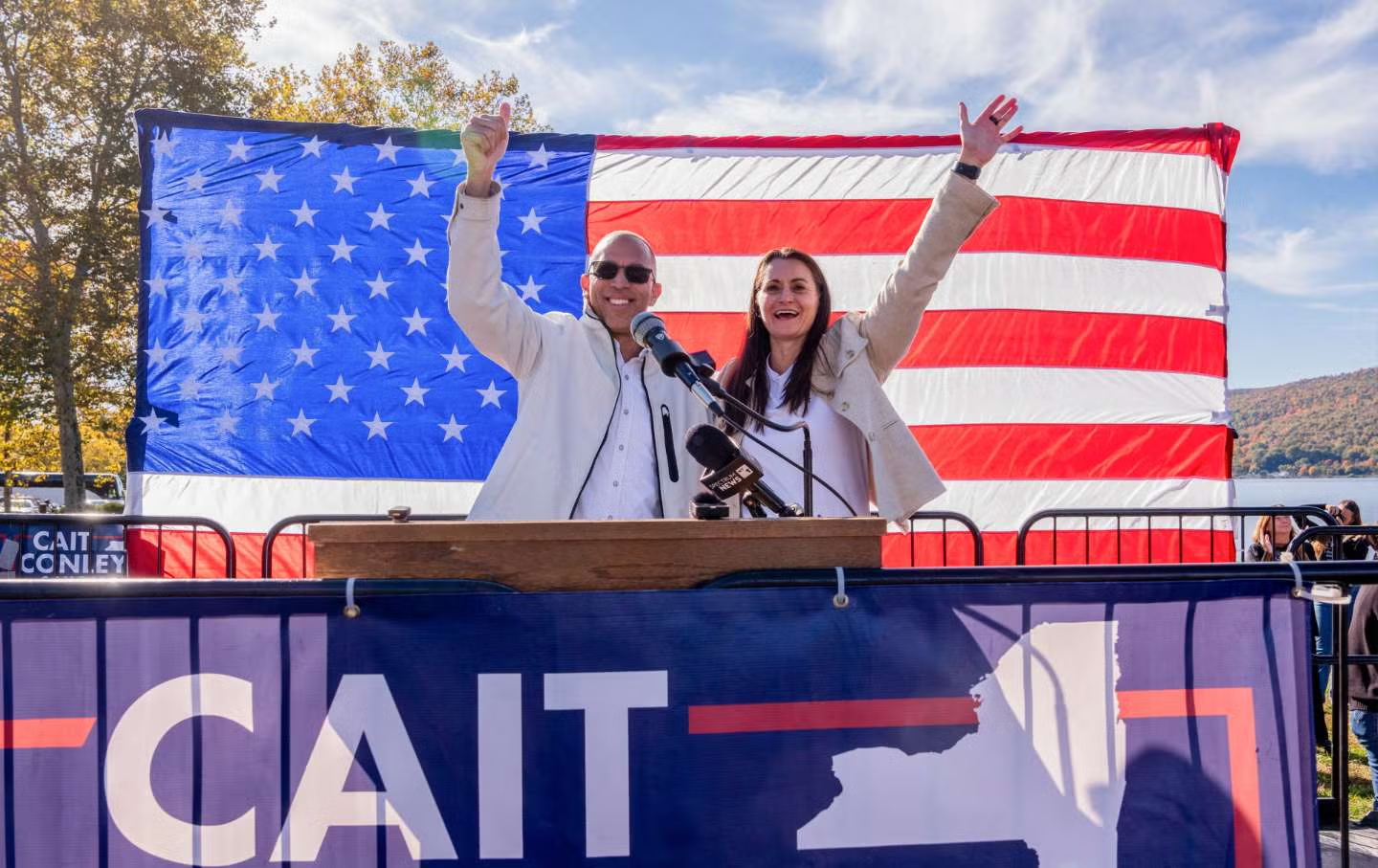
Local progressive groups have turned out a huge ground game to support Democratic nominee Cait Conley, despite her centrist leanings.
Because it does. The midterm elections are November 3, 2026, with control of the Senate and House at stake. Every vote matters.