
We are in an era of strategic silence—no longer in the age of the activist CEO. Instead, business leaders are being told to lie low and stay in their lane to avoid unwanted attention, including from the White House. In the wake of Jimmy Kimmel’s removal from ABC, CEOs are reportedly turning down press and speaking opportunities. Today, leaders are faced with the question of when to speak up . . . and when to stay strategically silent in order to protect their constituents.
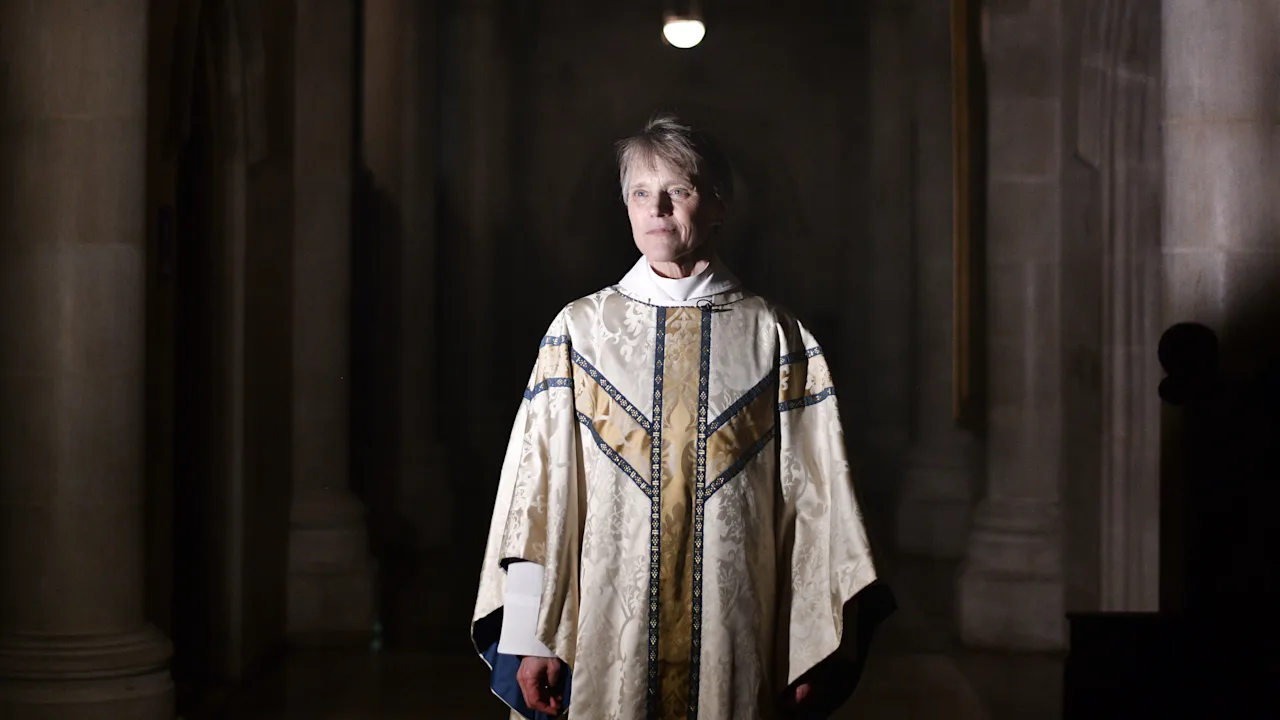
Reverend Mariann Budde is an expert on speaking up. She was thrust into the national spotlight during President Trump’s inauguration when she preached a sermon urging him to “have mercy upon the people in our country who are scared now.” In the weeks that followed, Budde was publicly criticized by President Trump, and received both hate mail—as well as an overwhelming amount of gratitude for speaking up.
Budde believes bravery can be learned. She is the author of How We Learn to Be Brave, a book about what courage looks like in our lives, and how we can cultivate it. She’ll be releasing an adaptation for younger readers, We Can Be Brave, in late October.
Reverend Budde sat down with Fast Company to discuss how leaders should think about speaking up in an environment where doing so has very real consequences.
In this paid Premium story, you’ll:
- Hear how Reverend Budde’s decision to speak out against President Trump affected her—both negatively and positively
- Understand the time and place leaders should speak out
- Get advice for dealing with the aftermath of speaking up
[The following conversation has been edited for clarity.]
How can leaders distinguish between when it’s necessary to speak up, versus when it’s actually not worth the risk and, in fact, foolhardy?
It’s a very important question. And if there were a formula then it would be easy, right? We would all know. And part of the uncertainty and the risk is that we don’t know.
Is this an important time—either for our personal integrity, the well-being of others, or the interests of our community or business—to speak out? Is this a time when we have reputational strength and wherewithal to withstand anticipated blowback?
You don’t have to rise to every occasion, if it’s not wise. I think in times like this, these are serious questions to ask, because whole constituencies are at risk.
However, there are times when we self-censor or when we step back unnecessarily, out of the anticipation of consequences that may or may not be real. There are dangers when we all take the safe route.
It leaves a big gap for really unhealthy dynamics in society to have free reign. I think we are at risk of seeing some of that now, to be honest.
What’s the cost to society if we all take the safe route?
Unfortunately, in the beginning, you don’t see it unless you are near a vulnerable population, which is why proximity to those who are most impacted by the large societal movements is so important. I live in Washington, D.C., and people ask me: What’s it like in Washington now?
It really depends on where you’re standing. For some people, life is just fine, and for other people, it is a living terror.
How do you decide when to use your voice?
Carefully. I don’t speak up every day. I did not and I don’t speak up on everything. I weigh my very limited public impact potential carefully.
I try to stay in my lane, which is where spiritual values that I represent are in alignment with the democratic aspirations of our country. When I speak up, I do so from that foundation, and also from a constituency base that I personally represent.
What’s a time when you didn’t speak up and wish you had?
I wake up almost every day thinking of human inflicted starvation in Gaza. I am asked repeatedly to speak out, and I have done so very rarely, in part because I have very deep ties within the Jewish community here in Washington and in this country.
I recognize not only the complexity of the situation, but also the impact that things I might say or do. The Archbishop of the Anglican church in Jerusalem asks us sometimes not to say anything because it just makes things worse for them.
But I tell you, it doesn’t feel good to be quiet sometimes. Not that I have any illusions in this particular political environment that I would make a difference, which is another calculation I make: If I have absolutely no chance of affecting change by what I say, I have to decide if it’s worth the cost.
You have spoken up in a very public way that has thrust you into the national spotlight. What was the impact on you personally?
Well, first of all, it was a very unusual opportunity that was given to me to preach at the post inaugural prayer service. In terms of the upside, that was a privilege. The downside, it was obviously hard. It cost me a lot to think that through.
I clearly offended the President and his inner circle, and they took the opportunity to make that known and it set in motion an onslaught of reaction for about three weeks. Our entire church was flooded with some pretty mean-spirited and false accusations. So that was the hard part.
The other side to it was also a huge outpouring of gratitude, the likes of which I’ve never experienced. Boxes and boxes of mail—so much we couldn’t open it. People wrote me letters that began with, “I’m not a religious person, but I wanted to tell you how much what you said meant to me. Thank you for reminding people that my child is a human.”
What advice do you have for people who do want to use their voice in a very public way, such as the way you have? Maybe people such as other leaders?
It’s very helpful to be grounded. For three or four days, you’re at the height of all this energy and attention, and then the world goes silent. And it’s time to take out the garbage and remember that you forgot 17 things on your to-do list.
It’s helpful to remember while there’s a response to you, your life is rooted somewhere else.
We’re not the first generation of Americans to experience significant pulling back from values that we thought had been well-established. It was no picnic in the early 1920s when resegregation was introduced into this country. What did the people do then, and what can we do now?
It’s also good to have a sense of humor, and a couple of children around to keep you grounded.
We are at a time of deep disconnection and polarization. What does good leadership look like right now, especially if you’re leading people who are deeply divided?
We don’t realize how influenced we have become by the contempt that’s poisoning our society. We can’t have conversations with people who differ from us in ways that don’t dehumanize and belittle one another. If we can’t figure out how to talk to each other across our differences, we will never, ever solve the problems that we’re facing as a society.
You do have to speak up in the face of hatred and intolerance, but how you do it matters. You have to meet that kind of intolerance with firm conviction and persuasion—and yet not robbing that person of their inherent dignity as well.
What does it mean to be brave?
From our earliest days as human beings, we have to and are summoned to do things that we have never done before. Stepping into something that is unfamiliar carries some degree of risk, and yet this is the miracle of our existence.
Even though we’re afraid, we know exactly what we’re supposed to do. Sometimes we’re really excited because we feel like we’re in our element and we can do this. Other times, we’re terrified. We don’t know if we can do it. And we learn sometimes that we can’t, in fact, do that thing, and we fail.
Then the most important learning is what is the brave moment after failure or disappointment or making a mistake? I find that the brave or the courageous call in those times is to step up, learn, wipe off whatever humiliation or wounding that happens, and persevere.