
Corporate leaders say they should be shielded from congressional inquiries because they had no alternative but to collaborate with the Trump administration. History says otherwise.
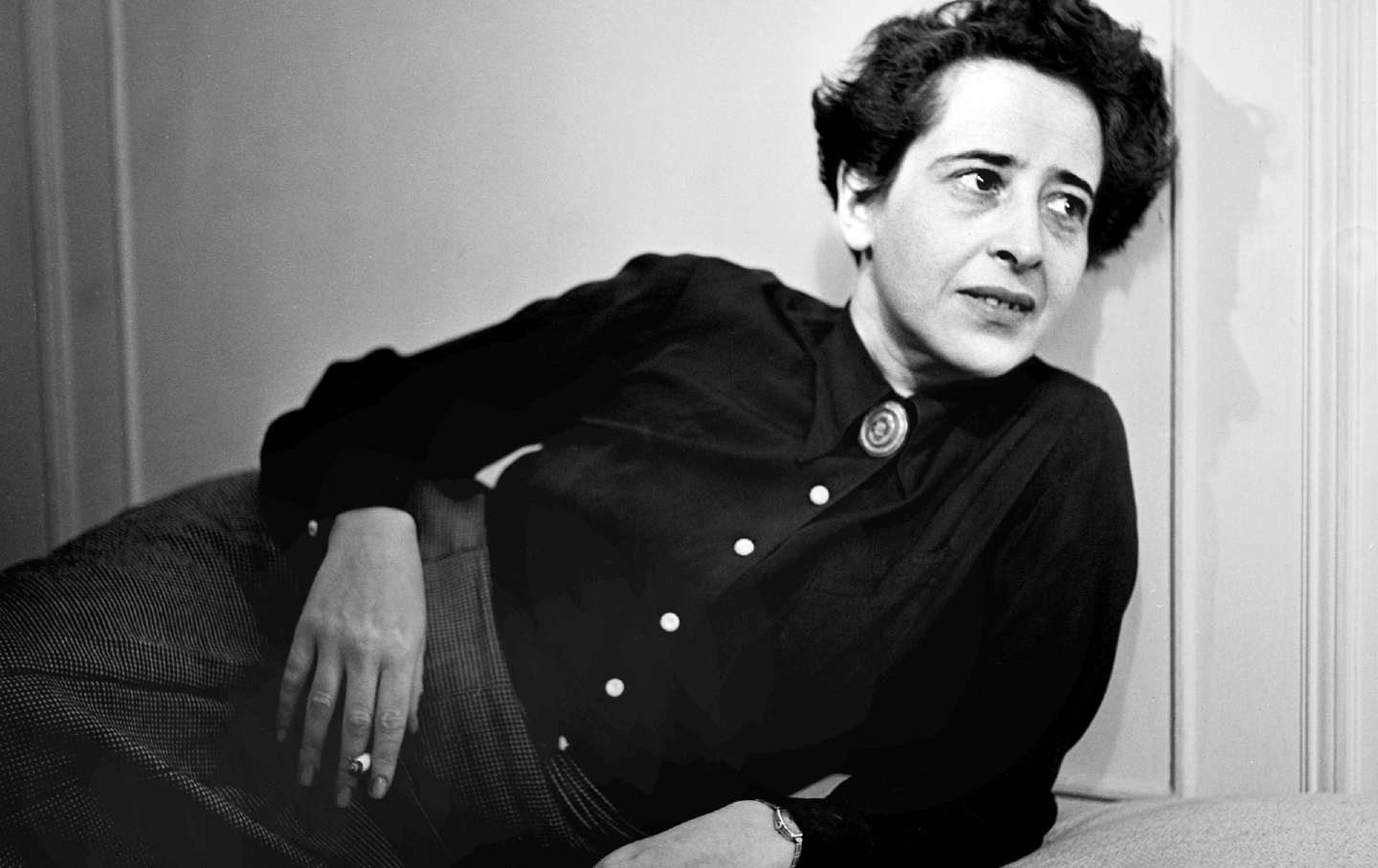
Congressional Democrats pondering how to hold Trump collaborators should consult the work of Hannah Arendt, author of “Personal Responsibility Under a Dictatorship.”
(Fred Stein / picture-alliance / dpa / AP Images)
On October 5, Politico writers Jasper Goodman and Kahterine Hapgood reported on a growing battle among Democratic Party leaders over how deeply to investigate businesses that directly abetted a fascist regime, which is also the single most corrupt presidency in the history of the United States. Progressives like Senator Elizabeth Warren (D-MA) and Representative Maxine Waters (D-CA), who are respectively poised to lead the Senate Banking and House Financial Services committees, are eager to target the executives at major tech companies and cryptocurrency exchanges for their financial and in-kind contributions to Trump. But moderates feel that pointing too many fingers would be unfair.
“A lot of the companies did things because Trump had a gun on their head,” Representative Bill Foster (D-IL) told Politico. “We’re going to have to be a little bit wise about when companies simply did something they had to do to survive this unprecedented level of corruption, compared to companies that actually got on board and profited more by being a partner in his corruption.”
Dave Vorland of the Big Tech front group Chamber of Progress makes a similar case. In Silicon Valley’s generous funding of Trump’s second inauguration and his new White House ballroom project, Vorland writes that “what looks like ‘bending the knee’ may be better understood as risk management.… the company leaders were forced to make that choice by Trump.”
Both Foster and Vorland appear to be arguing that it’s unfair to judge corporate leaders by their actions. Foster claims that at least some “corporations, law firms, and universities that took steps to stay in Trump’s good graces” simply had no choice. It was a matter of survival. Similarly, Vorland appears to treat “risk management” not so much as a business strategy but as an all-purpose moral justification: If it maximizes shareholder value, it must be beyond judgment.
Whatever investigations congressional Democrats undertake in the next two years will be the nation’s first steps toward metabolizing this utterly dark chapter in our history. In other words, congressional oversight of private-sector collaboration with Trump will be a prequel to the truth commissions and criminal prosecutions that we desperately need.
Yet Foster and Vorland want to preemptively write certain actors out of the story of the Trump years, even before Democrats in Congress start wielding gavels. That would necessarily narrow the kinds of story America can tell itself about what the Trump years were to a narrative of coerced collaboration. As Olúfẹ́mi O. Táíwò writes, when a nation chooses to forget certain facts about a shameful chapter in its history, that keeps certain claims about the nation’s character open to future demagogues. The politics of memory are difficult, but they represent nonnegotiable terrain for any honest reckoning with the age of Trump.
Current Issue

Surely though, Foster, Vorland and others would respond, business and civic leaders who paid off or assisted the Trump regime aren’t as bad as Stephen Miller or Pete Hegseth. That’s absolutely correct. But to end the conversation there forecloses other questions about the inner workings of Trump collaboration Americans urgently need to ask ourselves. When an evil regime rises and flips public morality on its head, are you still responsible for your actions? Should one be judged for doing the wrong thing when, for a brief period, the gatekeepers of social power and prestige seemed to require it?
The philosopher and Holocaust survivor Hannah Arendt spent much of her later life thinking about such questions—and about what distinguishes the participants and resisters of fascist and totalitarian regimes from each other. She was particularly interested in the role of individual choice and culpability.
In 1962, The New Yorker sent Arendt to Jerusalem to cover the trial of Adolf Eichmann, a high-ranking Nazi and key organizer of the Final Solution. In Eichmann in Jerusalem, her highly controversial book about the trial, Arendt argued that Eichmann was neither a fascist ideologue nor a hate-driven monster. Rather, he was a dull bureaucrat—a company man who committed genocide to avoid courting any conflicts in his working life so as to quietly climb the professional ladder. Eichmann’s mundane suite of self-justifications, in stark contrast with the gravity of his actions, inspired Arendt’s best-known phrase: “the banality of evil.”
Eichmann in Jerusalem set off furious criticism, to which Arendt responded in her 1964 essay and radio broadcast “Personal Responsibility Under A Dictatorship.” In her view, the controversy revealed “a widespread fear of judging” within high society, due to “the suspicion that no one is a free agent, and hence the doubt that anyone is responsible or could be expected to answer for what he has done.” Educated people recognize that systemic forces and vast institutions influence our daily behavior at all levels. But to Arendt, this acknowledgment too often shaded off into an ethos of personal non-accountability—a readymade rationale for avoiding any responsibility for one’s actions.
Seen in this light, Vorland’s claim that tech leaders have “chosen access and risk management over public confrontation” because “they were forced to make that choice by Trump” begins to fall apart. By definition, one cannot be “forced” into a choice: The tech companies could have chosen the path of “public confrontation” if they wanted to. Meanwhile, Foster’s apologia takes this bid to sidestep public judgment of one’s actions to absurd new heights. In his words, Trump “had a gun on their head.” But “they” are multibillion-dollar corporations—legal fictions without heads at all, who enjoy privilege and social deference on a scale unimaginable to ordinary Americans. The bosses of these entities weren’t facing imminent execution at the hands of the state, but only the prospect of diminished revenue.
The planning agendas of such institutions aren’t some impersonal force hovering above the messy world of moral decision-making; rather, they are subtended by particular people within them, who could have chosen otherwise. When Trump tried to revoke security clearances for attorneys at the major law firm Paul Weiss, it was then-chairman Brad Karp who raced to offer the president $40 million in pro bono legal work. Likewise, when Trump threatened to revoke Columbia University’s research grants, it was acting president Claire Shipman who agreed to pay millions to the Trump administration, crush the school’s roster of diversity, equity, and inclusion programs, and police dissent at her campus by wielding a false and weaponized definition of antisemitism. These are particular people who made particular choices. Many of their peers made other choices. Those peers are still alive, and their institutions are still thriving.
Karp is “described by colleagues as the consummate people pleaser, sometimes to a fault,” according to a New York Times investigation. Shipman was once a cable news anchor who wrote airport self-help books for white-collar professional women. Both are regular Democratic donors who have publicly voiced broadly liberal commitments.
Then, for a few months, it looked like a demagogue might take away their prestige and public funding. At the same time, prominent pundits with views akin to theirs were heralding a “vibe shift;” respectable people had to consider fascists respectable now. And so Karp and Shipman became puppets of a warmongering regime that kidnaps and murders citizens in the street because they didn’t want to anger anyone important.
Arendt would not be surprised. When she described life as a Jewish intellectual in Nazi Germany in “Personal Responsibility,” Arendtt wrote that she was shocked and outraged by the regime’s actions, but not disturbed: The Nazis, after all, were doing exactly what they said they would do.
No, she wrote, “what disturbed us was the behavior not of our enemies but of our friends, who had done nothing to bring this situation about. They were not responsible for the Nazis, they were only impressed by the Nazi success and unable to pit their own judgment against the verdict of History, as they read it.”
Still, did Karp, Shipman, and the tech giants do anything that was really so wrong? These were extreme circumstances, unprecedented in any of our lives. To what standard can we hold people in these situations?
Popular
“swipe left below to view more authors”Swipe →
In both Eichmann in Jerusalem and “Personal Responsibility,” Arendt distinguished between legal and moral culpability. She pointed out that in bureaucratically administering the Holocaust, Eichmann had not actually violated any laws. The Nazis had transformed Germany so thoroughly that under their rule, “every moral act was illegal and every legal act was a crime.”
The United States hasn’t quite sunk to that level, but the rulings of an arch-right Supreme Court across three decades have certainly enabled the legal prohibition of basic moral acts. Women have died of ectopic pregnancies because doctors correctly feared they could be imprisoned for performing medically necessary abortions. The Jim Crow 2.0 laws now sweeping the South, like the first Jim Crow regime before them and chattel slavery before that, are all perfectly constitutional. When schools suddenly made pariahs of their transgender students, and businesses eradicated people of color from their org charts overnight, they were following the letter of the law. If investigated by Congress, the leaders of these institutions will say they did nothing illegal, and they will be right.
Likewise, the Supreme Court has functionally legalized at least one crime pivotal to the Trump-branded derangement of the state: bribery. Political spending, even on presidential meme coins, is now a form of protected speech absent an expressly avowed and fulfilled quid pro quo. And even under those conditions, the leadership of the Trump regime, has instructed the feds to look the other way.
These reversals of long-standing interpretations of bribery statutes are what enabled tithes toward Trump’s arch and ballroom that Warren and Waters want to investigate. These donors, too, can correctly say that they did not break any laws—an alibi that readily morphs into a far broader assertion of moral justification for participants. Chamber of Progress CEO Adam Kovacevich wrote in August, “Midterm voters are way more pissed off about Trump corruption than they are about companies giving $ to the ballroom.” This is a distinction without a difference, since the ballroom donations are a prime example of Trump corruption. They simply are legal, under the Supreme Court’s through-the-looking-glass efforts to will the whole problem of political corruption out of the ambit of the law.
To find Eichmann guilty in court, the prosecutors in Jerusalem had to meet the standards set by mens rea—the legal doctrine holding that he should have known at the time that his actions were criminal. Arendt argued that they did so by appealing to a higher moral conception of Eichmann’s responsibility—demonstrating that the Holocaust was so singularly evil that no participant could possibly have understood their actions to be permissible.
Yet experience had left Arendt skeptical that all people shared “an independent human faculty, unsupported by law and public opinion, that judges in full spontaneity every deed and intent anew whenever the occasion arises.” After all, she wrote, “it was precisely the members of respectable society, who had not been touched by the intellectual and moral upheaval in the early stages of the Nazi period, who were the first to yield. They simply exchanged one system of values against another.”
Arendt was not saying that nobody is capable of independent morality. Quite the opposite: In one of the essay’s most powerful passages, she celebrates those who “refused to murder, not so much because they still held fast to the command ‘Thou shalt not kill,’ but because they were unwilling to live together with a murderer—themselves.” For Arendt, this refusal reflects a disposition “to be engaged in that silent dialogue between me and myself which, since Socrates and Plato, we usually call thinking.”
The resisters in our time likewise did what respectable society deemed impolitic. Minneapolis’s mutual aid networks that defeated ICE in February evolved out of the 2020 George Floyd uprisings. This is the city, and these are the people, whom Beltway apparatchiks condemned for setting a police precinct on fire. In national politics, Georgia Senator Jon Ossoff’s frank descriptions of the Trump administration’s obscenity infuriated Democratic consultants. Establishment orthodoxy in Democratic circles holds that respectable battleground-state candidates must poll-test every word and mathematically optimize a perfectly stage-managed campaign to reassure voters that their judgments won’t be too harsh. It’s too risky for them to form beliefs and describe them honestly.
But the Minneapolis protesters and Ossoff are people who think for themselves, even when it is dangerous, and even when it worries their ostensible allies. By contrast, what does it mean that so many business and civic leaders collaborated with Trump at the first sign of pressure?
We can make inferences, but the truth is that for now, we don’t really know. This is a good reason for Congress to act. Let us not assume that we have all the answers already. Let us, in good faith, ask all of Trump’s enablers—in the White House, certainly, but also in business and civic life: Why did you do these things? Did you not see how vile this man was? Do you not see what your support of him says about you?
Those who honestly answer “no” will have revealed that, in Arendt’s terms, they are not people who think. This is valuable information for the public and future historians. It may help explain the singular climate of impunity that took hold during the Trump era if there is clear evidence that many of this period’s high leaders were basically thoughtless people.
Such investigation may also heighten the contrast between the systems that selected these leaders and the system of democracy. Weakened, bedraggled, far from perfect under the best of circumstances, democracy still permits the people to course-correct. It is a grim rebuke to democratic idealism that an (ultra-narrow) popular plurality reelected Donald Trump in 2024. But it is reassuring that he is now the most unpopular president since modern polling began, and that his party is now predicted to lose everything due to widespread, justified rage against him.
This is why it’s imperative to require collaborators of the regime to justify their conduct, in plain English, to the rest of us. Maybe we’ll find their answer satisfying. Then again, maybe not. But at least it will be on the record. If we are ever to make sense of what exactly the Trump era was—and precisely what it revealed about American society—then we shall need all the data we can get. That means, at a minimum, having the CEOs, college presidents, and lords of Silicon Valley give their testimony under subpoenas from Congress.
More from The Nation
Data center opposition can foster a bigger Democratic tent by aligning red and blue, and rural and urban communities.
Minnesotans say the raid on Omar’s home was all about politics. They also argue that it will backfire and generate boosted turnout for DFL candidates.
After a federal agent shot an immigrant in New York, activists are questioning Mamdani’s handling of the NYPD and his relationship with the White House.
Allegations of gang rape and sex trafficking at Cornell University highlight persistent concerns about rape culture, even years after the #MeToo movement.
Candidates in 2026 are responding to an electorate that’s ready to abolish ICE, tax the billionaire class, and free Palestine.