
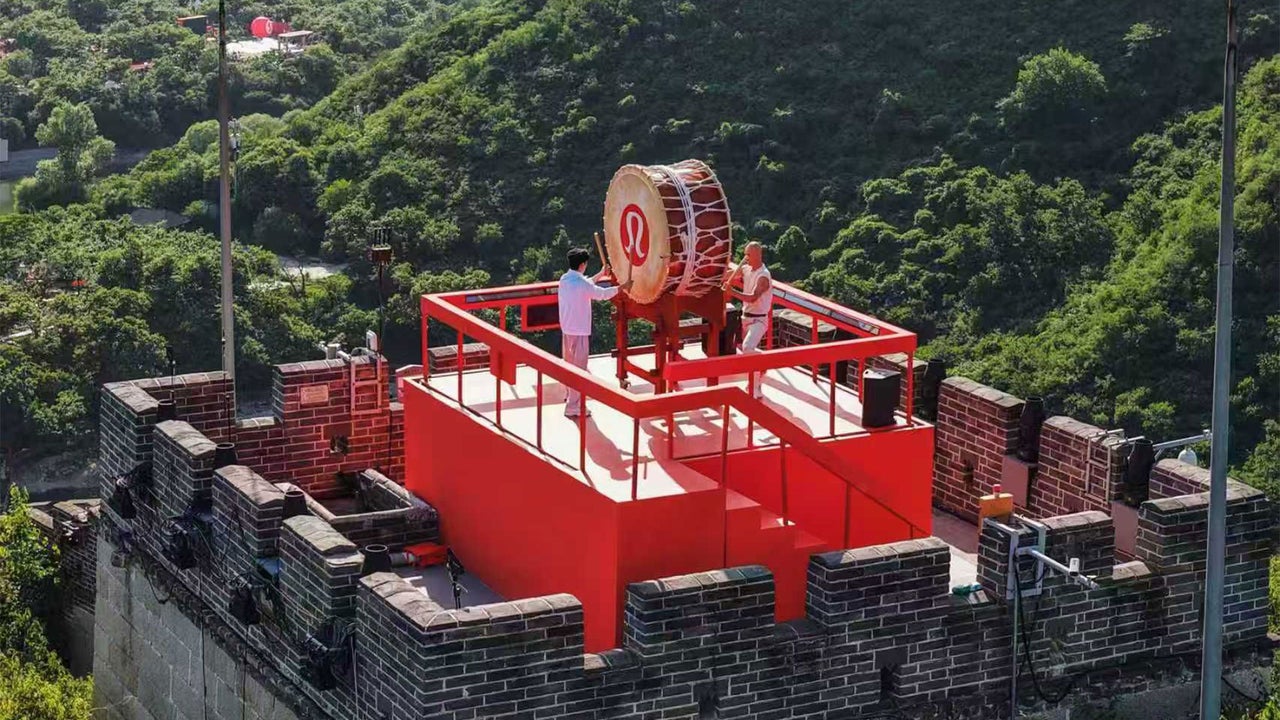
When done right, brand activations can bring real-life awareness and connect a brand with its customers. When not, these can turn sour quickly, bringing the opposite effect to a brand—as happened with activewear company Lululemon.
The Canadian athletic clothing retailer recently organized a promotional event on China’s Great Wall, as part of its move toward gaining share in the Chinese market. But the event, which was meant to be a celebration of Chinese culture and wellness—with 2,000 guests invited to a yoga festival—quickly backfired.
According to Chinese state-owned publication Global Times, Chinese actor Zhu Yilong was among the guests present during the event and participated in a drum troupe. But users on social media realized the brand had mistakenly used a Japanese Taiko drum, not a Chinese one.
The event gained traction as the actor posted an image of himself with the drum, which boasted Lululemon’s logo, on Weibo, one of China’s main social media platforms.
While the Japanese and Chinese drums may seem similar from afar—made with wood and cowhide tacked together—social media observers set them apart, flaming Lululemon for the mixup.
According to Global Times, discussions about the drum mixup reached 50 million viewers, with users calling the error insulting and inappropriate.
Following calls for the company to rectify the situation, Lululemon reportedly issued an apology via its Weibo account on Tuesday, and scrubbed videos and promotional materials related to the activation from their accounts.
“We attach great importance to the feedback from the society,” the statement said. “Due to lack of professional knowledge, we failed to fully identify potential disputes early and have fully recognized that we ought to have planned and reviewed the percussion performance with more caution and thoroughness.”
We’ve reached out to Lululemon for additional comment.
Bad news spreads
It wasn’t just social media users in China who took offense to the poorly planned event.
“Nothing says ‘respecting Chinese heritage’ like bringing what appears to be a Japanese taiko drum to the Great Wall. Lululemon speed running brand crisis in China,” a user said on X.
Another added, “honestly it’s crazy how a simple lack of cultural vetting can turn a massive promotional campaign into an absolute PR disaster overnight.”
The controversy also resurfaced rumors of the brand name’s controversial origin: Lululemon’s founder reportedly believed that the Japanese pronunciation of the letter “L” was amusing, coming up with a nonsensical name that had several “Ls” in it.
While the flop has gained much attention on social media, Lululemon is far from the only brand that has stumbled while trying to appeal to consumers in the Chinese market.
Notably, Dolce & Gabbana faced backlash back in 2018 when the luxury brand posted a promotional video to Weibo featuring an Asian woman trying to eat spaghetti, pizza, and cannolis with chopsticks.
The controversy reached millions. “If we don’t kick D&G out of China now, there will be many other foreign brands trampling on our Chinese dignity!” a user on Weibo said at the time.
Following the demands, Domenico Dolce and Stefano Gabbana went on to issue an apology video, despite a leaked conversation that appeared to reveal Gabbana calling China an “ignorant dirty smelling mafia.”
Since then, brands have continued to drop the ball when trying to connect with Chinese customers.
Last year, outdoor gear company Arc’teryx set off a display of fireworks in Tibet for promotional purposes. This led to controversy and calls for boycotts due to the potential environmental damage it caused the region, leading the company to issue an apology.
And earlier this year, fashion-forward brand Lemaire drew criticism following editorial images that featured a diffuser in the shape of Qing Dynasty-style long braided hair.
The criticism landed just as Lemaire had doubled down on its Chinese expansion, opening its largest flagship store in Shanghai.
And as more brands continue to try to enter the Chinese market successfully, consumers continue to call for companies to learn from others’ past mistakes
“Small mistakes in global campaigns can turn into huge backlash fast,” a user said on X. “Brands really have to double-check every cultural detail before going public.”