
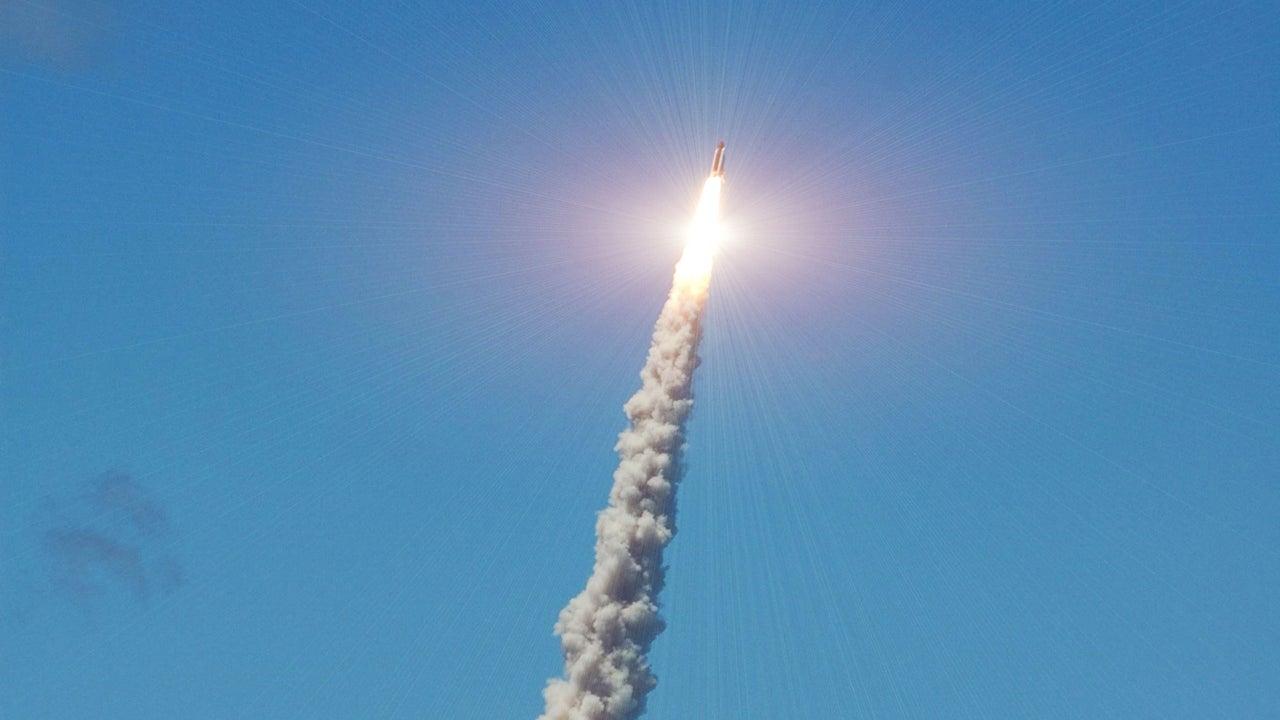
You might think about rockets as powerful vehicles that blast astronaut crews and robotic missions off into space. But what if they could be used to send cargo from one side of the Earth to the other, in a fraction of the time it would take a plane? The company SpaceX recently announced a project that aims to use its rockets to do just that.
SpaceX launched its Starfall demo mission on June 23, 2026. According to a document from the Federal Aviation Administration, Starfall has two main purposes: to use rockets to quickly deliver cargo around the world, and to deliver cargo to and from space. The latter could allow for in-space manufacturing markets that take advantage of microgravity and the vacuum of space.
We are aerospace engineers who study space flight. SpaceX seems to be positioning Starfall not only as a key component of a superfast delivery system, but also as infrastructure that could support future in-space manufacturing opportunities.
New opportunities for orbital cargo delivery
High-speed global transport isn’t a new idea. Airlines aimed to achieve a similar goal decades ago with a supersonic passenger aircraft called the Concorde. Orbital cargo transport, however, is a fundamentally different concept from the Concorde in several ways.
A big difference is the customer base. Unlike the Concorde, which served commercial airlines and transported passengers, point-to-point rocket delivery could benefit government and defense sectors, where rapid delivery is invaluable.
Space cargo transport likely will not replace conventional transportation methods, such as sea shipping or air freight. Instead, it offers a new option: ultrafast emergency transport. This type of transport could deliver critical medical products, deploy emergency disaster relief, or supply urgent defense support within a few hours.
Additionally, as SpaceX suggested when it announced Starfall, a future orbital cargo system wouldn’t just transfer payloads between two points on Earth. Rather, it could also take cargo to and from space.
In-space manufacturing is an emerging possibility for companies interested in producing or researching how to create pharmaceuticals, electronics, or other technologies in microgravity or a vacuum. These conditions, which are difficult to create on Earth, could be advantageous for certain applications, such as developing specialized proteins or semiconductors.
Although SpaceX already delivers cargo and crew to the International Space Station, orbital cargo delivery operates under a fundamentally different model. To meet the short timelines required for some types of cargo missions, this system would need to be able to launch without too much advance warning, whereas ISS resupply missions follow long, planned-out, and periodic schedules.
Potential challenges
Despite its potential, an orbital cargo transport system comes with a host of challenges that SpaceX would have to overcome.
Rockets, by nature, aren’t a smooth ride. In traditional air or ocean transport, ordinary containers are sufficient for safe delivery because the ride is relatively gentle. However, a launch vehicle is different. Because orbital transport requires overcoming Earth’s gravity, severe vibrations and high-G forces inevitably shake the vehicle during both ascent and reentry. Delicate electronics, fragile calibration tools, or volatile medical supplies may require specialized qualification or shock-absorbing casings to withstand these forces.
SpaceX has changed the launch vehicle paradigm by reusing rockets, which has made launches more affordable. However, making a reliable, working rocket is only a piece of the puzzle. Operating a cargo network requires solving a puzzle with a thousand pieces.
Systems engineering teaches you that initial planning decisions can determine the success of the entire project. For orbital cargo delivery, these early decisions may include where to put launch and landing sites, how to load and unload the orbital payloads to trucks or ships, and how many rockets to build.
To make the most of the precious time orbital transport can save, the system will need to fit into existing transportation logistics. Otherwise, the system will have to also include transportation of the cargo to and from the launch and landing pads.
Although many technical and logistical challenges exist, we know that experts in industry and academia are actively working on solutions. Overcoming these challenges may only be a matter of time.
If engineers can think through the logistical challenges early and carefully, we believe that orbital cargo transport could open a new chapter in transportation and the space economy.
Euihyeon Choi is a Ph.D. student in aerospace engineering at Georgia Institute of Technology.
Koki Ho is an associate professor of aerospace engineering at Georgia Institute of Technology.
This article is republished from The Conversation under a Creative Commons license. Read the original article.