
The value of higher education has been on a steady decline for Americans over the past 15 years. According to a September Gallup poll, only 35% of U.S. adults said a college education is “very important,” compared to 75% in 2010.
This is what a marketer would call a brand problem. The University of North Carolina is unveiling a refreshed brand identity and reorganizing its marketing structure to meet these 21st-century challenges.
The centuries-old university has a storied history as a top-ranked academic institution and a legendary sports brand (thank you Michael Jordan). Chancellor Lee Roberts says that awareness isn’t UNC’s problem. Everyone in North Carolina knows the school, and applications continue to climb each year.
“The truth is, it is a competitive landscape across higher ed. We are in a competition for research dollars, for rankings, and for the best students,” Roberts says. “We thought it was time to do a better job telling our story in a more proactive and effective way. In the contemporary media environment, you can’t just sit back and hope that everyone will recognize what makes you great and unique. You need to be a little bit more aggressive about communicating your story to the world.”
“First. And for all.”
It’s an obvious observation, but universities are not the same as corporations. The stakeholders involved in a brand refresh are many more than you’d find in a typical boardroom. It’s why marketing at UNC has long been decentralized, spread across its more than 25 schools and units, all telling their own stories in a variety of ways. As a result, even the UNC logo had been spread thin. All told, there were 666 variations of the UNC logo being used.
In order to more effectively tell the university’s story, as Roberts wanted, the decision was made to break down these silos and create a centralized marketing department. Adrienne King was hired in February, coming from Indiana University, as UNC’s associate vice chancellor for marketing to lead the effort. Roberts also brought in former Phoenix Suns CMO Dean Stoyer, a veteran of brands like Nike, Under Armour, and ESPN, as vice chancellor for communications.
“This is the first time we’ve ever had a centralized marketing team at the university,” King says. “But this isn’t a situation where we needed to come in and start all over.”

King and her team partnered with creative agency 2×4 to conduct market research, do a comparative analysis, and develop an updated brand positioning. The research included surveys, focus groups, and one-on-one discussions with alumni, faculty, staff, students, and North Carolina residents.
For starters, they found that the school’s interlocking NC logo dates back to the 1870s, and it has remained the symbol alumni and North Carolina residents most identify with. “From a brand perspective, it is internationally recognized. But more importantly, back at home we feel like it represents the people in the state that we serve,” King says. “This is the university for the people. And you can’t create a new logo that would have better equity than that.”
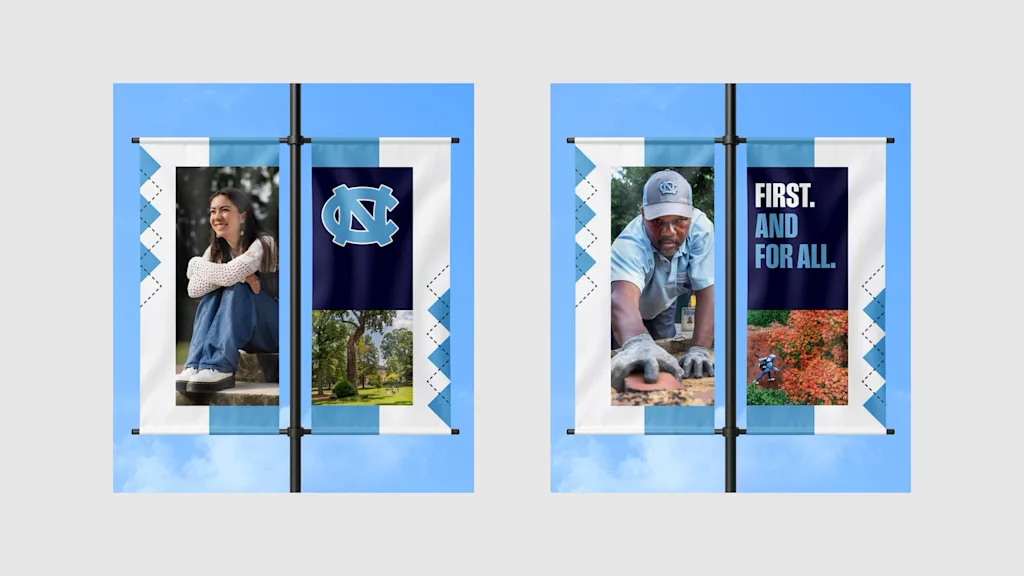
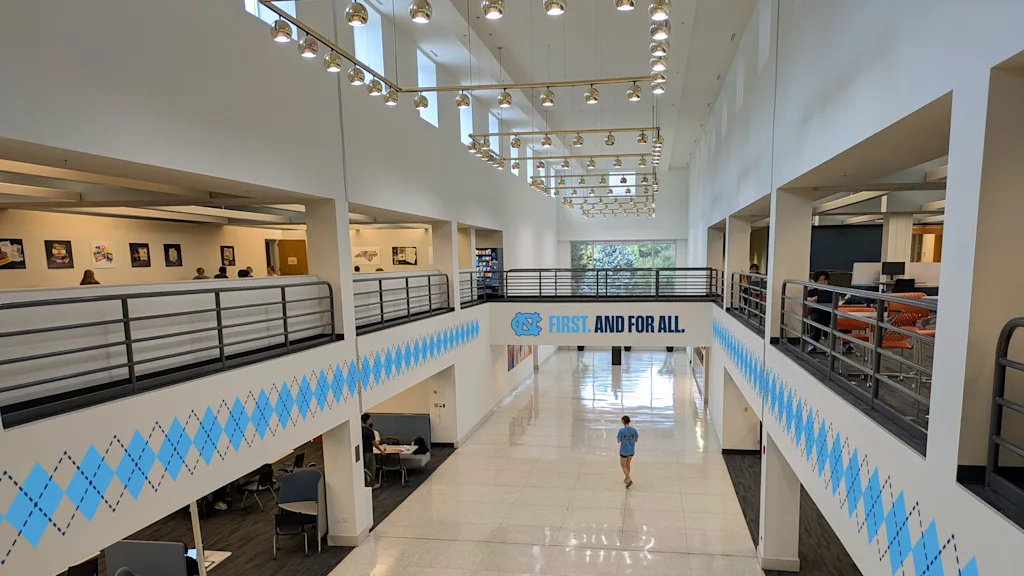
The brand refresh utilizes one version of that logo, as well as a standardized version of the iconic “Carolina Blue” color. For a tagline, the school looked back at its history as America’s first public university and landed on “First. And For All.”
In terms of the declining opinion about higher ed, Roberts says people tell pollsters they think universities are expensive, elitist, and don’t do a good job preparing students for the workforce.
“Well, here at Carolina, our tuition’s been flat for 9 going on 10 years in nominal terms, meaning it’s gone down by about 20% in real terms, and 82% of our undergraduates are from right here in North Carolina,” Roberts says. “We were just No. 3 nationally in the Princeton Review’s ROI survey. So we don’t think any of those concerns really apply to us. But again, that comes back to telling our story as effectively as we can.”
Meanwhile, competitors are stepping up, and not just the traditional rivals. Roberts name-checks schools like the University of South Florida, which is now a leader in new patents. “You have an entire crop of new entrants who are gunning for the traditional top tier of public higher ed in the United States, and it requires everyone to continue investing, continue raising the bar,” he says.

Demographic cliff vs. Reputation cliff
Twenty years ago, King wrote her dissertation on the role of marketing and higher education. “I remember at the time marketing was seen as very much a negative term, and when you thought of marketing and higher ed, it was strictly enrollment focused,” she says.
For years, the postsecondary education industry has been bracing for what it calls the demographic cliff, when high school graduation numbers—and consequently potential enrollment numbers—will decline significantly. A Western Interstate Commission for Higher Education report says high school graduates will peak this year at about 3.9 million, and then start falling until there are about 13% fewer graduates by 2041.
Kings says that given all the other challenges and narratives around the perceived value of a college education, more people within the industry are recognizing that while they were focused on that demographic cliff, they missed the reputational cliff that it has fallen off of.
Now the work to repair and rebuild that reputation includes acting like a world-class brand and telling the story of its value.
“I think often we in the public higher-ed sector take for granted that we are uniquely positioned within our states to drive economic development to benefit the people of the state,” King says. “I like to think our greatest investors are the citizens of North Carolina, and we need them to know all the ways that we are positively impacting their lives. That’s a very different position than strictly focusing on enrollment. That really is about reputation, and that’s what the focus is now.”