

No election result is monocausal, and there are clearly many factors that have converged to make the AfD Germany’s most popular party.
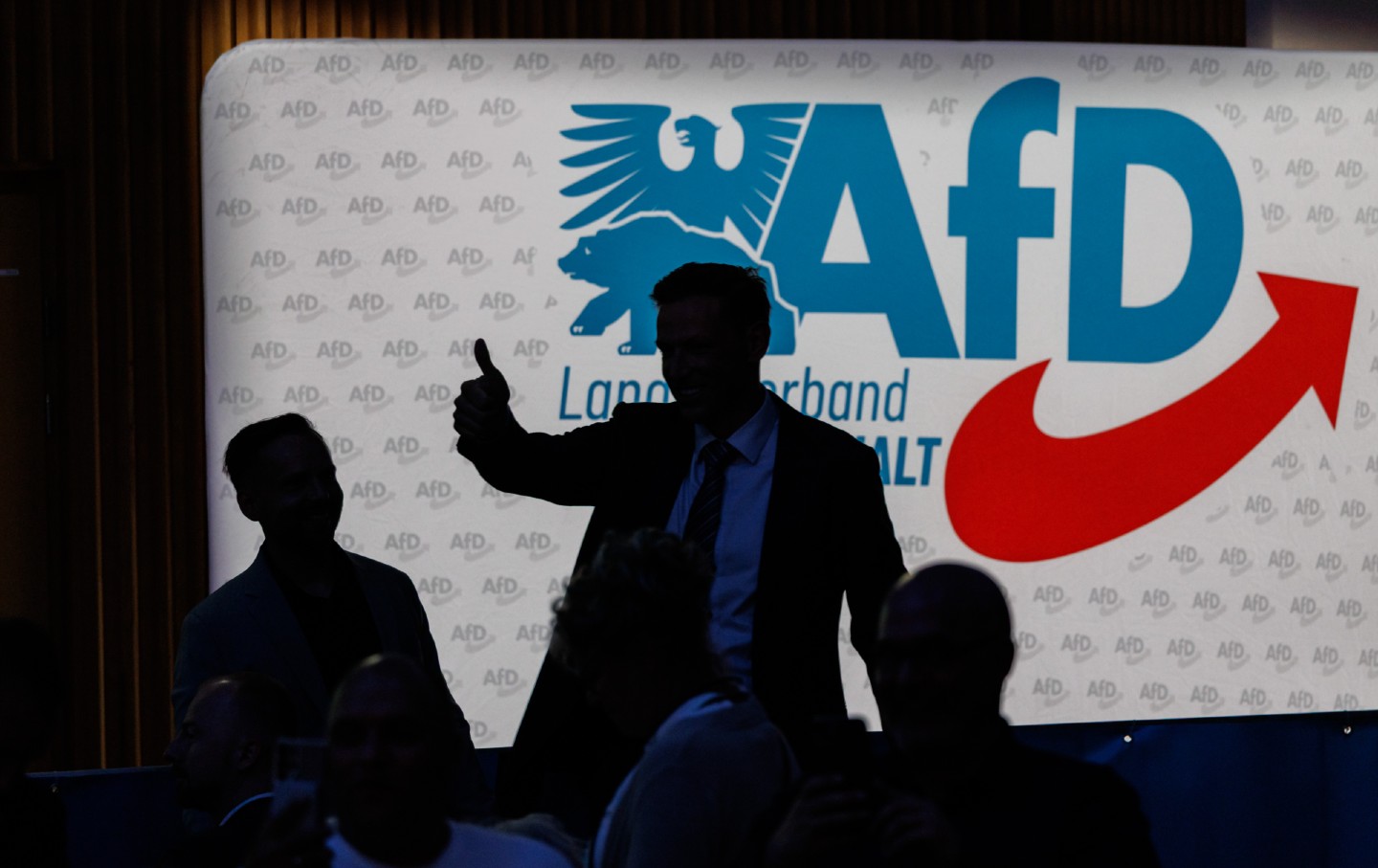
As the dust settles from Sunday’s alarming election result in Saxony-Anhalt, the entire world is asking how Germany got here: A party, Alternative für Deutschland (AfD), with ties to right-wing extremists and a tendency to play down the country’s Nazi history, has come within inches of forming the country’s first far-right state government since the fall of Hitler.
“I naturally ask myself how it could have come this far, what the reasons are that we allowed right-wing populism—and, in large parts, right-wing extremist populism—to come this far,” German Chancellor Friedrich Merz, of the conservative Christian Democratic Union (CDU) party, mused. Merz has reportedly decided that immigration is the answer, and is considering toughening Germany’s citizenship laws as a way to stop the AfD.
Left-wing voices have put forward more compelling explanations. France’s leftist presidential candidate, Jean-Luc Mélenchon, has offered that “the AfD’s victory is the result of the neoliberal policies” of successive German governments. The economist Isabella Weber has pointed to evidence that AfD voters are in financially precarious situations, reminding us that “economic insecurity is the breeding ground for scapegoating and hate rooted in racism,” and calling for a fundamental shift in economic policy to tackle unaffordability.
Yet almost entirely left out from this postelection analysis is one major factor: the Ukraine war, and German policy toward it.
It is true that the economic downturn and rising unaffordability that have hit eastern Germany particularly hard are major drivers of the AfD’s ascent. But those conditions are the direct result of Berlin’s sanctions on Russia, which saw Germany suddenly deprived of cheap Russian oil and gas in 2022, causing the highest inflation since reunification three decades earlier and plunging the country into recession, an affordability crisis, and deindustrialization.
East German states, already economically lagging behind their Western counterparts, saw higher inflation rates. In 2024, one east German town actively called on Berlin to potentially go so far as to restore Russian oil shipments, since the Russian-owned oil refinery that served as its beating economic heart was left in fiscal peril. Last year, German industries in the eastern states began openly talking about and planning for the return of Russian energy imports in the event of a peace deal.
Current Issue

As we have seen in the United States, widespread economic discontent creates a general anti-incumbency mood and bitterness against the establishment that paves a political path forward for the far right. And the AfD has been able to further capitalize on this by scapegoating migrants as the cause of people’s economic misery.
Economic struggle, coupled with eastern Germany’s generally more Russia-friendly attitude owing to its Soviet past, have made the region’s politics surrounding the Ukraine war markedly different than in the rest of the country. The CDU premier of Saxony, for instance, has effectively broken from the national party on the war, voicing skepticism of continuing to arm Ukraine and insisting that Berlin’s approach to negotiations with Russia is to blame for the lack of a settlement to the war.
But the AfD didn’t just campaign against the conditions created by Berlin’s Ukraine-war policy in advance of this Sunday. They also campaigned directly against that policy.
The AfD’s platform called for peace talks with Moscow, ending German support for the Ukrainian war effort, and restarting the flow of cheap Russian energy by lifting German sanctions on Russia. The party’s leader in Saxony-Anhalt, Ulrich Siegmund, has criticized Merz’s support for Ukraine for having pushed up energy costs and has vowed to cut support for Ukrainian refugees.
In March of last year, the AfD’s Saxony-Anhalt branch organized a conference titled “How Economic Sanctions Harm Us,” in which speaker after speaker inveighed against Germany’s sanctions policy. Jurij Christopher Kofner, an economist affiliated with the AfD, told attendees that German sanctions on Russia had cost the country 2.5 percent of GDP in 2024, or an average of around €2,500 per household. Martin Reichardt, one of the party’s representatives in the Bundestag, criticized the German media for painting the sanctions as a success, and accused the broader West of keeping the war going to weaken both Russia and Germany while keeping lavish arms contracts flowing. Another of the party’s MPs argued that Germany’s future hinged on cheap energy, taking aim at, among various climate measures, Berlin’s rejection of Russian natural gas, which he argued had weakened the national economy.
That the AfD would benefit politically from the war’s blowback is neither new nor surprising. A year after the sanctions rebounded on Germany’s economy, the AfD won a district council election in the eastern state of Thuringia and saw its national polling climb to a hair under that of the ruling Social Democratic Party (SPD). At the time, roughly half of voters viewed the sanctions as hurting Germany more than Russia, and most AfD voters reported they opposed the controversial decision to send Leopard tanks to Ukraine. A year after that, the AfD again made major gains in elections in eastern states, nearly toppling the SPD in Brandenburg, which it had governed for more than 30 years. Disaffection with the cost of living, the economy, meager pensions, and the war in Ukraine were major drivers in all three states. In last year’s federal elections, the party came second after taking an overtly hostile position to the German establishment’s war policy.
Popular
“swipe left below to view more authors”Swipe →
Since taking power last year, Merz and the ruling CDU have gone almost out of their way to make these conditions worse, embarking on the toxic combination of pitiless cuts to social spending—including healthcare and, more recently, raising the retirement age—and a massive increase in military funding. The chancellor carved out a special exemption from EU debt rules for the latter, even as he claimed that the welfare state had become impossibly expensive. This splurge is meant to fuel a massive German rearmament intended for a future war with Russia that the government regards as inevitable, and that it has struggled to recruit actual Germans to one day fight.
I have documented how the inflationary effects of the war created a political opening for far-right parties across Europe, as well as here in the United States. What is especially tragic is that this could have been avoided: There were numerous opportunities to bring the war to a close as early as a year into the conflict, but they were shouted down and scuttled at the time by politicians and commentators in favor of pursuing a military victory that looks increasingly impossible. Even now, much of the European and US establishment opposes peace on Moscow’s increasingly hard-line terms. Yet unfair and unjust as those terms are, continuing to reject a settlement, however distasteful, all but guarantees that the far right will continue to romp across Europe and condemns Ukraine to a bleak future of gradual social and physical destruction.
Needless to say, no election result is monocausal, and there are clearly many factors that have converged to make the AfD Germany’s most popular party today, from deep-rooted unhappiness with the neoliberal direction of the country’s post–Cold War economy to the failures of German reunification. But it is just as clear that the Ukraine war and its ripple effects have been a major contributor.
Unless this fact is understood and the political center adjusts its approach to the war, it is likely that the political center’s efforts to halt the march of the far right in both Germany and the rest of Europe will fall short. If that happens, it will be not just Ukraine that is the loser of Russia’s criminal invasion, but all of us.
More from The Nation

As the US strangles Cuba economically, Marco Rubio is running a $100 million “hearts and minds” program on the island.
How the EU is contributing to the rise of Europe’s far right.
The Alternative for Germany just shattered the political firewall meant to keep the party out. Now the country’s establishment is scrambling to stop the rise of the far right.
Gaza’s 2008 babies were born during an Israeli assault, grew up under blockade, and completed their final high school exams this summer during a genocide.