
Close Menu
    Facebook X (Twitter) Instagram
    TRENDING :
    • Here’s how much Trump’s Iran war is boosting EV sales around the world
    • South Point’s Cayden Rumph Refuses to Sit Out a Single Play
    • What to do when your employees are hiding their AI use
    • Charlotte 49ers Face Temple: Time, TV, Odds and Game Info
    • The Quiet Risk Growing Inside Your Service Business
    • Class A Chaos Reigns as Montana High School Football Rankings Shake Up
    • The Sheer Ignorance Of What’s At Stake Globally
    • Hate Your CPAP Machine? This Bootstrapped Company Has a Fix.
    Populist Bulletin
    • Home
    • US Politics
    • World Politics
    • Economy
    • Business
    • Headline News
    Populist Bulletin
    Home»Business»Here’s how much Trump’s Iran war is boosting EV sales around the world
    Business 4 Mins Read

    Here’s how much Trump’s Iran war is boosting EV sales around the world

    Business 4 Mins Read
    Share Facebook Twitter Pinterest LinkedIn Tumblr Telegram Email Copy Link
    Follow Us
    Google News Flipboard
    Share
    Facebook Twitter LinkedIn Pinterest Email


    The Trump administration has done everything it can to slow the growth of EVs. But in an ironic twist, Trump’s war in Iran is boosting the EV industry globally.

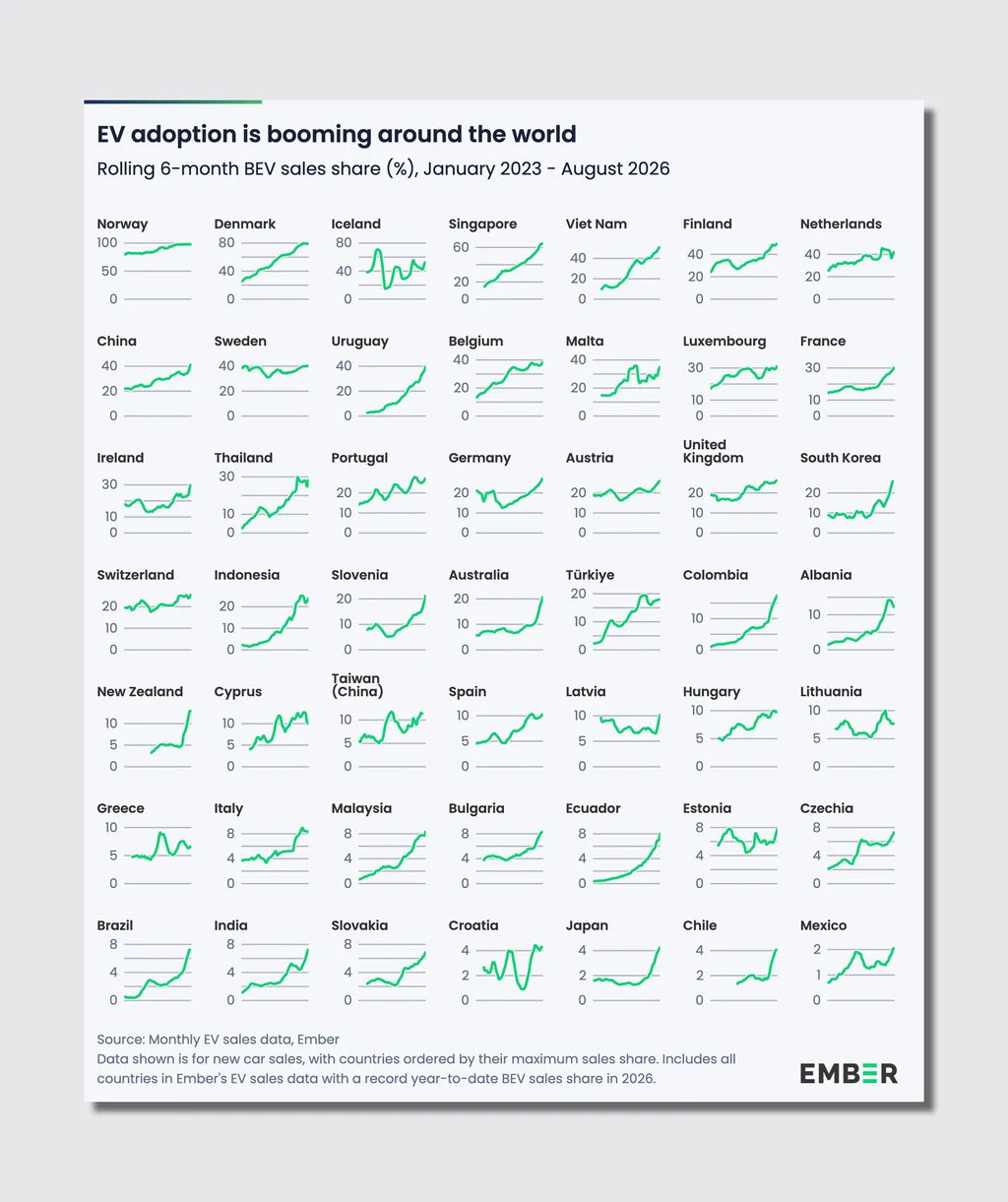
    After the U.S. attacked Iran in late February and the price of crude oil soared, global EV sales also surged. A new report from Ember, an energy think tank that is tracking EV sales in 56 countries, found that 49 of them have hit new records for EVs this year.

    [Image: Ember]

    Between March and August, EV sales in New Zealand grew 165% compared with the previous six months. In Chile, they were up 124%, and in India, 58%.
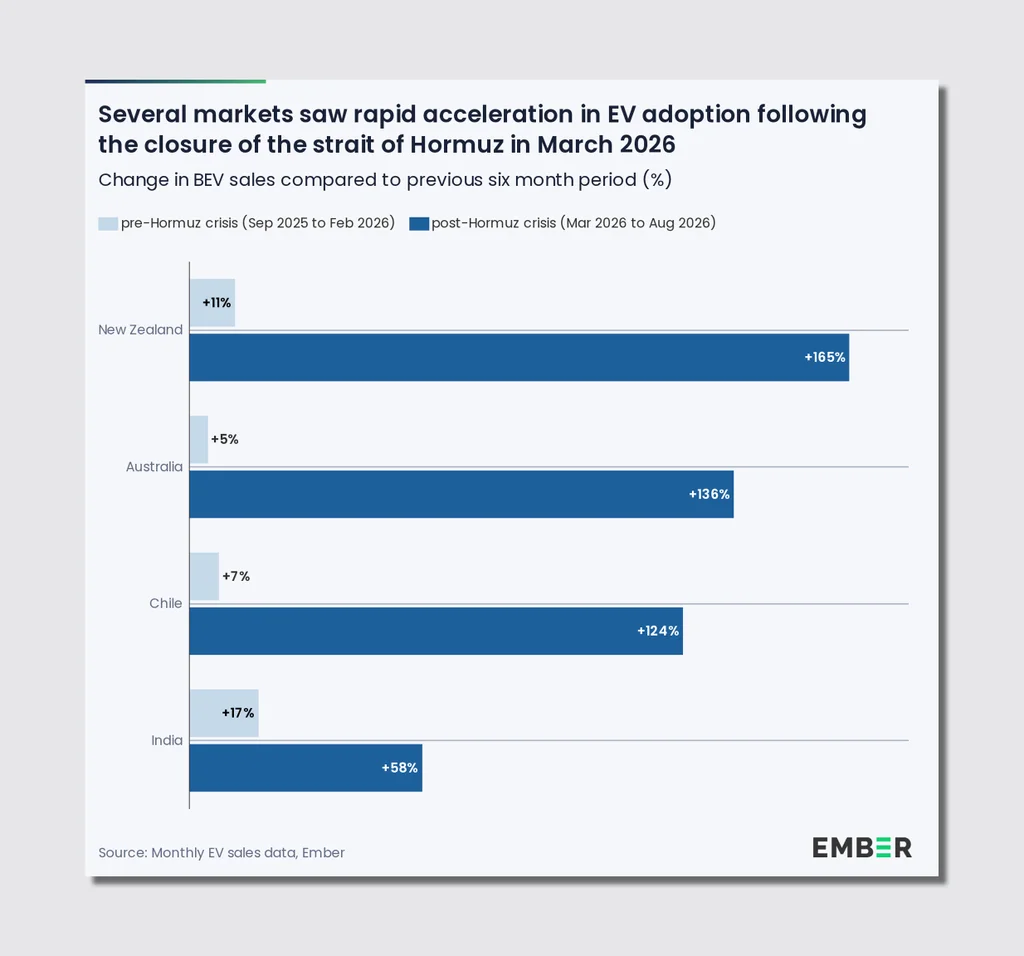
    Bar chart titled “Several markets saw rapid acceleration in EV adoption following the closure of the Strait of Hormuz in March 2026.” The chart compares changes in battery electric vehicle sales during the six months before and after the March 2026 Strait of Hormuz closure. Light blue bars represent the pre-crisis period from September 2025 to February 2026, while dark blue bars represent the post-crisis period from March 2026 to August 2026. New Zealand increased from 11 percent growth before the crisis to 165 percent after it, Australia increased from 5 percent to 136 percent, Chile increased from 7 percent to 124 percent, and India increased from 17 percent to 58 percent. In all four countries, EV sales growth accelerated substantially after the closure, with the largest post-crisis increases occurring in New Zealand, Australia, and Chile. The source is Ember using monthly EV sales data.
    [Image: Ember]

    In many countries, the growth was also supported by new policies. In Germany, for example, pro-EV policies that rolled out last year were in place as fuel prices rose. By August, as Germany’s gas prices reached a record high of around $8.52 per gallon, the country’s battery electric vehicle sales made up 27.5% of total car sales—a 50% increase over the same month last year.

    “First you had fuel efficiency standards—which basically means a lot of manufacturers suddenly started bringing out more affordable electric car models at the start of this year—and then there was also some more direct policy support in Germany,” says Euan Graham, senior energy analyst at Ember. “So, all of that has meant that as consumer interest in EVs has risen and as petrol prices have risen, consumers have also had more affordable electric car models to choose from.”

    In Uruguay, which has supported EV growth for more than a decade, the share of EV sales reached a record high of 38% in August. Vietnam hit 51%. Australia reached a 20% share. Norway, a longtime leader in EVs, hit 98%. Countries that have been slower to adopt the cars are also catching up. India had a 2% EV share in 2024, but that grew to 7% this August.

    Overall, total global EV sales are up 11% year over year for the first eight months of 2026. Excluding data from the U.S. and China (Chinese car sales have dropped overall), global EV sales have grown 45% this year.
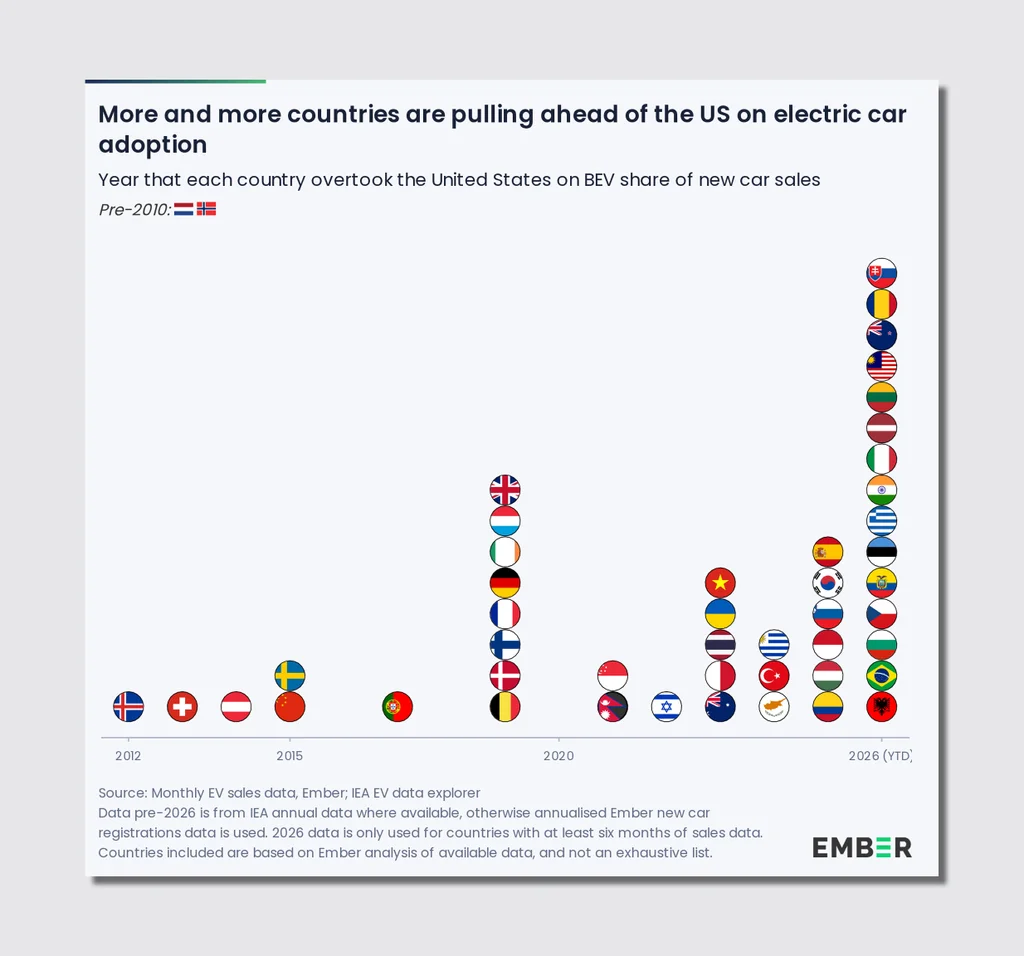
    Chart titled “More and more countries are pulling ahead of the US on electric car adoption” showing the year in which individual countries surpassed the United States in battery electric vehicle share of new car sales. Countries are grouped by year along a timeline from 2012 through 2026. Iceland and Norway had already surpassed the United States before 2010. Switzerland and Austria overtook the United States in 2013 and 2014, while Sweden and China did so in 2015 and Portugal in 2017. A larger wave followed around 2019, including Belgium, Denmark, Finland, France, Germany, Ireland, Luxembourg, and the United Kingdom. Additional countries overtook the United States in the early 2020s, including Israel, Nepal, Singapore, Australia, Thailand, Ukraine, Vietnam, Cyprus, Greece, Türkiye, Colombia, Hungary, Poland, Slovakia, South Korea, Spain, Ecuador, Estonia, the Czech Republic, Bulgaria, Brazil, Romania, New Zealand, Latvia, Lithuania, Italy, India, and others. The largest cluster appears in 2026, indicating that many countries recently surpassed the United States in electric vehicle adoption. The chart’s overall message is that the United States has been overtaken by an increasing number of countries in battery electric vehicle market share over time, particularly in the mid-2020s. Source: Ember, using monthly EV sales data and International Energy Agency EV data.
    [Image: Ember]

    The U.S. is being left behind

    There’s a notable outlier: New EV sales have fallen in the U.S. Over the first nine months of 2026, EV sales were down 30% compared with the same period last year.

    Several policy changes contributed to the decline. The Trump administration killed off the $7,500 tax credit for EVs. It also froze funding for EV charging infrastructure (a judge ruled that the freeze was illegal, though states have been slow to use the money). Tariffs made it more expensive to make EV batteries. The administration rolled back fuel efficiency standards. In response, automakers have canceled multiple EV models in the U.S., from the Ford F-150 Lightning to the Nissan Ariya. As gas prices rose this year, consumers had fewer options.

    EV sales in the U.S. rebounded slightly in the third quarter, and used EV sales are also growing. New lower-cost models like Slate’s minimalist electric truck and Ford’s upcoming $28,000 EV will likely help. Still, the U.S. is lagging behind the rest of the world.
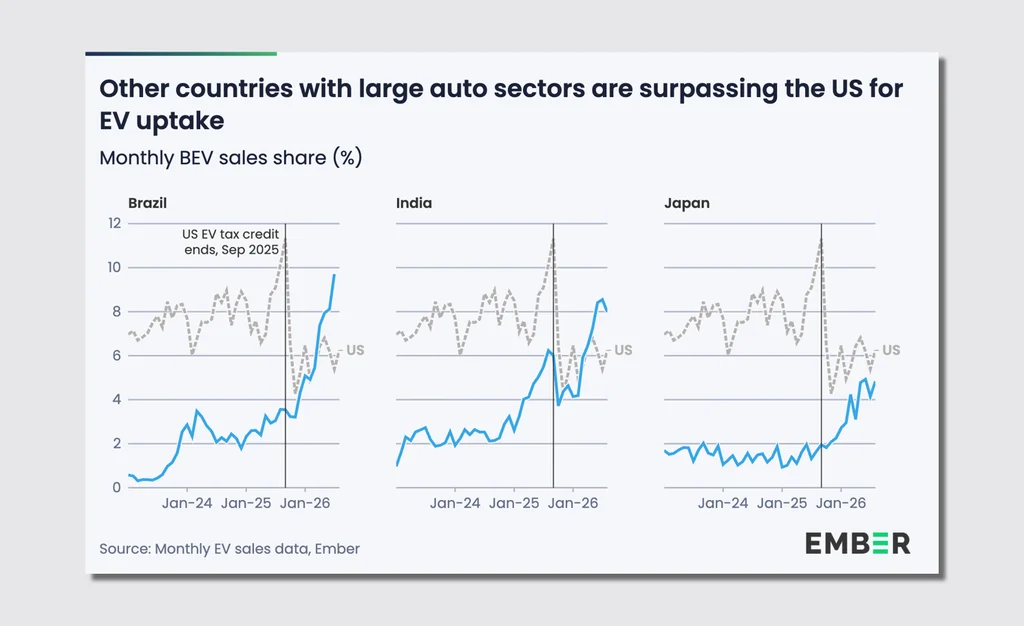
    Line charts titled “Other countries with large auto sectors are surpassing the US for EV uptake” comparing monthly battery electric vehicle sales share in Brazil, India, and Japan against the United States from 2023 through 2026. In each chart, a dashed gray line represents the United States and a blue line represents the country being highlighted. A vertical marker notes the end of the U.S. EV tax credit in September 2025. The U.S. line fluctuates around 6 to 10 percent EV share before dropping and then recovering to roughly 6 percent by 2026. Brazil’s EV share rises from near zero in 2023 to almost 10 percent by 2026, overtaking the United States. India’s EV share increases steadily from about 2 percent to more than 8 percent by 2026, also surpassing the United States. Japan’s EV share starts near 1 to 2 percent, then accelerates during 2026 to around 5 percent, approaching U.S. levels. The chart highlights rapid EV adoption growth in several large automotive markets, with Brazil and India moving ahead of the United States by 2026. Source: Ember monthly EV sales data.
    [Image: Ember]

    Ember tracks EV sales in every country where data is available. In 49 out of 56 countries, the market share of EVs has now outpaced the U.S. Fifteen countries, including India and Brazil, overtook the U.S. this year.
    China’s huge EV industry, which is now a major exporter, is benefiting. Domestic EV industries are growing in some other countries, including Vietnam and India. American auto manufacturers, meanwhile, have been forced to write down billions in losses because of their EV investments. Eventually, as the rest of the world keeps moving in a different direction, they may become obsolete. “I think the biggest impact is on the long-term competitiveness of U.S. auto manufacturers,” Graham says.

    The Ember report details how much countries with strong EV adoption have benefited during the Iran war. China, for example, has been able to displace $14 billion in crude oil imports because of its fleet of electric cars. (That’s not counting the additional benefit from the use of electric trucks, buses, and other vehicles.) Globally, the report estimates that oil-importing countries have been able to displace 200 million barrels of crude oil since the war started, worth around $20 billion.

    It’s not clear what will happen when the war ends and fuel prices stabilize. Graham expects the market share of EVs to continue to grow, but says that policy is still critical. “I think that the long-term impact of this supply crisis is really going to be defined by whether governments change how they plan for the future,” he says.


    Source link

    Share. Facebook Twitter Pinterest LinkedIn Tumblr Email

    Related Posts

    What to do when your employees are hiding their AI use

    October 14, 2026

    The Quiet Risk Growing Inside Your Service Business

    October 14, 2026

    Hate Your CPAP Machine? This Bootstrapped Company Has a Fix.

    October 14, 2026
    Top News
    Economy 4 Mins Read

    Virginia Permits ADULT MIGRANT MEN To Attend High School

    Economy 4 Mins Read

    Virginia is allowing 22-year-old grown men, illegal migrants who don’t speak English, to enroll in…

    Why your credit score might be slipping even if you’re doing everything right

    March 25, 2026

    Flash flood in Grand Canyon leaves 1 dead and several missing, National Park Service says

    August 31, 2026

    Will AI make language dubbing easy for film and TV?

    August 17, 2025
    Top Trending
    Business 4 Mins Read

    Here’s how much Trump’s Iran war is boosting EV sales around the world

    Business 4 Mins Read

    The Trump administration has done everything it can to slow the growth…

    World Politics 1 Min Read

    South Point’s Cayden Rumph Refuses to Sit Out a Single Play

    World Politics 1 Min Read

    South Point football standout Cayden Rumph has made it clear he wants…

    Business 5 Mins Read

    What to do when your employees are hiding their AI use

    Business 5 Mins Read

    I’ve been having a lot of conversations with industry leaders lately about…

    Categories
    • Business
    • Economy
    • Headline News
    • Top News
    • US Politics
    • World Politics
    About us

    The Populist Bulletin was founded with a fervent commitment to inform, inspire, empower and spark meaningful conversations about the economy, business, politics, government accountability, globalization, and the preservation of American cultural heritage.

    We are devoted to delivering straightforward, unfiltered, compelling, relatable stories that resonate with the majority of the American public, while boldly challenging false mainstream narratives that seem to only serve entrenched elitists, and foreign interests.

    Top Picks

    Here’s how much Trump’s Iran war is boosting EV sales around the world

    October 14, 2026

    South Point’s Cayden Rumph Refuses to Sit Out a Single Play

    October 14, 2026

    What to do when your employees are hiding their AI use

    October 14, 2026
    Categories
    • Business
    • Economy
    • Headline News
    • Top News
    • US Politics
    • World Politics
    Copyright © 2025 Populist Bulletin. All Rights Reserved.

    Type above and press Enter to search. Press Esc to cancel.