
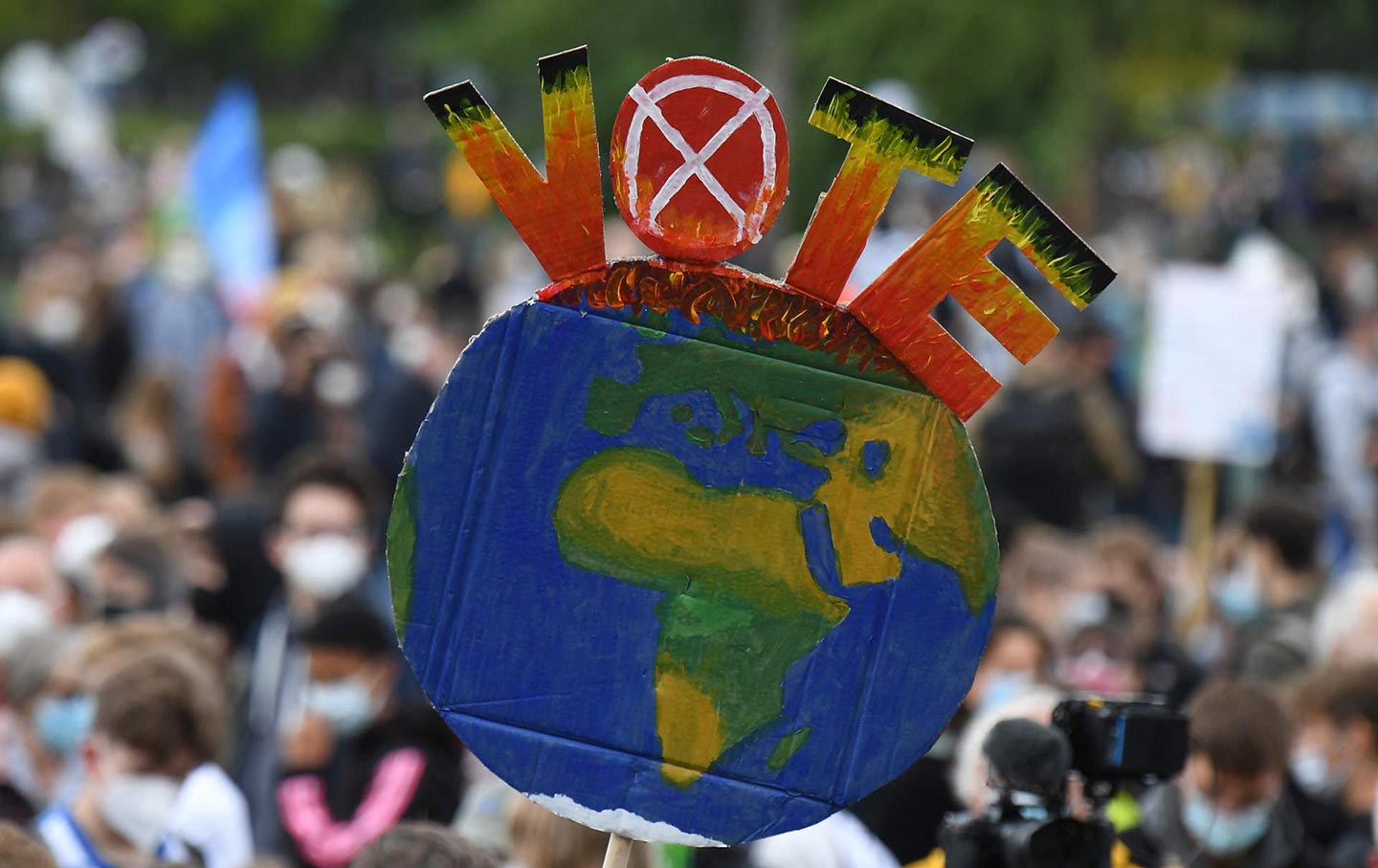
High cost of living and political turmoil are forcing climate change to the back burner, exposing a massive voter turnout problem for the environmental movement.
The cost of living, healthcare, and abortion were the top three issues for young voters in the 2024 election, according to a Tufts poll. Financial precarity and political instability are, in many ways, the defining features of young Americans’ futures. A record-high percentage of Americans say their finances are worsening; housing prices are 60 percent higher than in 2019, and credit card debt has risen 63 percent since 2021. It’s easy to see how a relatively post-materialist issue like climate change could get lost in this list of immediate concerns.
“There’s just an uncertainty that young people live with, and climate change is part of that, but it’s only one piece,” said Megan Mullen, faculty director of the UCLA Luskin Center for Innovation, which aims to advance effective and equitable solutions to pressing environmental challenges. “Climate doesn’t dominate students’ thinking, because there are so many other places of uncertainty for them.”
When survival in the present is already so exacting, thinking about what life may look like in a few decades becomes difficult, if not impossible. Inevitably and understandably, the climate has been placed on the back burner for many people. Though climate remains a concern for many Americans, this pattern indicates that those who care deeply about the climate aren’t considering it a top priority in their voting decisions—or even voting at all.
“It’s only when you narrow down to voters that the number of Americans who list climate as their top priority becomes so small,” said Nathaniel Stinnett, founder of the Environmental Voter Project. “Maybe the climate movement doesn’t have a persuasion problem as much as we have a turnout problem.”
Stinnett started the Environmental Voter Project to specifically address lagging electoral engagement. The nonprofit targets the millions of Americans who list the climate as one of their top issues yet don’t vote consistently in elections. In 2024, over 11 million people who identify as environmentalists did not vote in the presidential election.
For politicians, this is a sign that the climate doesn’t need to be prioritized, Stinnett said.
Current Issue

“Ultimately, nothing motivates a politician more than the prospect of winning or losing an election,” he said.
In nine years, the Environmental Voter Project has turned over 2 million of these Americans into consistent voters for presidential, midterm, state, and local elections.
But moving young Americans to vote, and vote specifically for the climate, can be a challenging task despite their high rates of eco-anxiety, an emergent mental health problem, according to UNICEF. A 2026 Gallup poll found that 66 percent of Americans think the environment’s quality is worsening, a near-record high. In addition, 71 percent of 18-to-29-year-olds said they think about the climate crisis at least once a week. Yet this hasn’t spurred them to go out and vote in large numbers for avowedly pro-environmental candidates.
The disconnect between worrying about the climate and the enormously resource-intensive lives most Americans lead compounds this issue, Mullen said.
“We can make modest changes to our lifestyle to try to reduce that imprint on climate, but we know that that’s not going to make a difference on the broader phenomenon,” she said. “So it’s hard to motivate, and we’re a little bit trapped. We’re already living our lives.”
Mullen added that in some ways, agency has been taken away from people. For example, artificial intelligence has proven environmentally ruinous. Yet, it has crept insidiously into search engines, apps, and websites. It can be difficult to discern how and where AI is being deployed, and even more challenging to opt out.
When individual actions don’t make a difference yet rates of eco-anxiety continue to rise, the cycle of climate inactivism and neglect continues. Unlike climate change denialism, those who are climate-inactive are aware of the severity of the problem, but feel impotent to address it.
Stinnett said he believes part of the problem is how climate solutions are framed.
When asked to name solutions to the climate crisis, unlike other pressing issues such as abortion, gun violence, and immigration, Americans are significantly more likely to name completely apolitical and individualized solutions, Stinnett said. The number one proposed solution was to reduce, reuse, and recycle, and the second was increasing general awareness, education, and lifestyle changes, according to a poll by the Environmental Voter Project.
“We’ve been taught to view the climate crisis as this collection of individual sins rather than viewing it as a systemic problem that requires political action,” Stinnett said. “And if that’s how you view it, of course you’re not going to think about politics as an outlet for change.”
Elena Halsenberg, a senior at UC Berkeley, agrees with Stinnett that certain climate discourse is responsible for inaction: “The media frames climate in a way that makes it almost seem like a doomed situation.”
Halsenberg, who is studying environmental politics, said the abundance of avenues to get involved with sustainability at Berkeley helps curb some anxiety for herself and other students. Berkeley activists, who engage in activities like lobbying and environmental bill tracking, view the climate crisis as something that can be solved and sustainability as the solution. However, Halsenberg said that those outside of these groups tend to be far less engaged. Indeed, because young people have been conditioned to believe they can’t change anything, an enormous pool of latent political power has been created, Stinnett added.
Popular
“swipe left below to view more authors”Swipe →
“If young people just started showing up, politicians would immediately start leading on climate,” Stinnett said. “Not out of the goodness of their hearts, but because they don’t want to lose elections. It is crucially important that whenever you vote, you hold politicians’ feet to the fire.”
This becomes especially critical at a moment that climate hushing—when political leaders deliberately sideline the climate—is becoming a prominent electoral strategy. Some Democrats have suggested that with the current political controversies surrounding the legitimacy of climate change, it may be more strategic not to mention the climate at all. According to Halsenberg, communication about environmental problems ought to be more consistent to combat the judging phenomenon.
To Mullen, the answer to tackling climate change at the systemic level lies in interest group action and community organizing. Particularly when voter turnout is low, bringing a group of voices together at any capacity becomes significantly more impactful, she said. Being visible in advocacy and creating a concentrated effort has seen success at the national, state, and local levels, with one of the most prominent examples being the Sunrise Movement. It was the activism around the Green New Deal that made the difference in ultimately producing the Inflation Reduction Act, Mullen said. She added that sometimes the most impactful thing to do is to mention the climate and voting in everyday conversations to make these issues part of everyone’s world.
“Young people have been taught to view the climate crisis as a suicide rather than a homicide,” Stinnett said. “They’ve been told that they must change what they buy and eat and drive in order to fix everything, when in reality, climate change is a systemic problem where politicians are letting companies get away with murder.”
More from The Nation
Hundreds of outlets across the country have joined the “I am the 89%” campaign.
A historically hot summer is revealing a society massively unprepared for the new climate reality.
“When people die during heat waves, there’s no sort of gunshot wound.”
The city’s primary winners campaigned on affordability, yet climate change, a major driver of rising costs and inequality, was conspicuously absent from the conversation.

From Indigenous practices to the Green New Deal, our country has always focused on prioritizing our planet.
In eastern Honduras, Indigenous guardians are risking their lives to protect the famous red parrot.