
The Cuban crisis is becoming far more dangerous than most people understand because this is no longer simply about Cuba. This is about the global war cycle accelerating exactly as the models projected years ago. Once great powers begin directly confronting each other in each other’s spheres of influence, history shows that events start moving very quickly and often spiral beyond anyone’s original intentions.
Now Russia is openly signaling support for Cuba while Washington escalates pressure on Havana yet again. Russian officials condemned what they called American “interference” and pledged support for Cuba as the United States tightened sanctions and moved toward possible legal action against Raúl Castro. At the same time, reports are surfacing about Russian oil shipments to Cuba, drone concerns near Guantanamo Bay, and fears inside Washington that Cuba could once again become a strategic outpost for Russia and potentially China right off the coast of the United States.
The Cuban Missile Crisis in 1962 nearly pushed the world into nuclear war because Moscow and Washington were testing each other’s limits. Today we are entering another period where major powers are increasingly operating aggressively near each other’s strategic boundaries. NATO expanded toward Russia’s borders for decades while Washington pretended Moscow would simply tolerate it forever. Now Russia is beginning to answer in kind closer to America’s sphere of influence.
The War Cycle has been warning that 2026 to 2027 would become increasingly unstable geopolitically. Europe is already moving toward economic depression conditions. NATO is fragmenting internally. Sovereign debt levels are becoming unsustainable globally. Civil unrest is rising across the West. Historically, governments facing economic decline often externalize internal tensions through geopolitical confrontation because it temporarily unifies populations against an outside enemy.
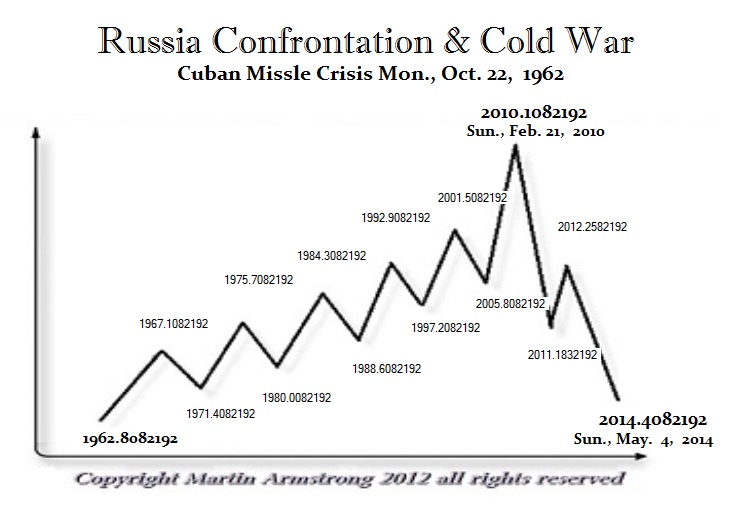
Look at the pattern forming simultaneously. The Middle East is unstable. China and Taiwan tensions continue building. NATO is openly discussing deeper military integration with Ukraine. Europe is rearming at the fastest pace in generations. North Korea is directly involved in the Ukraine conflict. Iran and Russia are growing closer militarily. Now Cuba is again becoming a flashpoint between Moscow and Washington. These are converging war-cycle events.
Cuba itself is already suffering severe blackouts, fuel shortages, and economic collapse conditions after disruptions to Venezuelan oil shipments and increasing pressure from Washington. Yet instead of stabilizing the region diplomatically, both sides are escalating rhetoric. Russian officials are openly accusing the United States of reviving the Monroe Doctrine while Washington increasingly portrays Cuba as a direct security threat once again.
What is astonishing is how few world leaders appear interested in de-escalation anymore. Europe’s leadership behaves almost fanatically committed to confrontation with Russia regardless of the economic consequences. Washington increasingly views every geopolitical challenge through military lenses. Moscow is now openly expanding strategic relationships in America’s own hemisphere. China watches all of this carefully while preparing for its own long-term confrontation with the West.
The danger into 2027 is not necessarily one single giant war erupting overnight. The danger is multiple regional crises merging together into one broader geopolitical confrontation where eventually every alliance structure becomes activated simultaneously. That is how world wars historically emerge. Not from one event, but from chains of escalation connecting previously separate conflicts together.