
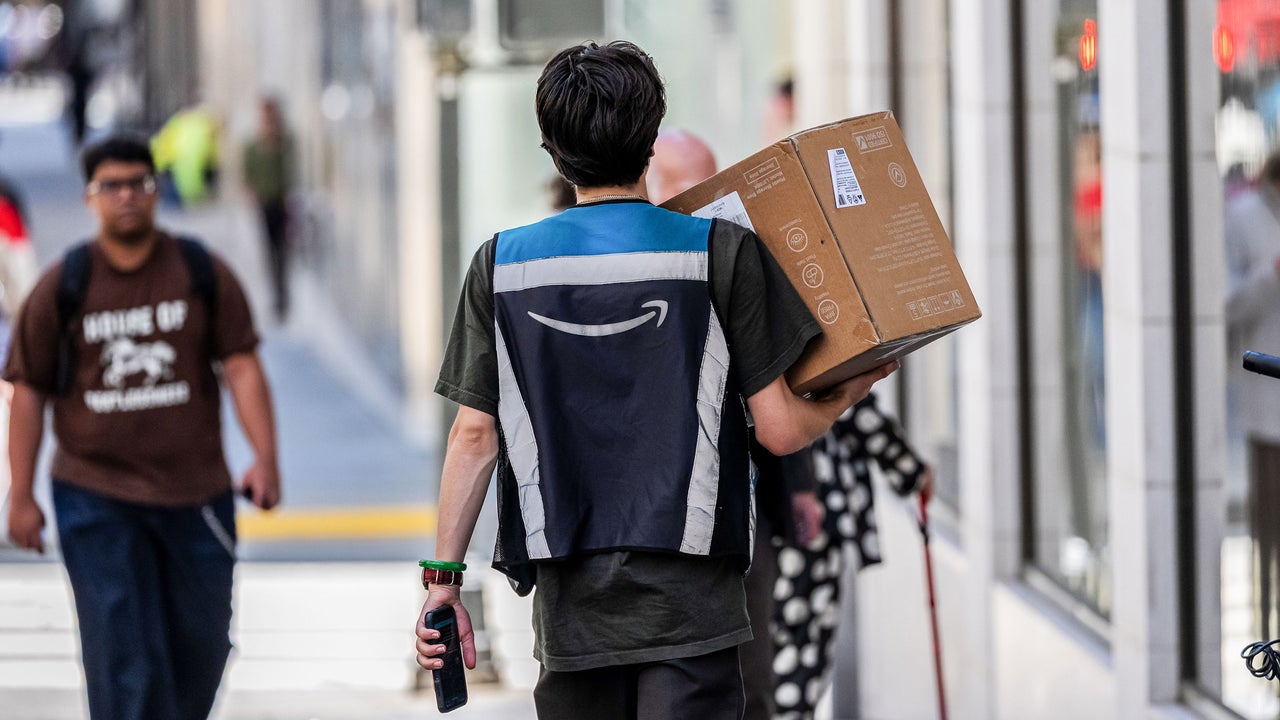
Every workday, Luc Rene puts on a shirt and pants branded with Amazon’s logo and heads to a distribution center, where he climbs into a van that also carries Amazon’s logo across its side to deliver packages with the company’s swoosh smile emblazoned on them. When he rings customers’ doorbells, he yells out, “Amazon.”
But Rene is not technically an Amazon employee. He’s employed by a delivery service provider (DSP) that contracts out his labor.
That could soon change in New York City, where Rene lives and works, if the City Council passes the Delivery Protection Act. The bill would require companies like Amazon to directly employ the people who deliver their packages while also creating a licensing system that would hold the companies to new safety, training, and labor standards. It has the backing of Mayor Zohran Mamdani and 31 of the council’s 51 members—enough for it to pass if brought to a vote. Supporters of the bill say it would increase street safety while also providing better protection for the workers who deliver Amazon packages.
Amazon has lobbied heavily against the bill. “We’re committed to creating good jobs and supporting our thousands of employees in New York City. We’re equally committed to the local small-business partners who work with us every day to provide fast, reliable delivery for New Yorkers,” Amazon spokesperson Steve Kelly tells Fast Company. “But as written, this legislation would directly undermine that commitment—threatening the small businesses that deliver to customers, putting the jobs of more than 5,000 of their employees at risk, and forcing us to consider relocating delivery operations outside of the city.”
Safety on the job has been an issue for Rene ever since he started delivering Amazon packages in 2022. After completing a training on a computer, he was supposed to spend a day being trained by an experienced driver; the driver never showed up, so Rene drove by himself. Since he was never told how to avoid injury during his shifts, which stretch 10 or more hours, he’s come up with his own regimen, stretching before and after work.
“No driver is ever required to complete a delivery if conditions aren’t safe—and neither they nor their DSP is penalized for making that call,” Amazon’s Kelly says. “Any allegation of unsafe working conditions would be taken seriously and we investigate accordingly.”
In 2023, Rene slipped and injured his knees while delivering a package. Unsure whether he could access Amazon’s medical services, he called his employer, which asked only whether he could keep working. He did, despite the pain, taking painkillers to get through it. “If I can’t show up to work due to the pain, I won’t get paid,” he says.
His experience appears to be common: A 2025 report from the New York City comptroller’s office found that last-mile facilities like the DSP that employs Rene reported an average of 678 injuries per year from 2022 to 2024, and 85% of them were severe enough to keep people from working or to need a reassignment. Amazon’s DSP program had the highest injury rates.
In response to a request for comment, a spokesperson for the New York Delivers coalition, which represents DSPs and is bankrolled by $5 million in money from Amazon, says DSPs “provide flexible, good-paying jobs with strong workplace standards, opportunities for career advancement, and competitive benefits,” adding that the Delivery Protection Act “effectively eliminates the small businesses in the industry, and puts over 10,000 New York City jobs at risk.” Amazon also paid to bus in workers and DSP owners to oppose the bill in a city council hearing earlier this year.
“On paper, Amazon’s not my employer”
When Rene started driving, all he and his fellow drivers were given to haul packages, some of which weigh more than 40 pounds, were giant plastic bins called totes. He says it took a strike in 2024 and a march on their boss to get hand trucks. The effort of dragging totes across the ground left Rene with back pain that lingers today.
There are other health and safety issues. In the summer, the heat is “really painful,” he says. But two years ago, Amazon instituted a change that means when he exits his van, the air-conditioning shuts off, leaving the van to bake while he makes his deliveries. The DSP has no control over that, he says, nor over how many packages he’s expected to deliver in such conditions.
In fact, Amazon directly controls much of Rene’s workday. When he shows up to the DSP, he has to hope Amazon provided enough routes for him to actually work that day; otherwise, he gets sent home. He must be in full company uniform before even leaving the dispatch center to get in his van. Once he arrives at the van, he has to go through an inspection checklist created by Amazon before he can drive the vehicle. If a defect is found, it’s Amazon that decides to ground the van, and the DSP has no power to override the decision, Rene says.
Further, Rene says Amazon dictates how much time he gets to load up the van before facing a penalty. Kelly denies that Amazon controls workers’ schedules, saying, however, that it does “assign dispatch windows.”
Cameras inside the delivery van watch Rene’s every move during his shift—and it’s Amazon, not the DSP, that watches the feed. (Kelly asserts that the cameras are only for safety and not for productivity or performance tracking, although many reports have disputed that.) If Rene presses the accelerator or hits the breaks too hard, Amazon gives him an infraction. If he gets into an accident while driving a delivery van and calls the DSP, he’ll be forwarded to an Amazon representative.
“On paper, Amazon’s not my employer, but in reality, Amazon is,” he says.
For all of this, Rene makes $25 an hour—a figure he arrived at only after a recent 25-cent raise that was implemented by Amazon. If the Delivery Protection Act passes, it “would change everything, honestly,” Rene says. Although he’s a member of the International Brotherhood of Teamsters union, the act would allow him and his fellow delivery drivers not only to unionize but also to negotiate directly with Amazon.
Then they can demand better training, higher pay, health insurance (especially critical for workers injured on the job), more control over their schedules, and a guaranteed 40-hour workweek. “All those little things to make the job feel, not easy, but basically like I can show up to work today and I know I’m safe,” he says. “Make it feel like I have something reliable, something people can actually live on.”