
At last, after seven months of public beta testing, Turntable is available today in the latest release of Adobe Illustrator. Presented at the 2024 edition of the Adobe Max conference as a sneak preview, the tool uses generative AI to transform any 2D vector illustration into a 3D object that you can turn around its vertical axis, as if it were on a clay modeling turntable. When it came out, its magicks left every Illustrator user cheering.
If you have ever used Illustrator to craft a vector illustration—from a logo design to an animation character—it’s understandable why people were so excited. “The idea for Turntable originated from a consistent theme we heard directly from customers around the time and effort required to manually redraw characters and illustrations from multiple angles, often taking hours,” says Deepa Subramaniam, Adobe’s Vice President of Product Marketing for Creative Professionals. It’s a perfect use case of generative AI actually helping human creators to save an incredible amount of time without sacrificing their artistic vision.
To understand Turntable’s wow factor, you need to understand why it is so hard to modify a 2D illustration. Drawing something complex with a stylus and a tablet using Photoshop requires very little time. It is as easy as drawing it with pencils and a notepad. But with Photoshop you can’t zoom in or out of a drawing infinitely without seeing pixels and jagged curves. With Illustrator, you can zoom-in infinitely, and it will always look perfectly smooth, but that benefit comes at a very high time cost.
Unlike raster hand drawing, it’s very hard to create an image using mathematical lines and fills, requiring you to endlessly pull from little handles that shape curves add or subtract basic geometry like rectangles and ovals into a new, more complex shape. Doing that again and again, to change the perspective of a faux 3D object, or to create 40 different versions of a 2D character from different angles, is truly maddening.
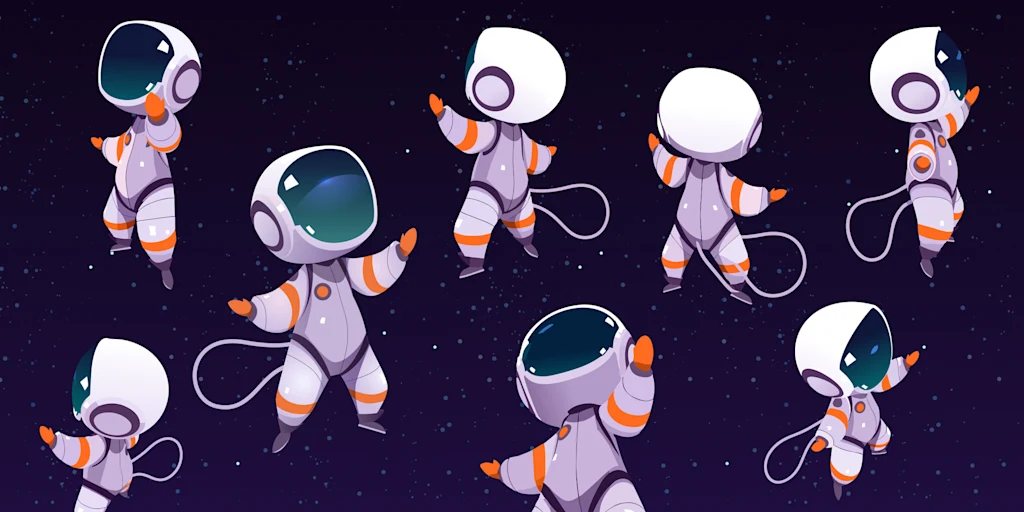
That is precisely why people love Turntable, a generative AI technology that runs in Adobe’s Creative Cloud to interpret what your mess of lines and shapes is—let’s say, an astronaut—and rotate it around 360 degrees to show its sides or back without you ever having to redraw the entire thing, all while keeping its infinitely-zoomable vector nature.
Vital time saver
When you feed a flat vector into this engine, it does not just blindly stretch the image. It perceives your mathematical anchors and curves like a constellation of stars mapped on a cosmic grid, intelligently recalculating the coordinates to reveal the hidden sides of the universe you built. The sheer shock of seeing an algorithm correctly guess the unseen geometry of a flat drawing stunned the industry.
As the editorial team at CreativePro Network noted when it came out, the collective reaction “was a fascinating mix of pure shock, genuine excitement, and a healthy dose of professional skepticism.” Unlike the messy chaos of prompt-driven image generators that vomit random pixels, this utility has a laser-focused mandate.
This singular focus turns a grueling marathon into a sprint, establishing Turntable as a brutal weapon against tight production deadlines. “Animation teams can quickly create character turnarounds for pitch decks, game designers can generate 360-degree assets for concept art and social media teams can create GIFs and micro-animations in seconds, all within Illustrator,” Subramaniam tells me.
The Adobe ecosystem integration makes the workflow even more powerful, directly linking your rotating vector assets to animation pipelines. As Subramaniam tells me, “with seamless handoff to tools like After Effects, teams can move from design to motion without breaking their flow.” This means a character spun around in Illustrator can be instantly dropped into a motion graphics sequence.
It processes the heavy lifting entirely in Adobe’s cloud, pulling from the monthly generative credits bundled into paid Creative Cloud subscriptions at a cost of 20 credits per generation. But while this all sounds like a bulletproof technological leap, the initial reality was much rockier, and early adopters quickly hit a wall of workflow-breaking limitations and strict structural demands during the public beta.
Is Adobe Turntable ready for prime time?
As it usually happens, after the Adobe Max stunning demos ended, the tool showed limitations in real-world beta testing. It initially demanded absolute perfection from the human operator. To prevent the algorithm from violently ripping the geometry apart during a rotation, users had to meticulously bind their layers together using Illustrator’s grouping functions. It was the digital equivalent of lashing pieces of a ship together to survive a hurricane; if your anchor points were loose, the AI would scatter them into chaos.
When it became available, Redditor LukeChoice warned early testers that they needed to be “adhering to established best practices to achieve optimal outcomes.” Even if the artwork survived the spin, getting the results out of the software was a chore. Early testers ran into severe export friction, requiring convoluted workarounds just to save individual frames as usable standalone files.
Subramaniam claims that they worked out these problems, which is why the tool left the beta testing phase now. According to the Adobe Community Release Notes, you “no longer need to group objects” before applying the effect. Furthermore, the development team shattered the artificial boundaries that previously capped rotations between -120 and +120 degrees. Now, the math pushes the vectors through a full 360-degree orbit in crisp 15-degree steps, as noted by contributors on the Illustrator subreddit.
The excruciating export roadblocks were fixed too. Users can now deploy a single command to instantly dump every generated angle directly onto the canvas, forming immediate character reference sheets. Adobe also injected native GIF exporting straight into Illustrator’s Contextual Taskbar.
These kinds of utilities represent a massive evolutionary leap for commercial artists, functioning as a hyper-efficient co-pilot that vaporizes hours of tedious labor. It is adequately fast too, as it runs on Adobe’s servers. By the way, each Turntable run will cost 20 AI-processing credits. When you run out of credits in your Adobe Creative Cloud subscription, that will cost you roughly $1.00 (via a $4.99 tier yielding 100 credits) down to just $0.10 (via a $9.99 tier providing 2,000 credits). Peanuts, considering the hours and days of work this tool may save you.
Yet, for all these advantages, the underlying trajectory of this technology points toward a chilling final destination. In Spain we have a saying: “Bread for today, hunger for tomorrow.” I have no doubt that generative AI will inevitably render Turntable, and Adobe Illustrator itself, completely obsolete. And you can do your own math when it comes to consequences to the human illustrators.
In the not-so-distant future, the act of visual creation will not require mapping mathematical vectors or coaxing an algorithm to rotate an astronaut. You will simply command a machine to manifest any concept, in any conceivable style, from any angle, with absolute precision and infinite resolution—bypassing the ability of the human hand or any human knowhow entirely.
This existential reality is exactly why some creatives fundamentally reject this tool, no matter how much time it will save them today. That’s not the time that matters to them; it’s the little time they have left as creators after so much time spent becoming expert illustrators and designers.