
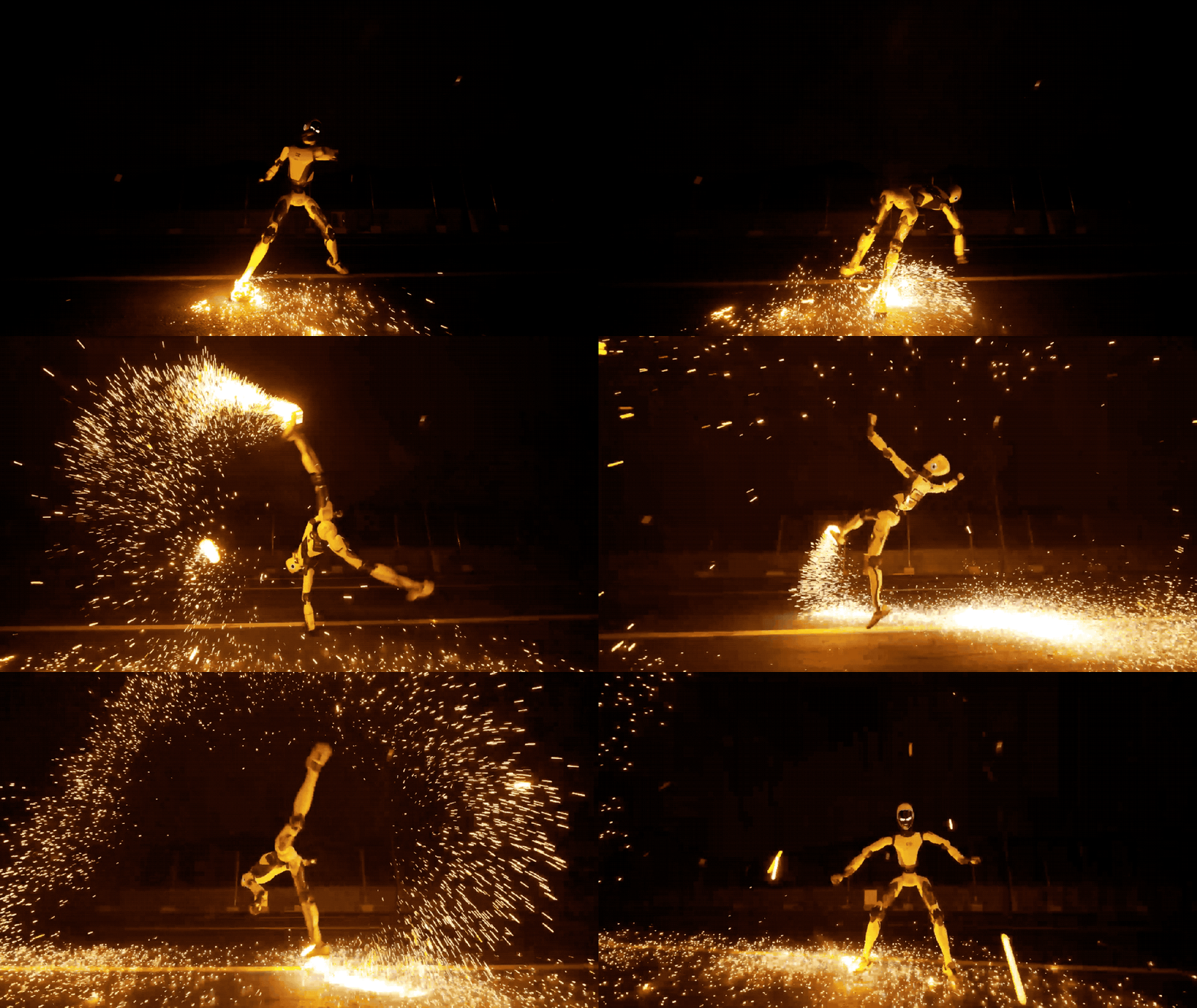
A hooded man with a knife walks toward a woman sitting in her backyard. Before he reaches her, a humanoid robot steps between them and squares up. That’s the money shot in the one-minute video Unitree released on October 21 to introduce the H2-X, aka “Kung Fu Legend Guardian.”
It’s a machine that, in the company’s words, offers “powerful performance to serve and guard you.” It’s a robot that a lot of people will want at home: the T-800 to their John Connor. If the robot actually exists as the Chinese robot maker imagines it, this will be a mess.
A combat-trained, metal-smashing, bone-breaking robot drags one of the nastiest unsolved problems of battlefield AI straight into the living room. Can autonomous robots really tell friend from foe? Short answer: No. Not yet. And perhaps it will never happen, the same way humans can’t always tell.
The video, which Unitree swears was shot for real and not sped up, opens in a junkyard at night. The robot springs up on top of a parked sedan, somersaults off it, kicks and knees a door until it buckles, and lands a flying kick on the hood. Then it drops from a platform marked as 13 feet high, rolls to soak up the impact, and stands back up into a string of side kicks and backflips.
The second half is where the “guardian” part comes in: the man with the knife. After the knife scene, the H2-X holds up the front of a car while someone pulls a dummy out from underneath, and shoves a child mannequin clear of an oncoming car, taking the hit itself.
It’s a wonderful idea! Like having your very own superhero guarding the well-being of your loved ones. And serving you tea and cookies. But there are some questions to answer before one of these lands in your house.
Unitree hasn’t said who, or what, was in control of the robot during the shoot. The company didn’t confirm to the South China Morning Post whether the robot acted autonomously, so it could have been running its own AI, been steered by a human operator with a remote, or been following a rehearsed script.
But it’s worth noting that Unitree does have the software chops for autonomous fighting moves. In September, it showed its smaller G1 robot sparring against a trainer with no remote control, driven by an AI model the company calls UnifoLM-X2-1.0. (Unitree hasn’t said whether the H2-X uses the same model.)
Bad guy/good guy
But what Unitree—or anyone else at this point—doesn’t have is the AI mind to evaluate who might want to harm you and who might be approaching you just to ask for directions.
In the video, the bad guy is impossible to miss: hood up, knife out. Real life doesn’t come with costumes. A robot bodyguard has to decide that the person walking quickly toward its owner is a threat and not a neighbor running late, a delivery driver, or just a typical teenager in a hoodie.
What will it look at to make that call? Clothing? Body language? Skin color? Every other kind of profiling we already worry about with facial recognition cameras?
Then it has to pick the moment to step in and dose its strength so it doesn’t snap somebody’s arm. And if it does break someone’s arm—or any other body part—who pays? The owner? Unitree? Whoever wrote the code? That’s a lot of unanswered questions (Unitree hasn’t responded to a request for comment).
Having to guess who is an innocent bystander or an aggressor is exactly the problem that haunts AI weapons on the battlefield. That’s why the U.N., Red Cross, and other nonproliferation organizations are asking for hard limits on autonomous weapons with target-and-kill capabilities.
When I interviewed Neil Davison, a scientific and policy adviser at the International Committee of the Red Cross, for a 2022 documentary on military AI, he singled out autonomous weapons designed to target people as the most troubling kind. “If a human target can change at any given moment, that requires context-specific human judgment,” he told me.
A city street may be even harder to navigate than a battlefield: crowded, ambiguous, and full of people with every right to be there. Now drop in a kung fu-trained robot that can crush metal with its bare hands and is programmed to Neo the hell out of any incoming human.
Maybe that’s why the company, after pitching it as a way to defend yourself, basically asks future customers to be very careful with this robot. “Please use the robot safely and in a friendly manner,” Unitree wrote when it posted the video. The clip itself closes with a screen of warnings: these are “extreme testing,” so no imitation; don’t modify the robot or use it in dangerous ways; and keep at least 2 to 3 meters (about 7 to 10 feet) away from it. Features vary by model and version, it adds, and the humanoid field is still at an early, exploratory stage.
Perhaps that statement—plus the troublesome racial and class profiling that a system like this would likely have—is enough reason not to do this in the first place.