

A few meters below the former site of Seville’s 1992 World Expo, a promising climate experiment blending ancient technology and modern science is underway.
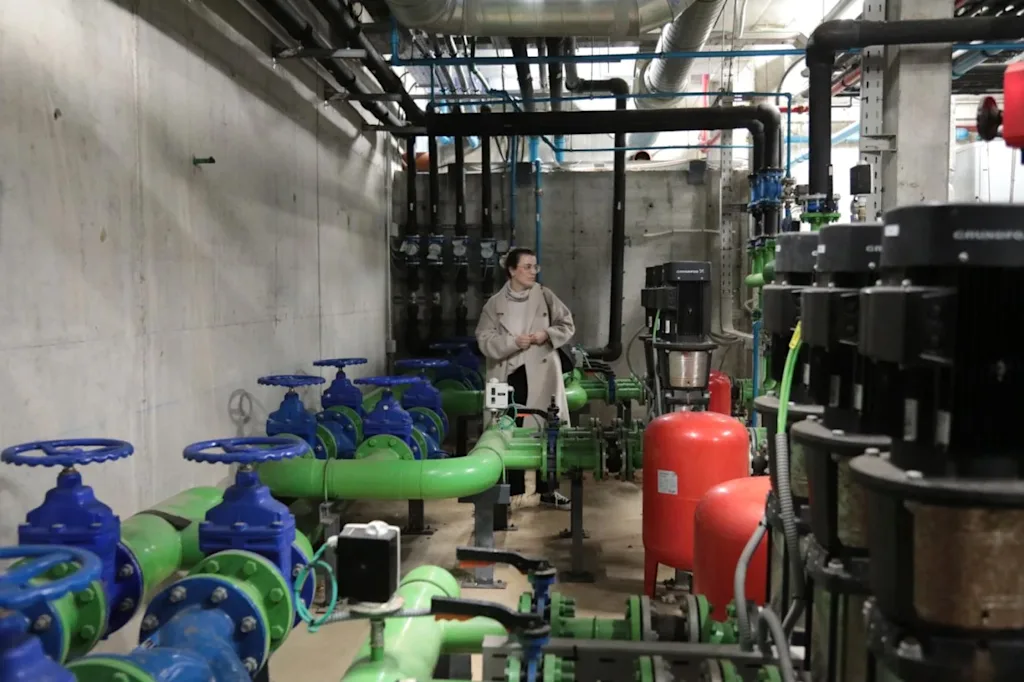
Rows of black pipes run along the ceiling and down the bare concrete walls. These, in turn, connect to bright blue and green tubes and enormous silver pumps. In a control room to the side, an array of monitors display the heat, humidity and wind speed above.
“We have deployed several types of cooling systems here, each one used depending on climatic conditions,” says Maria de la Paz Montero Gutiérrez, a researcher at the University of Seville, from down in the building’s bowels where she is helping supervise the project.
In 2020, authorities began to install these cooling systems in two public spaces in the Isla de La Cartuja neighborhood of what is one of Europe’s hottest cities. Every day about 30,000 people come to work and study in this northwestern district, which is mostly non-residential and home to university campuses, museums, and businesses.
Under the EU-funded project CartujaQanat, the so-called “qanats”—networks of underground aqueducts—were constructed in a newly-built 750-square meter site known as the Agora, which is large enough to fit about 400 people, as well as in a renovated amphitheater from the ‘90s that has a capacity of about 200 people.
The system, created millennia ago but updated for the 21st century, works by cooling water underground in the naturally low temperatures at night. To cool water more quickly, some is also sent to the roof via solar-powered pumps and sprayed out of nozzles in a thin layer through a method known as a “falling film,” before draining back down underground.
By day, as outdoor temperatures peak, the cool water is sent above ground into the ceiling to counteract the heat. Water is also funneled into subterranean pipes that cool air (up to 36,000 square meters an hour), which is then released via ducts in the public spaces. Outside, mist is sprayed in order to lower temperatures through evaporation.
“We have half re-invented the qanats, taking from their engineering ingenuity,” says head of the multi-stakeholder project, Lucas Perea Gil, whose team began operating the cooling system in 2022, running seasonally from March to October every year.
The original qanats, according to Nilou Vakil, an associate professor of architecture at the University of Kansas, date back 3,000 years to ancient Persia, or modern day Iran. The same system has been used in many regions across the Islamic world, from Balochistan to Jordan.
Historically, she says, they were used in arid areas to transport water from underground sources to irrigate crops and feed animals, but also for cooling homes.
“That’s how they were able to create civilization in places you couldn’t have humans living in before,” explains Vakil, who has researched the history of the qanats. “They allowed people to live with heat before the arrival of electricity.”
The project also represents something of a revival of past local practices. Similar water management technologies were deployed by the Moors across Andalusia, including at Granada’s Alhambra, several hundred years ago.
Seville’s low-emission solution is an encouraging response to the rising threat of extreme urban heat in Spain’s fourth largest city, home to 1.5 million people. Last year, Seville broke a record after recording 30 days above 40C (104F)—compared with an average of 12.8 days a year over the previous decade.
The city gets so hot these days it’s earned the unenviable nickname of the “Frying Pan of Spain.” And scientists project that due to manmade climate change, by 2050, Seville is likely to hit summer peaks of 50C (122F) while suffering an average 20% decline in rainfall.
That extreme heat, an increasing reality for cities around the world, is already causing serious harm to the population. The Carlos III Health Institute estimated that about 1,180 people died because of high temperatures during a heatwave in Spain between May and July last year. Meanwhile, researchers have calculated that more than 11,000 people died due to extreme heat in Spain during summer 2022.
“It’s a really serious health issue,” says Anna Beswick, a policy fellow at the London School of Economics working on climate adaptation and resilience. “Global average temperatures are rising, and so are extreme temperatures. Cities have specific vulnerabilities since they hold and retain heat more than other areas.”
City authorities are urgently trying to find solutions to beat the heat, especially ones that aren’t energy intensive like air-con, which can be costly and counterintuitive for climate goals. In Los Angeles, for example, the use of heat-reflective white paint on the streets has been effective in cutting temperatures. In Rotterdam, green roofs are helping to mitigate the urban heat island effect and to keep air clean. Others such as Freetown, Sierra Leone’s capital city, have gone as far as to hire Chief Heat Officers.
“There’s a lack of visibility over heat, it’s a silent killer, which is why governance on this is so important,” says Beswick, who last year published a report about low-cost, low-carbon cooling systems.
Seville has historically adapted to heat through its narrow streets and shaded courtyards and more recently by becoming the first city in the world to name and categorize heatwaves. Now, it’s showing impressive impact with the updated qanats—as well as other cooling techniques that are part of the project, including deploying heat-reflective paint, wind and sun blockers, and vegetation on interior walls.
Research by the University of Seville, shared with Next City, found the project led to indoor temperatures being as much as 12 degrees Celsius lower than outdoors in the summer of 2025.
At the same time, the project, which received 80% of its €5 million budget from the European Union’s Urban Innovative Actions office, requires zero energy. During the summer of 2025, CartujaQanat’s 380-square-meter rooftop solar panels produced 55,000 kWh, while running the machinery such as pumps consumed 42,000 kWh.
“It demonstrates that ancient tech can hold a very important point in our current environment,” says Vakil. “Cooling is one of the biggest issues that we are going to face in the future. Seville’s project serves as a scalable prototype.”
They’ve already learned important lessons for future iterations, such as the fact that they only needed three of the nine water pumps they purchased. “We thought we needed more,” says Gil. “But we didn’t. We learned from that. So, in the future, this model can be cheaper.”
CartujaQanat’s success has led to delegations from California, Germany and Dubai, among others, to visit the site to draw inspiration and take notes. But it won’t work in all cities. As Vakil points out, the qanat system is unlikely to be effective in humid climates since it relies on evaporation.
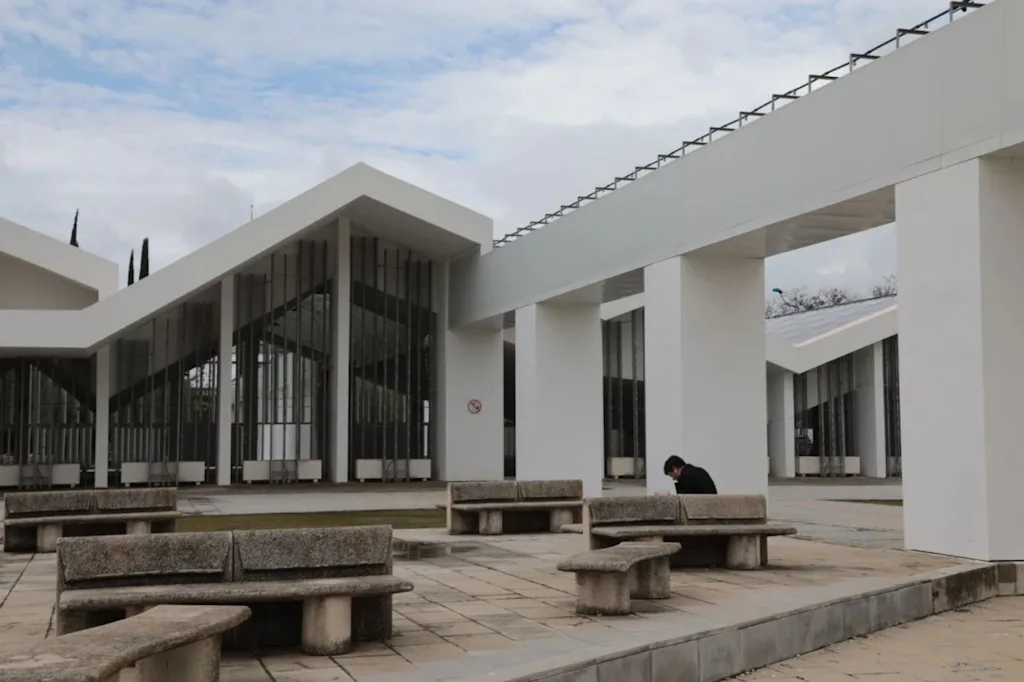
The project is also helping to revitalize the Isla de la Cartuja neighborhood, which despite its proximity to the city center, is a largely underused area. Local workers come to relax in the Agora during lunch breaks, teenagers use it to skateboard, and there are regular classes for all kinds of dance: hip hop, flamenco, swing and tango.
According to Gil, the reclaiming of space for the public is a significant motivation, particularly as extreme heat could force people to hide in their homes—at the loss of socializing.
It also shows how cities can re-develop large and unused public spaces. “We wanted to create a comfortable space that people don’t have to pay for,” he says.
Charo Sollero, who since last year has been running tango classes for groups of up to 60 people, is one of the beneficiaries. “It’s an open space that’s not too hot, it’s perfect for us,” she says. “We get together to eat and drink and then dance for hours and hours.”
While the floor is not made of wood, the material traditionally used for tango dancing, the space is a much cooler option than the hotel they previously met up. “It’s clear the temperatures are getting hotter in Seville every year,” adds Sollero.
And the city is wasting no time in rolling out this low-emission cooling model to other locations. Next year it will inaugurate the systems at a bus stop, square and school in the city’s Macarena neighborhood. In time, it will expand further.
“We believe that they can help us live with the heat that is coming,” says Gil.
This story was originally published by Next City, a nonprofit news outlet covering solutions for equitable cities. Sign up for Next City’s newsletter for their latest articles and events.