

Technology Reporter

 Energesman
Most people are inclined to shoo flies away from food, and the thought of maggots in your bins is enough to make anyone’s stomach turn.
But a handful of city councils have embraced maggots – more formally known as fly larvae – and their taste for rotting food.
In Vilnius, capital of the Baltic state of Lithuania, fly larvae have officially been given the job of processing the 2,700 tonnes of food waste the city’s 607,000 residents put out for collection each year, alongside that of the six neighbouring councils.
Energesman, the waste management company that began relieving Vilnius of its food waste earlier this year, doesn’t actually charge the city for this service.
That is saving the city up to €2m (£1.7m; $2.3m) per year, based on a target of processing 12,000 tonnes in 2026 says the company’s chief executive, Algirda Blazgys.
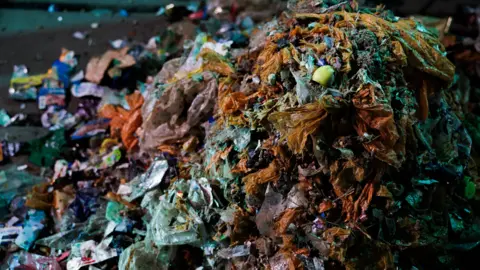
Energesman has rolled out new orange food waste bags to residents, alongside an influencer marketing campaign to encourage more Vilniečiai to separate their food waste, as the 2,700 tonnes collected is only a fraction of the 40,000 tonnes of household waste the city is thought to generate.
Last year it become mandatory for councils to collect food waste, so the city needs to find ways to deal with it.
Energesman, meanwhile, has plans to turn the fattened fly larvae into a new income stream.
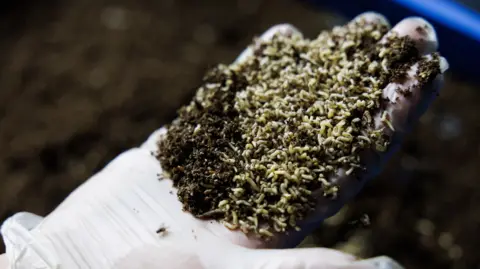
It houses around six million flies in a special zone within its Vilnius plant, who mate around every six hours, according to CEO Algirdas Blazgys.
A female fly can lay around 500 eggs in her average 21-day lifespan, so Mr Blazgys and his team are dealing with more than three million larvae a month, who can consume more than 11 tonnes of food waste in the first, hungriest days of their lives.
 Energesman
It’s the huge appetites of these tiny creatures that make them such excellent candidates for food waste processing. This study shows a swarm of them demolishing a 16 inch pizza in just two hours.
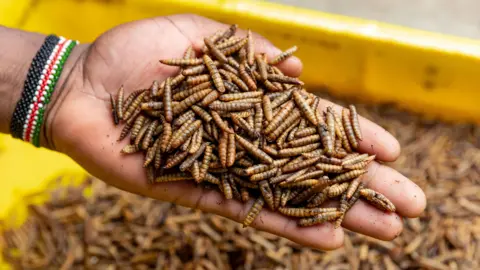
The trick is to cull them before they transform into mature flies. That way the protein rich fly larvae can be converted into protein products for use in animal feed or industrial use, for example as an ingredient in paint, glue, lamp shades and furniture covers.
Also, their manure, known as frass, can be used as fertiliser.
Energesman has already set up supply trials with partners in the paint, glue and furniture industries, but Mr Blazgys acknowledges it’s proving more complicated than he anticipated.
The sample paint produced using Energesman-reared fly larvae didn’t quite come out in the right colour, but the lamp shades created look promising.
He also has university partnerships in place to supply fly larvae for research purposes and for feeding bacteria. And of course, the larvae are in demand from the local fishing industry to use as bait.
But EU health and safety regulations mean fly larvae fed with kitchen waste can’t be used in edible insect products for human consumption, as there could be cross contamination from meat and fish scraps.
“We came up with some crazy ideas, then we started looking for other people that could also come with some crazy ideas about what we could do,” says Mr Blazgys.
“As it’s still very new, some people are still looking to see if we’re going to fail, so they don’t want to brag about it yet. But I think we’re going to come up with something good.”
While there are numerous cases around the world of fly larvae being used in food waste management, and being harvested as a protein ingredient, it’s largely on a commercial basis, for example, a private contract between a hotel or apartment building owner and a fly larvae rearer.
In Kenya, Project Mila is a social enterprise using fly larvae to tackle Mombasa’s mounting food waste problem, while also supplying frass as fertiliser to local farmers.
Yet there are just a handful of city councils that have adopted this way of processing food waste.
Goterra in Australia has used fly larvae to help Sydney get through its food waste, as part of a limited trial which began this year.
For the past three years, Goterra has also been working with three townships that are part of the neighbouring Queanbeyan-Palerang Regional Council, recycling around 10 tonnes of food waste.
 Flybox
Whether we will see UK councils start shipping in millions of flies, so their larvae can munch through the 6.4 million tonnes of household food waste produced here yearly, is only a matter of time.
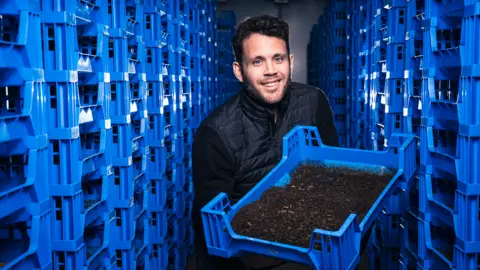
That’s the optimistic view of Larry Kotch. He’s the CEO and co-founder of insect waste management company Flybox, which he says builds more insect waste processing sites than any other company in the UK, which then work largely with private food manufacturers and supermarkets.
Flybox is also a founding member of the Insect Bioconversion Association, an industry body representing companies in the space.
UK councils are interested, Mr Kotch believes, especially because weekly household food waste collections will become mandatory in England from March 2026.
Around 148 of England’s 317 local authorities still don’t offer this, according to the Local Authority Recycling Advisory Committee.
 Flybox
But regulations set by the Department for Environment, Food and Rural Affairs (DEFRA) are currently barring councils from using fly larvae to process food waste.
If regulation could move in line with science, Mr Kotch argues that “the UK could see its first council-contracted insect plant within two years”.
“Unfortunately, with government it’s always safer to say no… Everyone we’ve spoken to in UK councils are very excited about insect protein and would much rather work with insect farms than alternative technologies.”
DEFRA confirmed to the BBC that the Animal By-Product Regulations restrict insects from being used to process organic waste streams.
It says there are currently no plans to review these regulations. “Our waste management regulations play a crucial role in protecting UK biosecurity and reducing the risk of disease,” the spokesperson said.
The current alternative for sending food waste to landfill is anaerobic digestion (AD), a breakdown process which creates biogas.
However, Mr Kotch says current AD plants aren’t enough to cope with the anticipated influx of household food waste.
“Globally, over 1.3 billion tonnes of food is wasted every year. We believe up to 40% of that could be upcycled using insect waste management. And not only does it avoid disposal costs and methane emissions, but it also produces valuable protein and organic fertiliser,” says Mr Kotch.