

Business reporter

 Getty Images
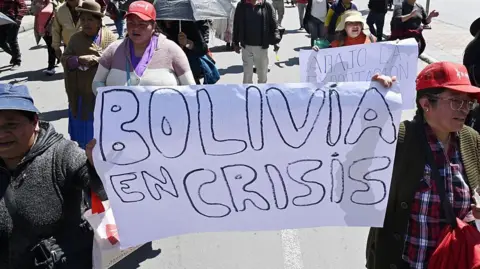
As Bolivians prepare to vote in a general election, the country’s deep economic woes are the central issue. Whoever becomes the nation’s next president faces a very difficult job to try to sort out the mess.
El Alto is Bolivia’s second-largest city, home to 1.2 million people. And, at an elevation of 4,150m (13,615ft), it is the world’s highest city with a population of more than 100,000.
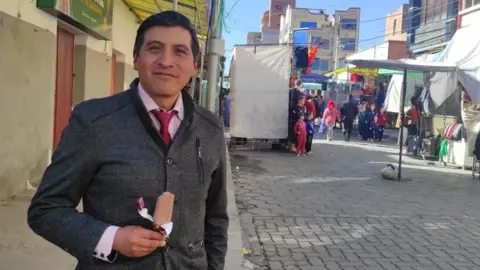
It’s full of narrow streets with vendors trying to sell you everything from oranges to knock-off designer trainers. Standing on a pavement, car mechanic Josue Macias is enjoying an ice cream with his young son.
He describes how Bolivia’s sky-high inflation is affecting him and his family. The annual rate soared to 24% in June.
“Prices for everything are going up, but we are still earning the same,” he says. “We are just about getting by, but it’s hard because food prices are rising all the time, things like meat, oil and eggs. They are double or triple what they used to be.
“We’ve had to tighten our belts. We don’t go out to eat in restaurants anymore. Instead, I’m here on the street having an ice-cream with my son!”
Bolivia’s inflation spike has been caused by a combination of factors. Falling natural gas production and therefore exports of this key foreign earner has led to a decline in overseas revenues.
In turn, this has meant a shortage of US dollars, making it harder and more costly for the country to import petrol, diesel and food stuffs, leading to shortages and price hikes. It has led to street protests across the country.
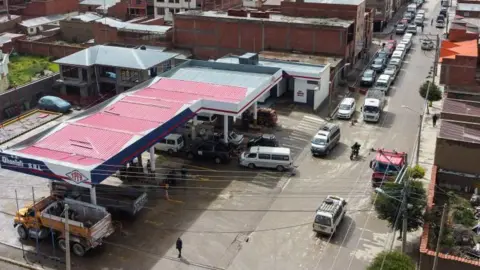
At some petrol stations across the country, lorry drivers often have to wait more than 24 hours to fill up.
Taxi driver Gonzalo Rios is frustrated. As we drive along the pot-holed streets of La Paz, the country’s administrative capital, he tells me about his struggles.
“Before it was easy to fill up with petrol. Now I must wait for around four to six hours at the gas pump to get some, and that’s too much. It’s such a waste of time.
“And the prices are so expensive,” he adds. “Now the money we earn doesn’t cover our costs. But we can’t put our fares up because if we do, we won’t have any customers. It would be too expensive for them.”
For almost 20 years the Bolivian government kept fuel prices artificially low through subsidies. This started when the government of then President Evo Morales nationalised the country’s hydrocarbon sector in 2006.
But in 2023, state energy company YPFB said Bolivia was running out of domestically-produced natural gas, due to a lack of investment in new exploration.
Without this gas to export, the Bolivian government is struggling to continue to find the funds to subsidise petrol and diesel. Last year it spent $2bn (£1.5bn) on such subsidies, according to a recent statement by a former minister of hydrocarbons and energy.
Outgoing left-wing President Luis Arce, who is not seeking re-election on 17 August, blamed the Bolivian parliament for the fall in natural gas production, accusing MPs of blocking vital oversea loans. His opponents in turn blame him for the economic turmoil.
The official exchange rate of Bolivia’s currency, the bolivianos, is certainly not helping matters. Since 2011 the government has fixed the exchange rate at 6.96 bolivianos to one US dollar.
But unofficially you can get 14 to 15 bolivianos per dollar. This has led to a thriving black market, especially of exports, from which the government misses out on tax revenue.
Economist Gary Rodriguez, the general manager for the Bolivian Institute of Foreign Trade, explains: “A product that costs seven bolivianos here in Bolivia can be sold for 15 bolivianos abroad,” he says.
“The problem is that businesses would prefer to sell items on the [overseas] black market rather than here in Bolivia which leads to food and fuel shortages.”
 Getty Images
Restrictions on the use of credit cards is another headache for Bolivia’s business community.
“The problem with the credit cards is that all the banks have limits that are ridiculous,” says Alessandra Guglielmi, who owns a food business called The Clean Spot.
“You can [only] spend around $35 a month over the internet with online purchases. $35 is nothing for a business.”
She is concerned about her business going under.
“I am worried with food prices going up I can’t afford to pay my staff a decent salary,” says Ms Guglielmi. “I am worried about the people not being able to afford to buy my products because I must put the prices up.
“And I am worried because my margins have gone down so it’s very hard right now for me to keep a business.”
Many people in Bolivia are hoping that a new government will be able to turn the country’s fortunes around. Two right-wing candidates are currently ahead in the polls for the presidential race.
Leading is Samuel Doria Medina of National Unity Front. He was previously the main shareholder of Bolivia’s largest cement manufacturer.
In second place is Jorge Quiroga of Freedom and Democracy. He has been president of Bolivia before, from 2001 to 2002.
If no candidate gets more than half the votes on 17 August – which no-one is expected to achieve – then there will be a second round of voting on 19 October.
Bolivian political scientist and analyst Franklin Pareja is sceptical that the next administration will be able to improve most people’s lives.
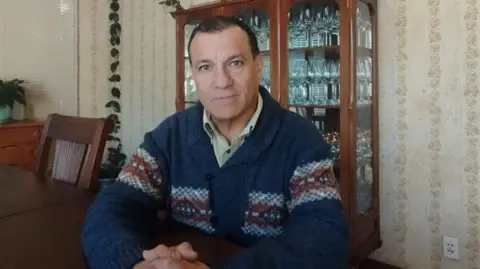
“The population is assigning a change in government almost magical qualities, because they think that with a change of government we’ll return to stability and prosperity,” he says. “And that’s not going to happen.
“Bolivia will only feel the hard impact of the economic crisis with a new government, because it will make structural economic changes, which will be unpopular.”
Mr Rodríguez is adamant that the Bolivian economy needs to be significantly altered. “We need to change the model, because the current model, has too much emphasis on the state,” he says.
“There are two actors, one the state sector and the other the private sector. The driver of development must be the citizen, the entrepreneur, and for that, the state must do what it’s meant to do. In other words, good laws, good regulations, good institutions.”
While polls suggest Bolivia’s next administration is likely to be right-wing, such radical governmental and economic change, to significantly reduce the state’s role, is not expected.