
When Abdul El-Sayed attacks the “corporate capture of our politics,” he recalls Roosevelt’s rejections of “greed and selfishness and striving for undue riches.”
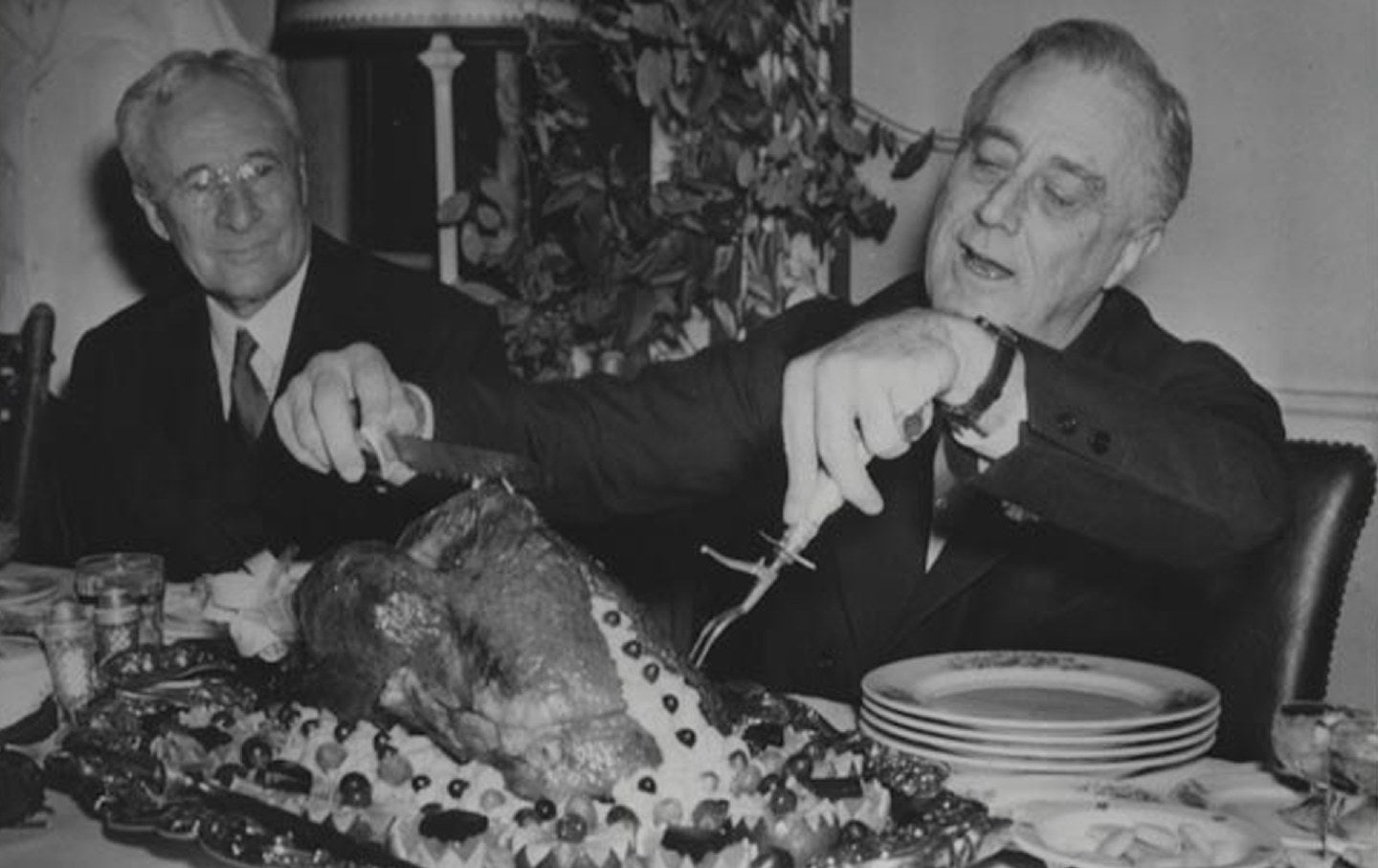
Franklin D. Roosevelt carves a Thanksgiving turkey on November 30, 1933.
(Franklin D Roosevelt Library / PhotoQuest / Getty Images)
Abdul El-Sayed, the Michigan Democrat who will join the United States Senate in January as part of a dynamic new class of congressional changemakers, is already shaking things up with proposals to work across party lines in order to establish a national healthcare system. He’s even caught the attention of President Trump, with an offer to name the initiative “Trump Care” in the event that the embattled executive might actually be willing to sign a Medicare for All bill into law.
That’s unlikely to happen. But the president did share an El-Sayed post on the proposal, and Vice President JD Vance’s office reached out to the new senator to arrange a meeting.
All of this is ironic, because, of course, El-Sayed was frequently attacked by Trump, Vance, and other Republicans during the 2026 election campaign as a socialist. The president even labeled the Michigander a “communist.”
That has never been the case. “I believe in capitalism, and I think capitalism works well to allocate resources in a market. And I think if you look at where we are right now, we don’t live in capitalism. We live in corporatism,” El-Sayed told reporters during his Senate campaign. In a late-summer interview with The Nation, El-Sayed explained that “what we have right now is a level of corporate capture of our politics, in every single part of American society,” where the political system and the government that extends from it “acts as a handmaiden to the richest and most powerful, accelerating the inequality that we have in our society”
El-Sayed brought this savvy economic critique into his campaign, describing his belief that a corrupted form of capitalism harms Americans “in every part of our lives: whether it’s the food system, which is controlled by a couple of very large corporations and agribusiness, [or] our healthcare system, which is captured by a few pharmaceutical and health insurance companies.”
With his Senate victory, El-Sayed has instantly become one of the nation’s leading advocates for a flexible, efficient and humane “Medicare for All” system. He proposes a “Break Up Big Medicine Act” to tackle the monopolistic profiteering of private-sector healthcare corporations, and he backs similar initiatives to address other concentrations of power in the hands of predatory corporations that neglect the needs of working Americans, as part of a headlong rush to turn billionaires into trillionaires.
Current Issue

What distinguishes El-Sayed in this moment is that he recognizes the importance of putting the economic and social reforms he seeks in perspective. That requires speaking not only in technical terms but also in moral language that voters can connect with. Ordinary people may not know the ins and outs of health policy, but they know what El-Sayed means when he argues, “No one should have to choose between getting the care they need or going into debt in the richest, most powerful country in the world.” El-Sayed is determined to employ every opportunity to drive forward the project of ensuring that capitalism serves working Americans rather than corporate bottom lines and the fever dreams of the billionaire class.
No one doubts El-Sayed’s dynamism or his potential. He will be a central figure in policy debates going forward; and, yes, he could even transform our economic discourse. Yet his approach is not new. It channels the ambition of the populist and progressive movements that took on the robber barons of the Gilded Age, and more particularly of President Franklin Delano Roosevelt.
Like El-Sayed, FDR sought to advance his New Deal agenda by offering a critique of capitalism as it had come to operate in the years leading to the Great Depression. Roosevelt declared in his first inaugural address, “Practices of the unscrupulous money changers stand indicted in the court of public opinion, rejected by the hearts and minds of men. The money changers have fled from their high seats in the temple of our civilization. We may now restore that temple to the ancient truths. The measure of the restoration lies in the extent to which we apply social values more noble than mere monetary profit.”
This critique of capitalism was a constant theme of Roosevelt’s presidency. He claimed as his mission “the liberation of the exploited” and announced that “there must be an end to a conduct in banking and in business which too often has given to a sacred trust the likeness of callous and selfish wrongdoing.”
FDR, a master communicator, recognized that this agenda could not be truly understood, or accepted, if it were merely delivered through addresses to Congress and in political debates. Like El-Sayed, FDR knew that his critique needed to permeate American life. So it was that the 32nd president used his Thanksgiving Proclamations to speak not just of bountiful harvests and prayers of gratitude but also of moral certainties that were at odds with unrestricted capitalism.
“May we ask guidance in more surely learning the ancient truth that greed and selfishness and striving for undue riches can never bring lasting happiness or good to the individual or to his neighbors,” read Roosevelt’s first proclamation, in 1933. A year later, he wrote: “Our sense of social justice has deepened. We have been given vision to make new provisions for human welfare and happiness, and in a spirit of mutual helpfulness we have cooperated to translate vision into reality. More greatly have we turned our hearts and minds to things spiritual. We can truly say, ‘What profiteth it a Nation if it gain the whole world and lose its own soul.’”
Popular
“swipe left below to view more authors”Swipe →
By 1935, with the New Deal project fully in swing, the president wrote: “We can well be grateful that more and more of our people understand and seek the greater good of the greater number. We can be grateful that selfish purpose of personal gain, at our neighbor’s loss, less strongly asserts itself.”
And after his landslide reelection in 1936—following a campaign in which he said, “We know now that Government by organized money is just as dangerous as Government by organized mob”—FDR encouraged Americans “to fulfill our obligation to use our national heritage by common effort for the common good.” That same year, he found cause for thanksgiving in the fact that labor organizing guaranteed “the toiler in shop and mill receives a more just return for his labor.”
The socialists of the 1930s would have had Roosevelt go further. But, as with El-Sayed, FDR was more than ready to echo the left’s condemnations of greedy oligarchs and self-serving autocrats. Nor did he hesitate to speak of economic democracy. Toward the end of his presidency, FDR would use his 1944 State of the Union address to outline an Economic Bill of Rights that demanded healthcare, housing, education, and living wages for all Americans.
As with his 1939 Thanksgiving Proclamation, which celebrated the fact that “[o]ur Nation has gone steadily forward in the application of democratic processes to economic and social problems,” FDR’s speech near the end of his long tenure in the White House argued, “We have come to a clear realization of the fact that true individual freedom cannot exist without economic security and independence. ‘Necessitous men are not free men.’ People who are hungry and out of a job are the stuff of which dictatorships are made.”
Conservative critics claimed that FDR’s vision was “socialist.”
But Franklin Roosevelt understood then, as Abdul El-Sayed does now, and as we all should in this season of reflection and sharing, that capitalism needs both regulatory guardrails and humane ambitions—because, as the nation’s longest-serving president taught us, “greed and selfishness and striving for undue riches can never bring lasting happiness or good to the individual or to his neighbors.”
More from The Nation

As artificial intelligence reshapes our world, questions of power, ethics, accountability, and human autonomy become increasingly urgent.
A single-issue bill strategy will either force Trump to veto enormously popular legislation—or sign bills that would actually benefit all Americans.

Politician-related thirst levels are reaching heights not seen in decades. Why is America’s longing for lusty legislators spiking so much?
November is Native American Heritage Month, a reminder to honor Indigenous histories, cultures, and contributions, not just this month but throughout the year.