
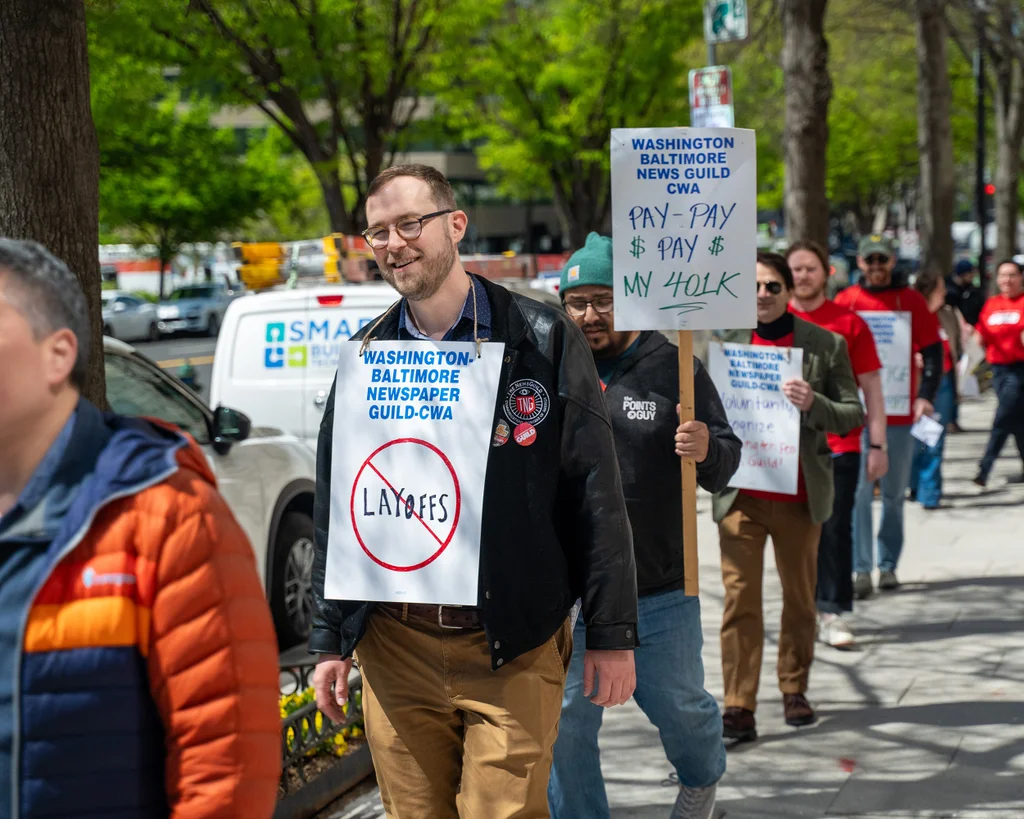
A decade ago, while working as a data reporter at the Los Angeles Times, Jon Schleuss watched a new boss take control of the paper’s parent company, rename it Tronc, and promise to supercharge the business by repackaging the paper’s “content” across an array of media. Instead, leadership began “running it into the ground,” says Schleuss. “We decided to fight.” He soon helped organize the newsroom’s first union. Now, as president of the NewsGuild-CWA, the largest news union in the United States, Schleuss is hearing a new version of the same story, this time powered by AI.
Case in point is USA Today Co., formerly Gannett, the country’s largest newspaper chain. In August, the company announced a partnership with Palantir—the data analytics giant whose clients include Nvidia, U.S. Immigration and Customs Enforcement (ICE), and Britain’s National Health Service—to better monetize its audience and content. It’s part of a broader effort that includes push-button videos, AI-written article summaries, and even whole articles. That sort of automation echoes moves across the media industry.
NewsGuild members at USA Today papers have demanded an end to the Palantir deal, citing reader trust and a conflict of interest for reporters who cover ICE. The union has also pushed back on some of the company’s artificial intelligence initiatives amid continuing layoffs. Last month, after the rollout of a new reader-facing chatbot across USA Today websites, guild journalists at two papers in Ohio pulled their bylines; among its hallucinations, they said, the bot misidentified the reporter covering a murder case as the suspect.
In an interview in September, Mike Reed, the USA Today CEO, told Fast Company that the company won’t replace journalists with AI. But unlike Ziff Davis, IGN, The New Republic, Time, and CalMatters, it hasn’t put that promise in a contract—something that NewsGuild journalists are now demanding in ongoing negotiations.
The layoffs keep coming, too, even in cases where contracts include AI protections. (The Local Journalist Index estimates that the U.S. has lost about 80% of its local journalists since the turn of the century, from about 40 per 100,000 residents in 2002 to just 7.8 today.)
But the upheaval is also fueling an organizing surge, one Schleuss says the union hasn’t seen since its founding in 1933 as the American Newspaper Guild, during the Great Depression. In the time that he has been president, the guild has added more than 10,000 workers from 246 workplaces—not just journalists but people in the publishing, tech, and nonprofit worlds. (Reporters at Fast Company and Inc. unionized with the Writers Guild of America East in 2018.) “You see CEOs that make millions of dollars and don’t increase your pay and want to lay you off and speak in this weird, AI-written code-speak,” Schleuss says. “It tends to tick people off when the price of groceries is just through the roof.”
Schleuss spoke with Fast Company about the industry’s embrace of AI, the growing labor movement in journalism, and what it will take to protect reporters—and the work they do. The conversation has been edited for length and clarity.
Generative AI is being rolled out all over the place, from healthcare to hiring to scammy content creating. Why is the discussion about AI in journalism so critical?
The news industry is the only industry mentioned in the Constitution—we can start there. A free press is essential to having a democracy, and so if you replace the workers who provide that free press with bots, you get misinformation.
Our currency is trust. And you can’t do that if you’ve got corporations that are just spewing out word calculators to replace those working journalists who have ethical responsibilities: seeking truth and reporting it, minimizing harm, acting accountable and independent, and being transparent. Those are all our key ethical concerns, and if we stray from them too far, then we lose faith, we lose trust, we lose our free press, we lose our democracy. So I’d say it’s all a pretty straight through line: Without journalists, we don’t have democracies, and replacing journalists with AI is a very quick way to get rid of the democracy. Which might be a goal.
Let’s start with USA Today Co., formerly Gannett, the biggest newspaper chain. How are journalists there seeing AI get rolled out in its newsrooms?
They’re pushing AI on people. One tool, Espresso, will take a press release and then try to spit out a story. But I don’t know, it seems really dangerous if the Nazis are emailing you a press release and you just make a quote-unquote story about it. They’re also trying to do that instead of hiring humans to write a story. So it becomes this one-sided slop that journalists are then forced to edit in as quick an amount of time as possible.
That’s not exactly journalism.
You have to approach AI with journalistic ethics, which I think is Gannett’s real problem. And that’s been the challenge all along: How do you make sure that we are doing the things necessary as journalists to be ethical when we’re using these systems? And that requires seeking the actual truth and reporting it, and not just relying on the output from a single-sourced community news announcement that was emailed to you. It requires actually fact-checking things. That requires going through any data that’s being analyzed to verify that these things that you’re saying are true.
Fact-checking is already a heavy lift. And more AI often means more checking. With fewer journalists and more AI, don’t we risk automating away the very things that we need to make the AI work? To make facts and society work. It’s like, remember why we are doing this to begin with. Why we are reading things.
Do you remember when the company Tronc was created? That was my life. I lived and worked for the L.A. Times, which was owned by Tronc. And its chairman at the time, Michael Ferro, was like, “We’re just going to put the content in different funnels.” It’s basically, I think, what [USA Today CEO] Mike Reed’s strategy is today. And it was a failed strategy. It’s like he doesn’t think about the work that journalists do as telling stories. He thinks of it as content. This is the thing that is just so broken to so many media executives. They think of content; they don’t think of stories. It’s absolutely tone deaf and 10 years old.
The thing that infuriates me: You go to any of the USA Today websites now, and the websites are broken. I wish that he would spend more time working on actual user interfaces. Try not to have so many ads that are autoplaying, because if you’re a reader and you’re trying to read the news, you are holding onto a bucking bronco trying to follow the words on the screen. Everything’s moving around so fast.
To me, the crux of the issue is: This is all about trust with readers. And if you align yourself with a very shady and dark company that has actively supported an agency that has hurt journalists, your readers are not going to trust you as much. And the latest polling shows that 52% of Americans are more concerned about AI than excited about it. It just seems such a bad move, when trust in journalism’s already at such a record low, for a journalism organization to then lean into AI.
What else do you think USA Today’s leaders are getting wrong? And how is the union responding?
There’s the part of his interview with you where Mike Reed says AI won’t replace journalists: “I think the Guild plants this, as well as outside cynics, that we’re going to replace journalists with AI. That couldn’t be further from the truth.” But the reality is, we have 95 contracts [across the union] that have AI language in them, and the best-case-scenario ones say the employer will not lay off workers because of AI. But Gannett has refused to agree to any of that language.
What’s the status of those conversations now?
We’ve got 46 different contracts at Gannett, so it depends on where each of them are. They’re still bargaining for a first contract at The Columbus Dispatch—they just unionized this year. But everyone’s been fighting for no layoffs because of AI. Mike Reed’s refused to agree to that, but then they’ve also actually laid people off.
What’s some of the most interesting AI-related language you’ve seen in other newsroom contracts?
What’s one of the funnest ones that’s super simple? The New Republic in December of ’24, says: “Generative AI may be used by bargaining unit employees as a complementary tool in editorial work, but it may not be used as a primary tool for creation of such. The use of AI shall not result in the layoff of a bargaining unit employee, be used to avoid filling any vacant bargaining unit position, or result in an employee’s compensation decreasing.”
There was also a lefty magazine, The American Independent, and its contract said, simply: “Employees shall not use AI to produce any published material, with the exception of quotes derived from interview transcripts . . . or shall not utilize or approve the use of AI to produce editorial content for publication.” It was aggressive.
What is the guild aiming for generally in its contracts?
The five major points that we fight for in contracts are:
Number one is no layoffs because of AI.
Number two is no salary reductions because of AI—another thing that Gannett has refused to agree to.
Number three is usually the formation of a labor-management committee so that issues can be worked out in real time. This has been, frankly, really successful and could be successful at Gannett, but journalists there have kept away from it.
Number four is just making sure that you don’t do any impersonation of journalists. Don’t train off of their work or impersonate them without their permission.
And the fifth and final one is really important for our readers: If you’re going to use AI to generate something, you need to label it.
When we spoke, Reed made it sound like that was a policy, that they would be clear if they were using AI.
The policy is adorable, but it’s not legally binding. It’s the AI language you actually want in a collective bargaining agreement—because if you don’t have a union, then you get no say.
What they typically push for from the management side is saying something like, “AI may be used to generate news content that is supplementary to local news reporting and is not a replacement for it.” And then they’ll say, “The use of AI by all parties shall be consistent with the ethical guidelines and policies for Gannett journalists regarding AI-generated or assisted content.” But there’s nothing, at least in these contracts that I’m looking at, that says anything about labeling. So it might be in that guideline that they put out, but again, if they can just change that, they will.
There’s a really good bill that’s sitting on [Governor] Kathy Hochul’s desk in New York called the New York FAIR News Act. It would require labeling for anything that was wholly generated using AI on a news website. Publishers are freaking out about it. They’re like, “Well, this is a violation of the 1st Amendment.” In 1933, whenever you didn’t want journalists to organize a union, you claimed the 1st Amendment protected you. But you have to put terms of service on [your website]. You have to have a privacy policy on your website. Labeling AI content on your news website shouldn’t be bad. It seems basic.
What happens when AI gets better at simulating journalism, and the disclaimers disappear?
It’s already gotten better at writing, but the problem is, I think, people have also gotten better at seeing it. And even if it’s like, “Is this Coke or is this Coke Zero?”—people then are just assuming it’s all shit. So that’s also a problem. Actually, it would be so much more productive to say: We are not in support of AI. That would actually resonate with people, because it’d be news without AI. I think that you could actually wholly market a news organization off of that.
I hate this, because I’m a big believer in the open internet, but I actually think that news organizations right now need to create siloed universes where people will build reputational trust with an organization, because it’s not AI slop. Within five years, the majority of things we see on the internet will just be AI slop. It’s already there. So why not create a website that people can actually trust, written and curated by humans?
And Reed was gesturing at that. At the idea of being this oasis of trust in a sea of slop.
Then why put out AI slop?
Let’s talk about their deal with Palantir. USA Today’s execs told me Palantir works only with “highly controlled” data and has no access to newsroom systems or reporters’ notes, and accused the union of spreading fear and falsehoods about the deal. What did you make of that?
My general reaction was just one of disappointment that both [president of USA Today Media] Kristin Roberts and Mike Reed have been so far removed from working in a newsroom that they forgot what it was like to have an organization that’s powered by journalists. They came off as extremely defensive of the relationship with Palantir, which has actively been working for ICE and DHS [Department of Homeland Security], which is not only a major news topic right now, but also is an organization that has actively assaulted journalists in city streets in the United States. We’ve had to file three separate lawsuits on it because it’s been so bad. So it’s really disappointing that they can’t see how this is an ethical issue, that this is a safety issue, that there’s a security issue here.
Palantir has worked with or is working with a number of media organizations, including Axel Springer and Fox News. What specifically are union members concerned about?
What are you actually doing with readers’ data here? What are you losing control over? And then they came out swinging in defense of what Palantir has access to in terms of their journalists’ data. They’ve only now offered some clarity in your interview, when they have refused to do it until this point. But there’s much that’s still unclear.
I also wonder about how one goal of the partnership—targeting readers using “anonymized” data—impacts the relationship with readers. Of course, many media organizations target their audiences with ads.
Reporters in the group chat say they’ve heard from readers who are really concerned about this relationship, what it means about their data. So that’s been an open question.
Instead of using Palantir, they could find a good data journalist who could look at Google Analytics and help you figure out that this actually does better here and that does better there. And this webpage is taking three minutes to load: Maybe we should fix that?
I think some of the best things that work for us—this is so basic that it sounds stupid—is literally creating decently written newsletters that bring readers in and center their concerns. Here’s this newsletter from a local reporter; here’s a human being who wrote this. And it’s not just headlines and links. It’s literally, this is what happened in your neighborhood in New York City over the last day. That’s what people are hungry for, and it’s not rocket science. You just create and curate communities where people actually want to congregate and learn.
What else have journalists been pushing for specifically when it comes to AI in the newsroom?
So there’s notification—this is what we won the Politico arbitration over. Politico didn’t notify its workers and journalists that they were rolling out new tools. One was a report builder tool, and it was supposed to be based off of the archive. And our members asked it, “Is abortion legal in the United States of America?” And it was like, “Yes, ever since Roe v. Wade.” And it just totally missed the story, broken by its own journalists, that showed that the Supreme Court overturned Roe v. Wade. So we filed arbitration for that one, and they shut down the tool—they had violated the contract, which required 60 calendar days’ notice of any new tool.
And how about compensating journalists if their work has been used in AI training and inference?
The compensation piece has been a real challenge. There’s not been a company, a news company, that’s agreed to compensate journalists. There’s a prohibition on training off of work by a journalist if they don’t get their consent. So you need consent if you’re going to have anything trained.
The New York Times [Company], for instance, has a deal with Amazon for AI and their content, and they have refused to provide compensation to New York Times journalists. Which is wild, because if a newspaper in Brazil picks up a story from the Times, the journalists get compensated for it.
It seems like the media companies are still trying to figure out the compensation schemes themselves. Isn’t some kind of compensation essential to the future of the business?
So many of these news companies are entering these dumb deals with AI companies, though they don’t know how much the Atlantic deal is worth versus the New York Times deal versus the McClatchy or the Gannett deal. They don’t know the cost. You’d think that they’d know how to bargain better, but they are bargaining in the dark and then accepting peanuts for something that these AI companies are just hungry for, which is original content. And that’s being stolen from all these journalists.
How do you think AI tools could be valuable for journalism?
I think that there could be some that were valuable if they were for a specific purpose. You look at The New York Times’s Manosphere Report, which basically looks at and transcribes hundreds of hours of podcasts from right-wing podcasters and then turns that into an internal email report that goes to Times journalists. That’s really helpful, because it saves you the time of having to listen to a lot of podcasts. And then it gives you a sense of, well, is there a particular trend that is happening in this particular area? Analyzing millions of records from Jeffrey Epstein being released by the government—that’s helpful. Transcribing interviews—that’s helpful.
But it all needs to be checked. Every single one of these things has to be checked. You can’t just publish it and just say it’s the truth because it came from the machine.
But back to Gannett. There’s another AI tool called Streamer, which essentially pulls from the archive and puts together short-form videos with AI-generated text and voiceover. The main problem, journalists say, is that it sucks. It’s not good. And there’s a 10-year-old internal tool that’s better than the AI tool.
Have you personally found a way to use AI that’s helpful, that’s reasonable?
In my union work, I have been unimpressed with its lack of accuracy. I could see ways, maybe, at some point, where it could be helpful to try and do comparisons of contracts, but I’ve just seen it fail.
Back when I was working at the L.A. Times, one of my coworkers was building a machine learning system to build a big database of recipes, because recipes are structured data. Then you can point the machine learning algorithm at the newspaper from a hundred years ago, at a PDF, and say: Figure out where the list of ingredients is, the ordered list of operations. That was a really helpful tool. And that was more than 10 years ago.
I think organizing large sets of data is really interesting. Like the Epstein stuff. Or if you’ve got a large cache of, say, the archive of the Guild newspaper, and you want to find letters about constitutional questions. We just published our archive on our website, this printed newspaper that goes back to 1933. It’s 1,300 PDFs—huge. That’s an area where, if you’ve got a ton of documents, it’s actually helpful. Not to provide verified truths from the AI model, but to be able to say, “Well, how many times was automation mentioned in the 1930s?” And then have it directly cite, say, page 4 of this issue. And then you’d have to go back as a human and check it.
Kristin Roberts mentioned an internal chatbot at USA Today that helps reporters with FOIA [Freedom of Information Act] requests. Are there other ways that AI might be useful in newsrooms, or things that you’d like to see management do with it?
In my old job, I would scrape websites, like transit agencies and police departments. And I’d be creating a spreadsheet, so I’d have to write these scripts in Python. One thing that’s nice is you could actually speed that up a bit using AI. What would take me weeks and weeks to work on scraping is something that I could do much faster, because I’m able to use a system that has been trained on a ton of Stack Overflow pages and can say, here’s the programming language. It’s still important to know what the language that’s coming out says, so that you know it’s not just hacking the website or making things up. You’ve got to double-check it.
And there’s definitely an argument, too, that we should just have more staff to be able to do it, because Mike Reed’s ultimate argument here is, this is going to free us up to do more things. But you’ve already cut the staff so much. You need to instead just hire staff to do the actual journalism, not try to find tools to fix a problem that you’ve created by cutting the staff so much.
Beyond jobs, what are you hearing about AI’s impact on the process of reporting and writing itself?
Besides the jobs, I think an overarching issue is that a lot of the executives at news companies don’t actually understand what AI does, and they’re just trying to push it out. So we see that, whether it’s Axel Springer or McClatchy or Gannett, they’re all just these guys at the top who think that this is a good idea because they were with one of their millionaire friends who said this is a good thing, and they just believed them, and they don’t actually know what the systems are doing.
I think the other thing in this moment of AI is, it actually makes it harder for journalists, because there’s so much AI slop and misinformation. And so it’s making it harder for journalists to know what’s true.
Are there certain areas of coverage that newsrooms need to be paying more attention to now?
I think that having accountability reporting is really, really key right now, because when we lose journalists at the local level, that costs us money. When we don’t have someone who’s watching city council, watching our school boards, that means that the elected officials then can just do whatever the hell they want. So accountability is the big thing, and they’ve been shifting away from that. McClatchy has also done a major shift away from that, which has been really horrible. They laid off 30% of our represented membership in September. They got rid of a lot of accountability.
So how about, don’t lean into the very unpopular thing that people say is bad for society, and instead focus on humans that are telling stories and holding power to account. Because that’s been a working formula for thousands of years. Ever since we started grunting around as Neanderthals, we were telling stories.