

In 2024, Lukas Bentel helped pull off a heist at the Metropolitan Museum of Art. Sort of.
Bentel is a cofounder of the iconic Brooklyn-based art collective Mschf and, until recently, served as its chief creative officer. After nearly eight years with the brand, he’s parting ways with the collective to start his own design practice. He says it is still in an “exploration phase” but will include a major focus on “making things physically with my hands.”
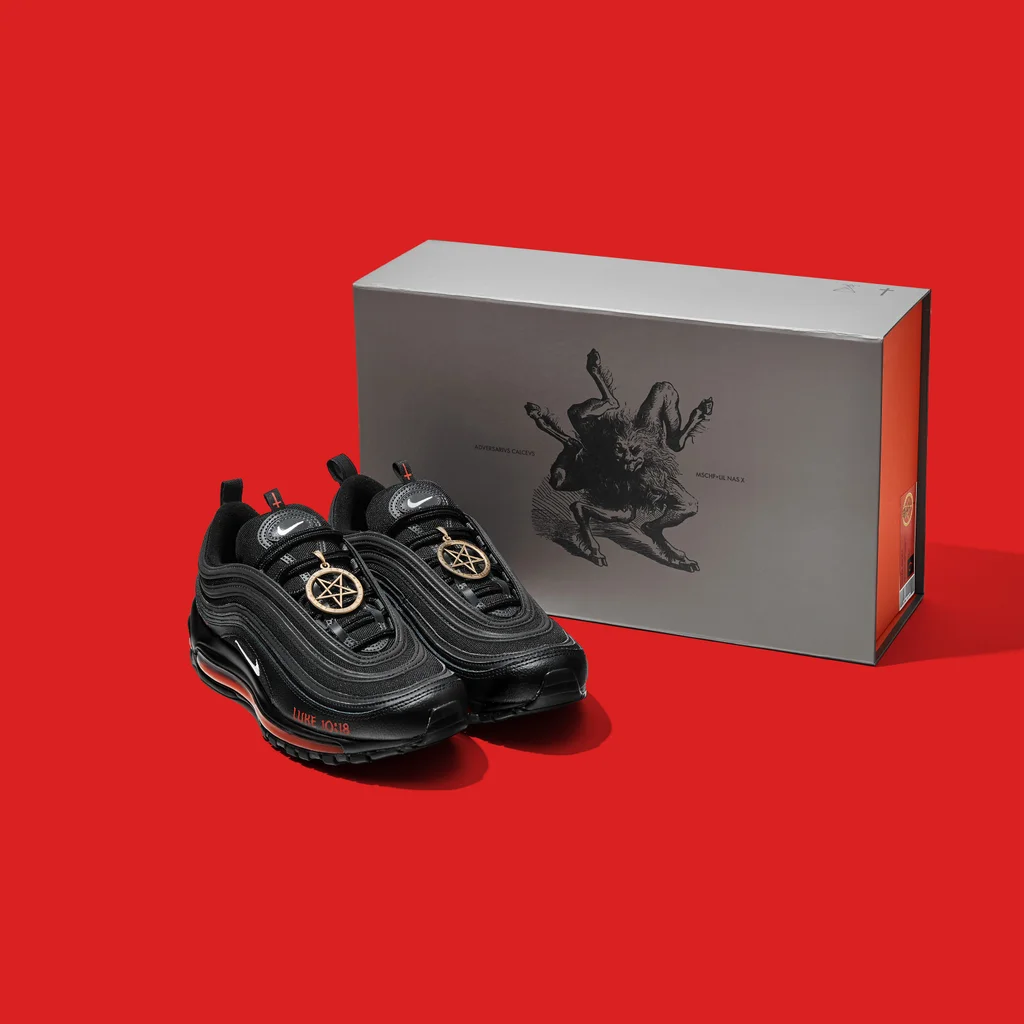
As Bentel moves on to his next venture, he brings along a unique formula for creating products that manage to combine high art and satire with mass appeal. He was the creative mastermind behind some of Mschf’s most commercially successful launches, including its era-defining Big Red Boot, culture-war-starting Satan Shoes, and museum-worthy ATM Leaderboard.
Looking back on his time at Mschf, though, Bentel is even more proud of some of the projects that built cult followings: the time his team stole a sink from the Met a piece at a time, “Ship of Theseus-style,” he says, or the time he bought an authentic $30,000 Damian Hirst painting and cut it up into 88 resellable pieces.
In many ways, Bentel’s work defined Mschf’s knack for toeing the line between poking fun at and profiting from modern consumerism. Here, Bentel looks back on his art philosophy, recounts the book of guidelines that turned Mschf from a small art collective into a commercial powerhouse, and explains why it’s time for him to “get back into the dirt.”
This conversation has been condensed and edited.
What were some of the learnings that shaped your career pre-Mschf?
[In grad school at RISD], I stumbled into three or four friends who would make a lot of work together. We started an artist group called Hello Velocity, which made things that were, conceptually, very similar to Mschf.
There was generally a problem in art school where you would spend so long making something, you’d put something up on the wall in a gallery space, and the only people it would actually engage with would be your peers, maybe your friends, maybe the teacher. Beyond that, almost no one else. That was so frustrating.
I’d read this one book by these two people called Dunne and Raby, and they wrote about speculative design. They argued that objects were great for making critical work, because everybody knows how to interface with an object. Everybody knows how to hold a cup and drink out of it. So if you fuck up a cup, the people that are engaging with it will know exactly what’s wrong. Whereas I think a lot of fine art is, one, put in a space that is completely protected from a physical touch and interaction perspective. And, two, is often only trying to cater to an audience that, to be honest, I’m not particularly interested in all the time.
Hello Velocity eventually became its own marketing and branding agency. What were some of the most memorable projects from that era?
I think probably the best project that we did at Hello Velocity was in 2012 or 2013, and it took the form of a biotech company called Byte Labs. This was at this tech-optimistic period in time where I remember all my peers being like, “I need to get the job at Google.” We were using all that language around that space to make something that, in my mind, was a critical art object—just put in a different environment. What we were doing was soliciting celebrity biopsies so that we could grow in-vitro meat from those celebrities and basically sell human celebrity salami back to their fans.
In my mind, it was a critique of celebrity consumption at its base level. It could have taken the form of a weird neat sculpture in a gallery space, but instead it took the form of this fairly real-looking startup, and then actually got a ton of traction because people didn’t know how to interface with it.
After running Hello Velocity for five years, how did you end up forming Mschf?
Kevin Wiesner [Hello Velocity cofounder] and I met a guy named Gabe Whaley who had a marketing studio which was called Miscellaneous Mischief. As soon as we met him, we realized that he knew how to operate a business. He had a great team of young, hungry developers and people that could really make things. We realized that we fit each other’s puzzle pieces quite well, in terms of him knowing how to operate and run a business and us trying to make as crazy work as possible.
Honestly, the ups and downs of the business of Hello Velocity were a lot—I never wanted to work in an advertising space, necessarily. So, we decided we were going to fire all our clients and start something totally from scratch. Kevin and I sat down and came up with a series of rules, sort of like a book of guidelines for how we were going to run this practice.
In my mind, this was the ultimate Warholian artist practice exercise. It was, “Let’s use all the tools and trappings of a business to make as great of a creative artwork as we possibly can.”

You mentioned Mschf’s original book of guidelines. What are some others that stand out?
This is a rule I always bring up because I find it interesting—it was very good for the art practice, but bad for business. We told ourselves we’d never do the same medium twice. By that, I mean if we made a painting, we’d only make one painting ever. If we made a shoe, we’d only make one shoe ever. If we made a book, we’d only make one book ever. Basically, to force ourselves into a headspace of never being too comfortable within a medium.
For the first two years of Mschf, we operated exclusively like this. It was that punk mentality of, “I’ve learned how to play the guitar too well. Shoot, let me give this to somebody else and have them play it.” I’ve worked now with a number of people in the footwear industry, and they almost never think outside of the normal trappings of a shoe, because that’s all they’re thinking about. It was a test of being able to jump into a new medium, try something, launch it, deploy it, see what happens, fail, move on to the next thing.
Are there any projects from that early era that you’re particularly proud of?
We kind of quickly stumbled into some early success. The third thing that we did was this thing called Jesus Shoes, which was a Nike Air Max 97 where we injected holy water that we shipped over from the River Jordan that was blessed by a priest so that you could walk on water like Jesus.
This was in the height of the very consumer speculation footwear, hype beast time, and we were trying to make fun of that. We were like, okay, well, everyone’s smashing up all these collaborations and spending a lot of time and energy—why don’t we put the two of the most famous brands together, the Roman Catholic Church and Nike?
To be honest, I didn’t think anybody would consider buying it for real. We priced it at $1,425 because the Bible verse Matthew 14:25 is the verse where Jesus walked on water. We made 12 of them because we were like, “Oh, let’s make 12 for the 12 disciples and each of us can take a pair home,” basically. We launched them, and the people in this footwear universe ate them up like crazy. We sold out in about a minute.
What are some Mschf releases that you think don’t get enough hype?
Maybe the only piece we did that was actually illegal was a concept I’d come up with to steal a sink from the Metropolitan Museum of Art. The way we did it was Ship of Theseus-style. The idea was, we would go to this one bathroom in the Met and take the faucet, take the handles, take the plumbing, take the drain, piece by piece. But every time we were there and we took a piece, we would replace it. So technically the sink never left the Met.
It never went to court, and I think the Met refused to comment on it, which is probably a good thing from their perspective PR-wise. You don’t want the Streisand effect to happen with the Met sink. In my head, I was always like, ‘It’d be so funny to have a lawyer in court arguing the Ship of Theseus philosophical problem.”

Is it the Met sink? Who can say!
Yes, exactly. It’s sort of the perfect crime. Even though, at the same time, I very much acknowledge that maybe taking a thing outside of the Met is a museum heist of sorts. That’s a piece I loved that skirted under the radar.
So why was now the right time to leave Mschf and go your own way?
It was a bit of a long time coming. It’s been seven years since we started Mschf. From my perspective, I see it in a very linear arc from what Kevin and I were doing in college. We might’ve been the only people there that were as concerned with the art historical canon in comparison to everybody else. For the first five years, we put out a ton of individual work. We kept that schedule going. We technically put something out every 10 days for the first three years.
But at some point in time, I think we decided to focus on other aspects of the business and slowed down our production cadence on individual pieces. Mschf has a lot of great work, and I know a few of the projects that are currently inbound. I just personally felt like I needed to get back to the feeling of making things and being scrappy. I mean, for years I’ve talked about making things with my brother, and we’ve always been in different parts of our professional lives. Either I was running a studio with other people or he was running his practice very successfully. I’m very, very much looking forward to that.
Ultimately, I’m very, very proud of all the work that we all did, and I think we’ve left a legacy there that they’re going to be making crazy things for a long time. But at this point in time, for me, I need to get back into the dirt. I’m very much looking forward to getting back to making things physically with my hands. I feel like I really need to scratch that itch again.