

Kevin Scott is a maker. Given that he’s been Microsoft’s CTO for almost a decade, that doesn’t come as a shock. But his passion for making stuff extends to two hobbies—pottery and woodworking—that he pursues in a studio he built in Los Gatos, California. Large and lavishly outfitted, it’s packed with the tools of all his trades: a gas-powered kiln and a full woodshop, but also an office bedecked in computing equipment. On any given day, he may spend 9 or 10 hours there on video calls related to his day job.
Scott’s studio/office sits in a sleepy neighborhood more evocative of Mayberry than Silicon Valley in all its hard-charging glory. (There’s even a barber shop across the street.) When I dropped by recently, he showed me some of his handiwork, along with tech projects such as the infrared radiometer he devised to read carbon monoxide and carbon dioxide emissions from his kiln’s chimney. More to the point of my visit, he was quick to draw parallels between the craftsmanship he pursues on his own time and the massive shift the software industry is currently going through.
“When I was a little kid, there was this debate about your legitimacy as a woodworker if you used power tools instead of exclusively making things with hand tools,” he remembers. “People believed that hand tools were superior and led to a higher-quality product. It was a raging debate.”
By contrast, today’s software engineers are being pragmatic about their own extraordinary new power tool: generative AI.
“People more clearly understand that it’s just a tool,” Scott says. “And it’s not a particularly useful tool unless you have someone asking it to do a useful thing in a useful way.” Already, one study says that 42% of developers are using the technology to generate at least half their code.
Microsoft’s understanding of what people want out of AI has outsize impact on the entire world of software. Some 71% of developers work in its Visual Studio Code environment, according to a recent Stack Overflow survey. More than 225 million programmers—users of Microsoft and non-Microsoft coding tools alike—store their work on GitHub, which the company acquired in 2018. Its developer constituencies are dwarfed by the user bases of general-purpose platforms such as Microsoft 365 (more than 500 million users) and Windows 11 (a billion plus).
How AI is changing Microsoft’s products and how it’s changing the company itself are inextricably linked. Back in the 1980s, Microsoft coined the term “Eat your own dog food,” which became widely used across the industry to refer to a company using the products it creates. Lately, some people replace it with the less pungent “Drink your own champagne,” but the idea remains the same: You can’t build great products unless you have a personal investment in how they operate in real life.
That has never been truer than with generative AI, a technology the entire industry is still figuring out how to make palatable and profitable. Thanks to its prescient investment in OpenAI, Microsoft got off to a strong start. Yet when I spoke to CEO Satya Nadella for a 2023 Fast Company feature, he cautioned against reading too much into that momentum: “As far as I’m concerned, early leads in technology don’t matter.”
As if to prove his point, the OpenAI partnership soon grew increasingly fraught. More recently, their agreement has undergone revisions that make it less central to Microsoft’s AI future. The company hasn’t been forced to start over, exactly. But last year, it began constructing a more disciplined, independent strategy for how it would build AI and deliver it to customers.
“We had these different places where we were all kind of doing bits and pieces of this on our own, in our own worlds,” says Jacob Andreou, the executive VP for Copilot. “The last year and a half has been a story of stitching all of that together.” (I spoke with him and other executives during a visit to Microsoft’s Redmond, Washington, headquarters, a much less idyllic setting than a pottery studio.)
Andreou’s own time at Microsoft reflects this shift. A former Snap executive and Greylock partner, he came aboard in February 2025 to work on the consumer version of Copilot. At the time, that version had its own team and road map, distinct from those of the edition for business users.
A little over a year later, the company reshuffled its AI leadership to facilitate creating a single Copilot “super app,” similar to the unified experiences offered by OpenAI’s ChatGPT and Anthropic’s Claude. Andreou now oversees this app. (Various aspects of it are in private preview and available to members of Microsoft’s Frontier program, with no date announced for general availability.)

Charles Lamanna, a 13-year Microsoft veteran, also got a new job as part of the organization, becoming Executive VP of Microsoft Copilot, Agents, and Platform. (At Microsoft, like many large companies, trying to suss out who’s in charge of what from titles can be a brain teaser.) Recently called out in a profile by The Information’s Aaron Holmes as a possible eventual Microsoft CEO, Lamanna declares that the new app “will be the end of ‘Copilot-palooza’”—the period, currently winding down, when there have been many, many products called Copilot. How they relate to each other may not be clear to anyone without a desk in Redmond.
With the new app, “There’s one Copilot for your personal life and your work life,” Lamanna says. “There’s one Copilot across Chat, Code, Cowork, and Autopilot. There’s one Copilot that shows up in Word, Excel, PowerPoint. It may have different UIs on it, but it’s all the same Copilot behind the scenes. Kind of like how I have Outlook on my PC and I have Outlook on my phone. They’re different apps that look different, but they connect to my same inbox.”
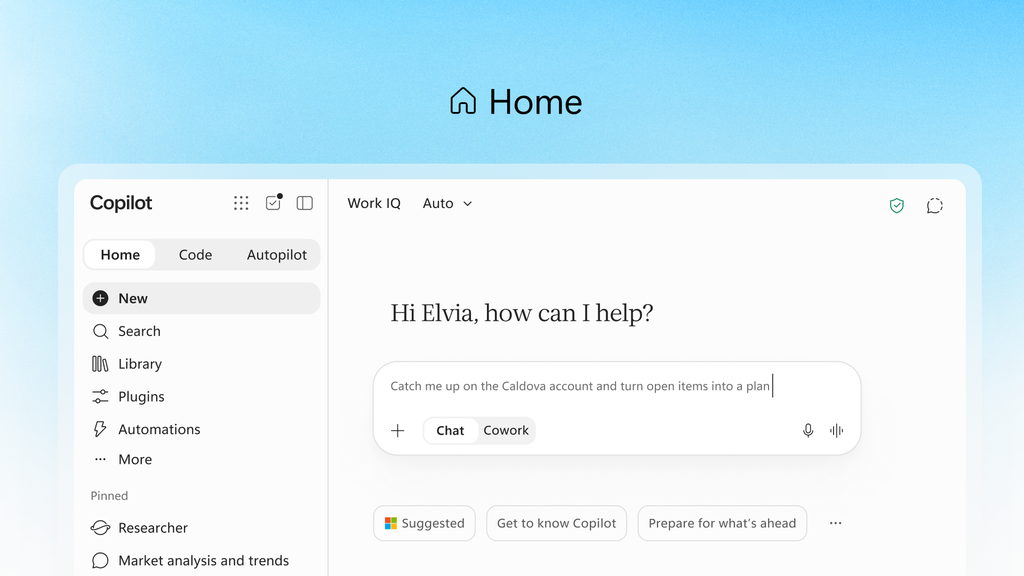
Copilot’s consumer version had been the domain of DeepMind and Inflection AI cofounder Mustafa Suleyman, who joined Microsoft as CEO of Microsoft AI in 2024. He now oversees the development of cutting-edge in-house AI, a necessity given the loosening of ties to OpenAI. “Essentially the core mission is self-sufficiency for Microsoft, ensuring that we have absolute frontier models available that have been highly tuned to our products,” he says.
While Microsoft was busy resetting its goals for Copilot and reassigning executives to meet them, the competitive pressure from OpenAI, Anthropic, and Google only increased. “Even though we were pretty early in the build-out for generative AI, just keeping on the treadmill and making sure that we’re building, building, and building all of this stuff in a sensible way is consuming a huge amount of our time,” says Scott.

The company can’t afford to get off that treadmill anytime soon. During its July earnings call, Nadella said Microsoft 365 Copilot had passed 30 million paid seats. That doesn’t translate into usage—last February, a survey found that only 18% of workers prefer Copilot if their employer also provides access to ChatGPT—but it’s up from 20 million in April. It’s also higher than the most recent figures for paid enterprise seats reported by Google and OpenAI.
At Microsoft scale, however, 30 million paying users remains far from the kind of customer base that justifies its current investment—both intellectual and financial—in generative AI. All of the energy it’s expending right now looks toward a day when its AI is as pervasive as its biggest, best-known products.
“I joke with my team that we want to be the Costco of AI,” says Lamanna. “You know, you get a lot of AI at a great price. . . . We want to get to 400 million, 500 million [users]. As many people as use Office today should be using Copilot.”
That is a bold ambition, even by Microsoft standards. But even at this early stage, there are signs of incremental progress. “To me, Copilot seems like it’s a lot better than it used to be, because they’re not the middleman anymore between you and OpenAI,” says Larry Dignan, editor-in-chief of Constellation Insights.
AI, accelerated
Though reorgs and reassignments might be necessary to gird Microsoft for the AI opportunity ahead, they’re just a start. As expertise accrued within the organization at all levels, it was too often staying local rather than spreading. And in early 2025, Nadella decided to do something about it.
“Satya felt like the learning loops were not happening fast enough, and that a lot of the ideas just weren’t making it to him and weren’t making it to the right people,” says Will Guyman, partner technical adviser. “We weren’t cross-pollinating and making the connections that needed to be there. Which was interesting, because I think a lot of people were very up to speed on what was happening with AI externally, but were kind of blind to what was happening internally.”
The answer turned out to be creating an AI accelerator, now run by Guyman. Though the term may bring to mind startup accelerators such as Y Combinator, what Microsoft came up with is a little simpler. At its heart is a giant Teams meeting, held on Thursdays at 1 p.m. (A small percentage of attendees participate in person.)

With the meeting’s silo-busting goal in mind, the attendees represent a diverse cross-section of staffers from across the company. “We have people from everywhere, from Xbox to LinkedIn to GitHub to Azure to Office to Windows—we have a weird kind of mix,” Guyman says.
Crucially, they don’t skew toward the highest echelons of the org chart. As Guyman explains it, “Satya went top down and asked his leadership, ‘Who are the key people in AI that you would recommend?’ The typical attendee tends to be a researcher, an engineer, or a product manager, and they tend to be highly technical. Kind of at the principal partner level, but senior enough that they can make decisions.” (That said, Nadella and other top executives often participate, too.)
“I get on there and I listen very intently,” says Corporate VP of Microsoft Security David Weston, who joined the company in 2008. “What are the GitHub folks doing? What are they doing over in Cowork and Charles [Lamanna’s] world? I beg, borrow, and steal whatever information I can to take back to my team, and vice versa. It’s fun.”
Around 130 to 170 staffers participate in the weekly call. Much of the action goes on in the chat, where a higher percentage of attendees can chime in. The discussion continues asynchronously in a Teams channel with about 1,000 members. Quarterly lunches offer a fully face-to-face complement to the otherwise mostly virtual experience.
“Chief claw officer”
The AI accelerator’s ability to turn information sharing into action is seen in the recent career trajectory of Omar Shahine, who’s been at Microsoft since 1999. Last February, he was fooling around with OpenClaw, the powerful open-source AI agent whose arrival ignited a frenzy of excitement among techies. Like many other early adopters, Shahine came away from this encounter convinced that OpenClaw presaged a new age in which people would offload more and more tasks to AI assistants capable of working autonomously.
This takeaway was exactly the kind of learning that the accelerator was designed to disseminate. “Will [Guyman] reached out to me and said, ‘Can you come give a talk?’” Shahine remembers. “Because I don’t think people really have experienced building with OpenClaw the way you have.’”
Shahine’s presentation turned him into everyone’s go-to authority on the product. “Internally, we called him the chief claw officer,” Guyman says. Within weeks, that role was formalized into a new job spearheading the creation of Microsoft agents built on top of OpenClaw-based infrastructure.
Until then, Shahine had been the corporate VP in charge of Word, a 43-year-old Microsoft mainstay. “I went from running a team of a few hundred people around the world to a team of zero people,” he says. “And then building this very small team of very capable individuals who were using OpenClaw and really wanted to work on this product.”
How Microsoft could add value to OpenClaw was obvious. In its stock form, the agent was a bear to set up, pretty much required its own computer, and was rife with security pitfalls. The best advice you could give a layperson who was thinking about installing it was “Don’t.”
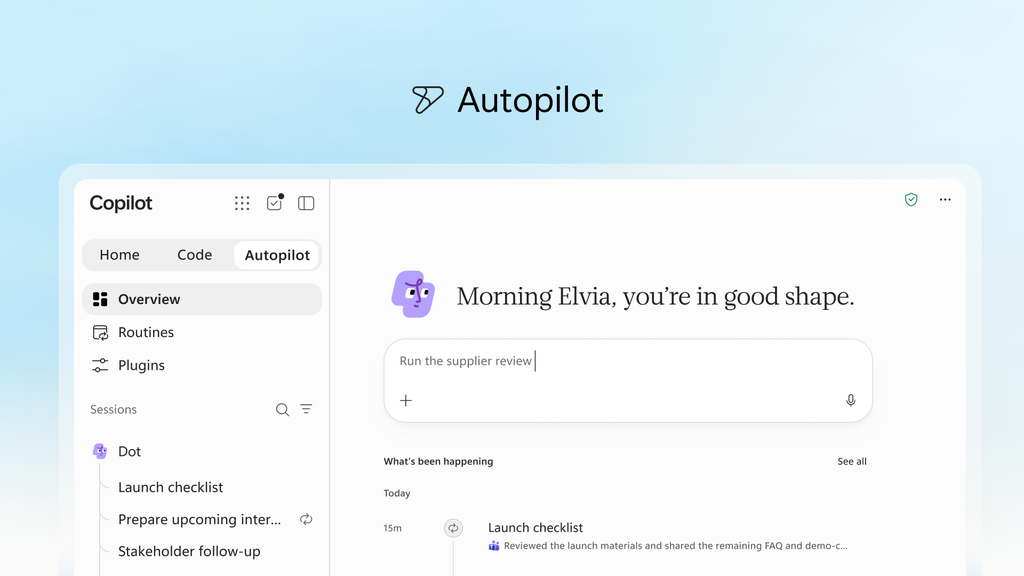
Shahine and his team set out to build safer agents that would be accessible from the newly unified Copilot app and run 24/7 in the cloud. Ones, in other words, that stood a chance of being as broadly used as other Microsoft productivity products.
I spoke with Shahine shortly before the company decided to change the name of its first agent from Scout to Autopilot. He was wrestling not only with its technological intricacies but also the social norms it may bend.
“People are, I would say, rightfully concerned about what it’s going to look like when everybody has an assistant reporting to them,” he told me. “One of the things we’ve been experimenting with in our team is having the agents talk to each other. Because if I want to schedule time with you, do I talk to you or your agent, or do I have my agent talk to your agent? I think the answer is going to be that people are going to ask their Scouts to talk if the other person has one. And it’s quite hilarious to actually see them talking to each other.”
Once Autopilot reaches general availability, it will jockey for attention with a multitude of other AI agents, from Meta’s Muse to upstarts such as Hark. For now, Microsoft is still learning from its own employees who are using it. Despite working for a tech company, many aren’t nerds—an advantage when it comes to testing a product intended for the masses. An early version that mostly ran locally rather than in the cloud grew to 40,000 weekly active users within Microsoft, with 77% retention week over week.
“Some of the biggest adoption we’ve seen internally has actually been in nontechnical teams,” says Andreou. “Teams that would have almost certainly never thought, Gosh, I should open VS Code and code something up.”
People you can trust
Whether the AI accelerator becomes a truly permanent element of Microsoft’s approach to AI remains to be seen. Large companies do have a tendency to fall in and out of love with new approaches to innovation. Back in 2019, when I wrote an article about Microsoft’s then-current approach to AI, it took special pride in The Garage, a network of hacking spaces for employee projects, many of which involved AI. Last week, The Verge’s Tom Warren reported that The Garage is being shut down.
When I asked Guyman about the accelerator’s future, he noted that it can’t keep on growing forever. After all, 50,000 members would generate too much activity for anyone to process. Ultimately, he argues, it’s the power of a community of experts that matters rather than the fact that they happen to meet in a weekly Teams call.
“In this world of digital abundance, having people that you trust, that can help filter the signal from the noise is really important,” he says. “But I think [the accelerator] will continue to evolve.” Its spirit is already reflected in additional accelerators and forums that Microsoft has created, as well as a more general emphasis on ensuring that people throughout the company with shared interests are actually talking to each other.
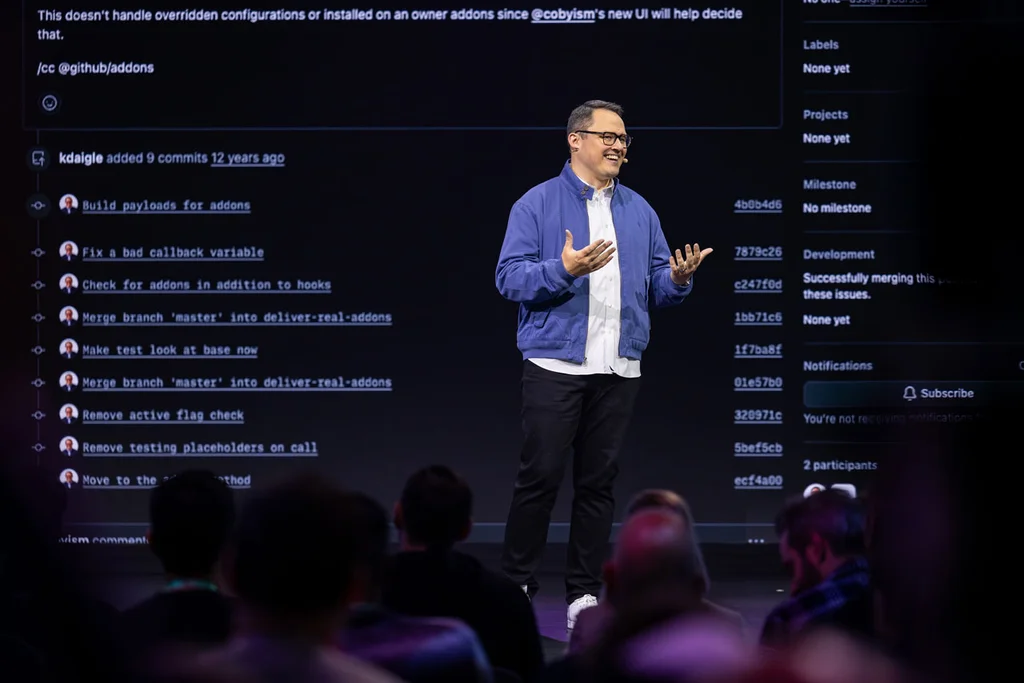
GitHub COO Kyle Daigle was more than five years into his career at the startup when Microsoft bought it. The acquisition thrived because the software giant was smart enough to let GitHub be GitHub. Now, however, it’s more serious about thoughtfully connecting the dots between the collaboration platform and other Microsoft developer products. In January, that shift led to Daigle adding a Microsoft title—CMO, developer—to his existing GitHub responsibilities.
“I can show up in meetings around Windows and give feedback on what a developer is going to say when they see that button or they use this app,” he says. “And it’s not, ‘Oh, that’s a subset of our audience’ or ‘That’s a side concern.’ That is immediately an enormous concern that we need to go resolve.”
Bottlenecks old and new
In the end, no matter how adroitly Microsoft employees pool their expertise, the software still needs to get written. Thanks to generative AI’s uncanny ability to churn out working code at warp speed, that’s the one area of workplace productivity that the technology has already transformed. (This revolution kicked off in 2021 with GitHub Copilot, which could autocomplete lines of code, but it’s lost the buzz wars in recent times to other code generators, especially Claude Code.)
Unlike certain companies that are quick to tell you their software is now overwhelmingly generated by AI, Microsoft isn’t sharing any company-wide stats: “I don’t even know how good a metric that is,” says CTO Scott. He does add that “For net-new things, all of that code is getting written by AI right now.” Introducing AI into a human-created code base that’s been around for years, as so many Microsoft products have, is presumably a thornier challenge.
Regardless of AI’s precise contribution, the Microsoft software factory is already undergoing upheaval in ways that may or may not presage wholesale changes coming to other forms of knowledge work in the years ahead.
Like coders everywhere, those at Microsoft used to spend much of their time, well, coding. Now much of that labor is giving way to oversight of algorithms that can do it more quickly. “If you look at what a software engineer used to do in a day, two years ago, maybe 90-plus percent of that is now things that the model is able to do quite well,” says Andreou. “Writing lines of code is just no longer the bottleneck.”
Of course, removing an existing bottleneck doesn’t necessarily result in a clog-free workflow. No matter how rapidly AI spits out code, Microsoft found, the humans overseeing its work can communicate with each other only so efficiently. The lag time inherent in person-to-person collaboration had become a new bottleneck.
To address that, “We actually just physically colocate people,” Andreou says. Early this year, for instance, the company built an automation system called Copilot Tasks, which has since evolved into Copilot Cowork. For eight weeks, 30 to 40 people sat in the same room working on the project.

The sheer collaborative density “took that human interconnect to infinity in terms of the bandwidth between people,” Andreou says. “Because it meant that if you got stuck, the person who could unblock you was 10 feet behind you.”
Another emerging bottleneck comes when companies validate software that has been generated by AI. “Most of the industry is hitting this right now,” says Caitie McCaffrey, a member of the technical staff. “How do you verify the code and make sure it hits our trust and safety and security and compliance bars? The pain point is that code review bottleneck.”
It’s not that code review is a new step: Software written by humans has always undergone testing before being released into the wild. But developers inside and outside Microsoft are still developing confidence that AI code works properly, shows taste comparable to that of fully human-developed software, and generally reflects the product that its overseers set out to build.
That uncertainty can be a drag on the whole process. “We hope, as time goes on, to get better and better and better at building trust in the code,” says Tim Bozarth, corporate VP of engineering for Microsoft CoreAI. “But right now, that’s the place where a ton of energy has shifted.”
Beyond identifying and minimizing new bottlenecks, Microsoft is also dealing with the disruption that comes when people’s long-held, well-loved jobs no longer map to how software is created.
“We used to have a front-end coder, a back-end coder, a designer, a product manager, maybe a project manager, maybe a technical program [manager],” says Lamanna. “You’d have all these disciplines. Now it’s just one discipline called ‘builder,’ and they’re a member of the technical staff or something like that. They just do everything. Those are scary things. Getting the organization through that is one of the big challenges for us.”
Beyond tokenmaxxing
Early this year, the mania for AI coding led some companies to convince themselves that tokenmaxxing—gorging on frontier AI for its own sake, damn the expense—would allow them to pull off great leaps forward in coding productivity before their competitors did. By the time I spoke with Microsoft executives for this story, that fever had broken. Now it’s more fashionable to spend sensibly, which often means opting for models based on cost effectiveness, not raw bleeding-edge power.
As Weston puts it, “V12 Lamborghinis are great, but you don’t need to use them to go pick up the kids from soccer. Driving around in [Anthropic] Fable or [OpenAI] Astra is fairly wasteful.”
Scott says that when Microsoft’s developers “have something very interesting and useful that they need lots of tokens for,” the company doesn’t want to skimp on resources. “We use a ton of our own tools. We have our partnership with OpenAI, where we’re using a ton of OpenAI things. But we also have people who use Anthropic’s models for a bunch of different things.”
On October 5, however, The Information’s Aaron Holmes, Jyoti Mann, and Kevin McLaughlin reported that a projected $1 billion bill for internal use of Anthropic’s Claude had led Microsoft to urge staffers to prioritize use of in-house AI. Doing so allowed the company to reduce Claude spending by more than a third, they wrote. (For the record, the company says each division is responsible for managing token use “thoughtfully and efficiently,” and that use of the auto model picker, which selects the best model for the task at hand, is recommended.)
For Microsoft, the ideal scenario would be its employees clamoring for homegrown models, not to pinch pennies but because they prefer them. Scott says that’s starting to happen: “In the internal marketplace inside Microsoft, where people do have a pretty large degree of choice about which coding models they use, they’re increasingly choosing to use Microsoft AI models, which is awesome to see.”
As with everything else about how Microsoft is embracing AI, what it needs from its models internally blurs right into what it wants to offer to customers: “They are starting to create blueprints that they’ve obviously developed for themselves that they’re hoping other companies can start to use,” says Bob O’Donnell, president of TECHnalysis Research.
One of the advantages of putting Suleyman on frontier AI full-time is that he can steer the company’s research toward these blueprints.
“We need to ensure that our pretrained models are adapted to the agentic coding and enterprise knowledge work use cases that our customers care about,” Suleyman says. “That’s where we’re focusing. It’s going to be a multiyear transition to get to that point. But I think we’re going to produce the best models in the world in 2027.” (He has 14 months to make that prediction come true.)
Microsoft’s greatest advantage in AI remains how deeply entrenched it is in workplaces of all sizes. New products such as Copilot can tap into data that companies are already storing in apps such as Word and Outlook; the company’s salespeople can bundle AI into plans clients are already paying for. It’s an enormous head start, even if Microsoft hasn’t fully taken advantage of it yet.
“The massive software influence that they have within businesses positions them well and gives them the opportunity to keep evolving,” O’Donnell says. “They certainly haven’t lost the race, even though OpenAI and Anthropic get all the attention these days.”
The quality of the models won’t determine how successful Microsoft is all by itself. “Best-of-breed and enterprise traction aren’t necessarily one and the same,” says Forrester analyst Tracy Woo, who calls Office “crappy” despite its ubiquity. “A better tool that has limited adoption will still lag a broadly adopted solution with lesser capabilities,” she adds. “The same is true for Copilot.”
There’s a nicer, more aspirational way of saying something similar. If Microsoft gets anywhere near its goal of getting hundreds of millions of paying customers for its AI, it might not be because its models test best in the lab or its apps trounce others in wild new features. Just getting useful tools in front of people so they can use them also matters. And if any company has proven it can do that, it’s Microsoft.
“We all get caught up in the AI model race and ‘What is the new intelligence? Are we approaching AGI?’ or whatnot,” says GitHub’s Daigle. “But I think the real question is, ‘How many people can we enable to do something that they couldn’t do before?’ And that feels really unique here.”