
You have probably noticed it on a hot summer day: A basement feels cool even when the air outside is baking. The ground does not heat up and cool down as fast as the air does. A few hundred feet down, it stays close to the local yearly average all year, which can be around 50 degrees Fahrenheit (10 Celsius).
In Verona, Wisconsin, the health software company Epic Systems has spent two decades turning that fact into infrastructure. It has drilled roughly 6,100 wells, 300 to 800 feet (90 to 240 meters) deep, that now heat and cool about 40 buildings on its own campus by using the waste heat from a 3.5 megawatt (MW) data center.
What makes this setup unusual is not that Epic pulls heat out of the ground in winter—ordinary ground-source heat pumps do that in homes across the country. What’s uncommon is that Epic puts heat into the ground in summer and takes it back out months later.
That matters more than it sounds because timing is what usually kills the idea of reusing a data center’s heat. Servers make heat every hour of the year. In most of the U.S., buildings need to be heated for only about four months. Piping it straight to nearby buildings works beautifully in February, but solves nothing in July. Storage is the missing piece.
You may have seen data centers and geothermal energy in the news together lately. Google is buying 115 MW of geothermal power in Nevada, and Meta has contracted for 150 MW from a geothermal plant in New Mexico.
Those projects drill for heat the earth already holds, deep enough and hot enough to generate electricity. Storing heat underground is the mirror image. Same drilling, same rock, but the heat comes from the building, and the ground’s job is to keep it rather than supply it.
The snow pile in the parking lot
Heat can behave in surprising ways. A thin layer of snow on a driveway may be gone by afternoon, but a pile of snow the plow pushed into the corner of the lot can still be sitting there in April. Same snow, same weather. The difference is shape. The pile has less surface area for its volume, so less of it is exposed to the warm air.
Storing heat underground uses the same principle, though in reverse. A little heat leaks away quickly. But push enough of it into a large enough volume of rock, and most of it is still there months later because heat can escape only through the edges of the warmed zone.
In July, water heated by the servers is pumped through a pipe deep underground, where it warms the rock around the pipe. Rock is a poor conductor of heat, which sounds like a defect but is in fact a crucial element. It’s why the warmth stays close to where it was originally stored.
When January comes, water is pumped back through the pipe in the ground, which still contains much of the warmth stored in July. The water picks up that heat and returns to the surface warmer than it left. There is no tank buried down there, and no battery is being charged. The rock is the storage, and what’s being stored is heat.
The water that comes back up is lukewarm. In winter, similar systems in the Netherlands pull their stored heat out with water that surfaces at around 59 F.
What the heat is good for
Much of my own research goes into wells that turn stored heat back into electricity. In those systems, surplus solar and wind power runs a heat pump that heats material packed into the well to as much as 284 F, and that heat later drives a generator.
At the temperature a data center’s servers produce, about 140 F, the recovered heat isn’t enough to drive a turbine to generate electricity. But it is efficient for warmth; a heat pump can move large amounts of heat with relatively little electricity.
At Epic, that heat warms offices, supplies hot water to the dining halls, and melts snow off the sidewalks.
A problem
Boreholes into rock face a problem: too much heat building up. If more heat goes into the ground each summer than comes back out each winter, the rock around the boreholes slowly gets warmer year after year, until the field can no longer take heat at the temperature it was built for.
As Epic’s campus grew, the company drilled more boreholes to be able to store, and use, more heat.
There are two ways to fix that imbalance. One is to use more of the heat, such as preheating water for the buildings’ boilers or melting snow. The other is to give the heat more room, drilling more boreholes so it can be spread through more rock. But drilling takes land, equipment, and money. Epic hasn’t published what its system cost, though the U.S. Department of Energy reports that Epic’s buildings use about 25% less energy than comparable buildings in the same climate.
Part of the cost could be avoided by using holes that are already in the ground. The U.S. has more than 141,000 documented orphaned oil and gas wells waiting to be plugged. My colleagues and I have modeled how idle wells in California could be turned into thermal storage without replacing their steel casings.
However, in most states, a well is regulated either as an oil and gas well or as a plugged one, with no category for turning it into heat storage. A colleague and I have proposed a streamlined permit process that states could adopt to allow wells to be used for this additional purpose.
Two other limits are worth saying plainly. The first is distance: The stored heat sits under or beside the facility, so whoever uses it has to be close by. The second is size: Epic’s 3.5 MW data center is tiny next to the AI campuses now being built at 100 to 1,000 MW, and its borefield serves the whole campus, not just the servers.
No one has yet stored a data center’s heat underground at that scale. However, a similar system that stores heat in underground water reserves called aquifers has been providing 60% to 80% of the winter heat demand of a complex of offices, a hotel, a medical center, and a data center in Bonn, Germany, since 2009.
An opportunity
The heat is not going away—but it needs to go somewhere. In the U.S., data centers used about 4.7% of the country’s electricity in 2024, a share the Lawrence Berkeley National Lab projects could reach nearly 12% by 2030. And in some places, that proportion is even higher, accounting for 15.4% of all electricity consumed in North Dakota, where I teach, and 25.6% in Virginia.
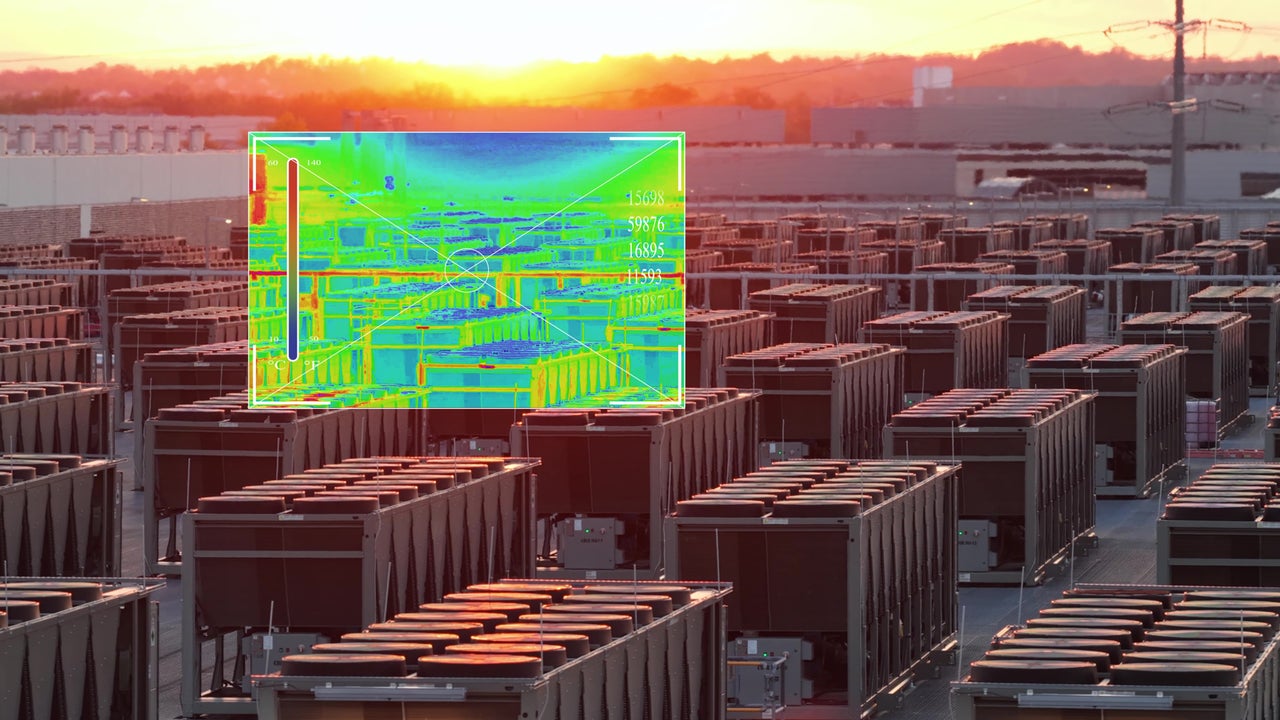
About 30% to 40% of that usage is for cooling, and the heat it removes goes into the sky, as the water heated by electronics evaporates.
Communities are already fighting about data centers raising their power bills and using up precious water. Making different choices about how to handle the heat could help keep power bills down and water in local rivers.
Moones Alamooti is an assistant professor of energy and petroleum engineering at the University of North Dakota.
This article is republished from The Conversation under a Creative Commons license. Read the original article.