
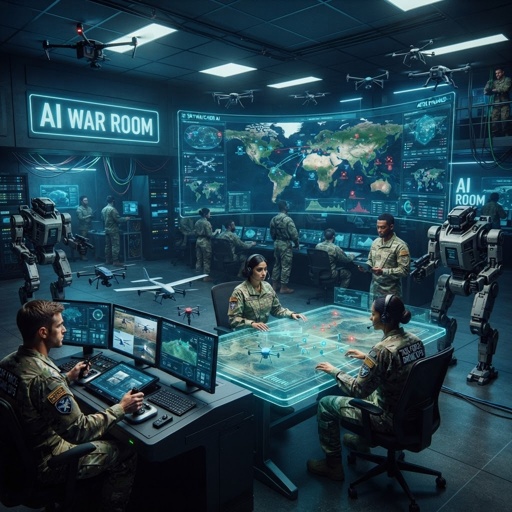

Beginning in 2027, qualified artificial intelligence researchers will once again be permitted to satisfy their military obligations by working in laboratories at major corporations rather than interrupting their careers for conventional military service. This program has effectively been closed to the large conglomerates since 2013. Now, Seoul is bringing it back specifically for AI. That tells you precisely how important artificial intelligence has become to national security.
Seoul has concluded that taking highly trained AI specialists out of laboratories and putting them into conventional military service can actually weaken the country. The government will allocate 240 positions for master’s-level AI researchers in 2027, with 120 available to large corporate laboratories and another 120 for government-funded and defense-industry research institutions. Samsung Electronics, LG Electronics, Samsung Medison, and HD Hyundai Robotics are among the companies recommended to participate.
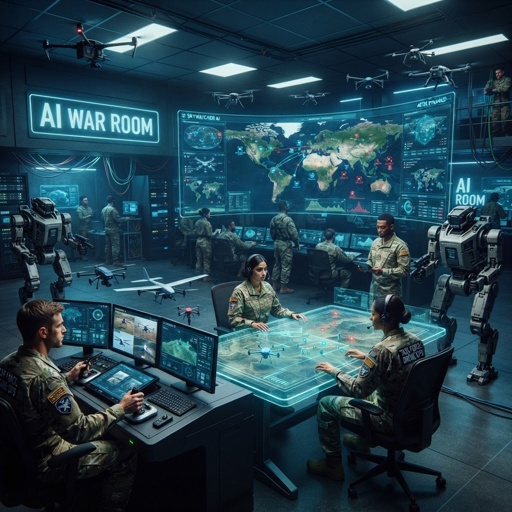
This is where governments have to wake up. Warfare has changed. The most valuable soldier of the next war may never carry a rifle. Artificial intelligence is increasingly tied to drones, autonomous systems, intelligence analysis, cyberwarfare, logistics, targeting, surveillance, and the processing of battlefield information at speeds no human command structure can possibly match. Ukraine has already demonstrated how inexpensive drones and software can alter the battlefield. The Financial Times recently examined how AI is already shortening military decision-making and targeting cycles dramatically. The next arms race will not simply be who has the most tanks. It will be who has the best algorithms, semiconductors, engineers, data, and computing capacity.
South Korea understands this because technology is existential to its economy. The government is not merely creating a military exemption and calling it a day. Its Military Manpower Administration says 6,300 people will be allocated to industrial-support service programs in 2027, including 2,300 professional researchers, while AI, defense, semiconductors, and advanced industries receive particular attention. Korea has also built overseas training programs involving institutions such as Carnegie Mellon, the University of Toronto, and Oxford, and has expanded those efforts into AI semiconductors. This is a country treating intellectual capital as strategic capital.
The interesting part is that South Korea is also trying to prevent these people from simply leaving. The entire purpose of restoring the large company program is partly to retain specialists who might otherwise take their skills overseas. Human capital moves just like financial capital. Tax it, regulate it, restrict it, or interrupt people’s careers and they will go somewhere they are treated better. Governments never seem to understand that you cannot imprison talent within a border merely because somebody was born there.
There is even some irony in the initial response. The government reserved 120 positions for large corporate laboratories, yet the nine recommended research institutes requested only 81. The requirements are apparently so restrictive that nearly one-third of the available positions were not requested at the recommendation stage. This is classic government. They finally recognize the strategic importance of retaining AI talent and then immediately construct enough rules around the program to reduce its usefulness.
Nevertheless, the direction is significant. South Korea’s broader economic strategy is increasingly tied to AI and semiconductors. Its proposed 2027 budget places major emphasis on AI and semiconductor infrastructure, while the enormous profits generated by its semiconductor industry are themselves helping finance government revenues. AI is no longer some speculative technology sitting out in Silicon Valley. It is becoming embedded in economic growth, corporate profits, national defense, energy demand, and government policy.
This is why the AI revolution should not be dismissed as another dot-com bubble. Individual companies will certainly rise and collapse. Valuations will become absurd. There will be fraud, speculation, and plenty of companies calling themselves AI that will disappear. That always happens with revolutionary technology. It happened with railroads and then again with automobiles. It happened with the internet. Speculation surrounding a technology does not mean the technology itself is meaningless.
AI is fundamentally about productivity. One skilled individual equipped with artificial intelligence can increasingly perform work that previously required teams of people. That will disrupt employment, government, finance, medicine, manufacturing, and warfare. Governments that attempt to suppress AI because they fear job losses will eventually discover that other nations will embrace it and gain the competitive advantage. You cannot legislate technological evolution out of existence.
Wars have always accelerated technology. Radar, aviation, rockets, nuclear energy, computers, satellites, and eventually the internet all became intertwined with military competition. AI will be no different. The nations that understand this first will possess an enormous strategic advantage over those still measuring military strength by counting how many young men they can put into uniform. The battlefield of the future will be fought by soldiers, but increasingly it will be designed by engineers.