
How Troy Jackson rose from wildcat striker to Democratic Senate nominee.
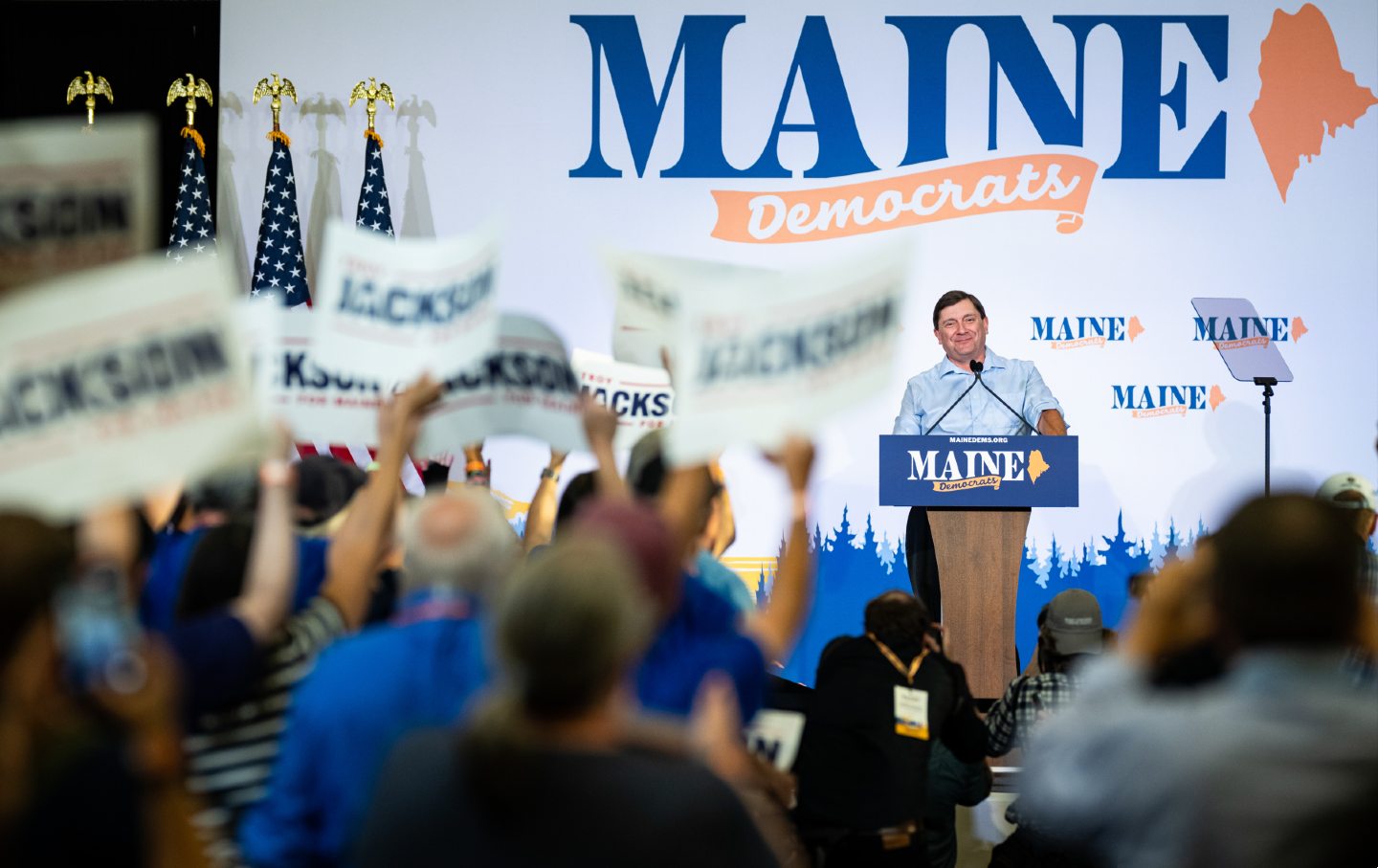
Troy Jackson, Democratic US Senate candidate for Maine, speaks during the Maine Democratic Party special state convention in Bangor, Maine, on July 25, 2026.
(Graeme Sloan / Bloomberg via Getty Images)
Bangor, Maine—As delegates to the Maine Democratic Party’s special Senate nominating convention on Saturday morning filed into a convention center in the former “lumber capital of the world,” a box truck sponsored by Teamsters Local 340 pulled up to the curb. It was flying “Troy Jackson for Senate” flags from the hood, and the trucker inside pumped his fist to egg on the attendees. Inside, a handful of union officials compared notes on fifth-generation logger and former state Senate president Troy Jackson’s improbable ascent from second runner-up in the primary for governor to emergency Senate nominee. Jake Teitelbaum—secretary of the Maine Service Employees Association, a union that represents state employees—explained it to me: “Maybe some of the other candidates could mobilize money quickly, but Troy had the connection to labor. And we mobilize people.”
Jackson’s political career began in the late 1990s when he joined 14 fellow loggers in a wildcat strike in northern Maine. Not surprisingly, during his two decades as a state legislator in Augusta, his support for organized labor was unwavering. Those enduring ties help explain why Jackson was able to outmaneuver his rivals to secure enough delegates to turn Saturday’s convention into a coronation ceremony.
As the assembled delegates waited to sit down in the hall where his nomination would be made official, some gathered around a TV playing clips of Susan Collins expressing concern at any number of Trump administration outrages, then picked up signs reading “Retire Susan” on one side and “No more concerns” on the other. Everyone who wasn’t already wearing swag from SEIU or the UAW found themselves pulling on a blue or yellow Troy Jackson shirt as a show of party unity.
One exception was B.J. McCollister, one of the Jackson campaign’s lead strategists, who stood near the TV in a blue suit looking bleary-eyed. McCollister said he’d barely slept in days, not that he minded. “I’ve worked in Maine politics for 15 years,” he said, “and I’ve never seen anything like the energy over the past week.” McCollister told me that more than 1,000 volunteers had leapt into action as soon as Graham Platner dropped out of the Senate race, making it possible for Jackson’s hastily thrown-together campaign to contact tens of thousands of Mainers ahead of the county meetings where his victory was secured. When I asked what it would take to keep that level of energy going through the general election, McCollister cited the support of organized labor: “Troy has always stood up for them and now they’re standing up for him.”
McCollister excused himself as the delegates began to head into the convention hall to find their seats. In the rush, I found Cynthia Phinney, the president of Maine AFL-CIO. “We’ve had so many successes in the legislature that Troy was key to,” Phinney enthused, ticking a few on one hand: raising the prevailing wage for workers on publicly funded construction projects, ensuring that apprenticeship programs are recruiting women and minorities, and combating wage theft. Phinney was especially complimentary of Jackson’s willingness to wrestle with Governor Janet Mills over mandating union labor on major projects, a years-long fight that culminated in 2023 when Mills vetoed project labor agreements for the offshore wind industry. “Labor standards are one of the things that a lot of people are first to cave on when it comes time to compromise,” Phinney said. “Troy does not cave on those things. They’re fundamental to any project he’s supporting.”
Current Issue

If Troy Jackson manages to defeat Susan Collins in November, he will immediately become one of the most influential voices for the labor movement in Washington. With that in mind, I canvassed prominent organizers in Maine as well as Jackson’s colleagues in Augusta ahead of Saturday’s convention in order to get a better sense of exactly how his commitment to unions has manifested over the years in a place that’s not typically associated with organized labor.
“This is a rural state,” said Beth Edmonds, who led the Maine Senate when Jackson was first elected to the body in 2008. To her, Jackson’s career proves that labor is not synonymous with the urban working class. “When you organize a union here,” she said, “you’re doing it in a much smaller, more local way. But I think that’s what more and more people are asking for as the economics continue to divide people with huge wealth from the rest of us.” Jackson embodies that broadening of the movement. “Troy represents those who have worked on the ground for a long time,” Edmonds said. “I think that’s going to speak to a lot of people.”
The first time a photo of Jackson made the news in 1998, he stood between two fellow loggers in a Chicago Bulls flat brim and flannel shirt, all of them staring down some Maine State Police officers amid their blockade of a border crossing into Quebec. This blockade was one of many in the decades-long effort to stop lumber companies in Maine’s northern tip from hiring Canadian loggers. Because those workers received government-sponsored healthcare in Quebec, companies had long sought them out in order to avoid paying for the benefits American loggers demanded.
Jackson once told the Maine Beacon about how his father’s life had been similarly upended a generation earlier, when his bosses had reclassified his status with the company. “One day he’s an employee, and the next day he was a contractor,” Jackson said. “I mean, it just happened like that.” By the late ’90s, loggers like Jackson had ample reason to feel like people in a profession that had formed the backbone of Maine’s economy for two centuries were being left behind.
While the 1998 blockade drew national attention to the plight of the loggers, Jackson realized that they would need to enact systemic change if they hoped for better employment conditions. It remains a foundational event in his life. On Saturday, Jackson recalled the episode. “That fight opened my eyes,” he told the crowd of delegates during his victory speech. “I went from somebody that didn’t want to get out of line—was told not to get out of line—to where now I understand that you have to get out of line because the people in power are keeping us there.” “Working people,” he continued, “are not powerless. We’re only made to feel powerless when we stand alone, and that is what they’re trying to do: divide us. And that’s why I entered public life.”
Jackson was elected to the state House in 2002, representing the district surrounding his hometown of Allagash in Aroostook County, then moved to the state Senate in 2008. While much has been made of his early conservative views on social issues—Jackson initially opposed abortion and gay marriage, before becoming a champion of both women’s reproductive rights and the LGBTQ as Senate president—nobody has ever doubted his ironclad commitment to labor. Come 2019, he sponsored and passed legislation that made it possible for loggers to finally engage in collective bargaining with lumber companies.
“Troy has been a strong worker-progressive from day one,” said Betsy Sweet, a longtime activist known for staging spirited primary challenges against centrist Democrats like Mills and Sara Gideon, the most recent challenger to Collins. While national observers have criticized Jackson’s faltering cadence in his speeches and his everyman approach to politics, Sweet thinks that those qualities are exactly why he has so much credibility with the working class. “He is different. He isn’t polished. He doesn’t have a consultant telling him what to do,” she said. “He kind of goes with his gut, but he gets it.” You don’t need to be a stunning orator to reach people if you have “this visceral sense of injustice. It’s innate. It’s in the fabric of who he is.”
Case in point is how Jackson threw his weight behind an unionization effort by nurses at Maine Medical Center, the state’s largest hospital, in 2021. In an op-ed for the Portland Press Herald, Jackson recounted having a heart procedure at Maine Med when pandemic protocols were still in full effect. “Like most Mainers who’ve been hospitalized during the COVID-19 pandemic,” Jackson wrote, “I was completely alone.” He described how it was the nurses at the hospital who had “put my anxiety to rest, answered my questions and gotten me back on my feet.”
“After all that these nurses have done for me,” he continued, “the least I can do is be there for them in their hour of need.”
Popular
“swipe left below to view more authors”Swipe →
Beyond providing rhetorical support for the organizing campaign, Kelli Brennan, a nurse at Maine Med, told me that Jackson had proved to be a major ally of their union in Augusta. The first time she met Jackson was during a lobbying event organized by Maine AFL-CIO, when she and other nurses visited the Senate chamber. “He made sure we all had a place to sit, pulled up a chair, and then he let us go roundtable about what our issues were,” Brennan said. At the time, their main priority was passing a bill that would create nurse-to-patient ratios at Maine’s hospitals. “He knew that our bill might have some areas where it would be difficult to get other people to compromise on, but that didn’t stop him from supporting us,” Brennan said. (Jackson managed to shepherd the bill through the Senate, though it failed to clear the state House.)
Jill Duson, a state senator from Portland, was similarly impressed by Jackson’s accessibility. While their constituencies—the state’s largest city and most thinly populated county—would seem to be diametrically opposed to each other, Duson said, “I just found him very open to hearing our concerns and providing useful advice on how we might approach legislators from other communities.” That included a bill that would have helped Portland’s minor league baseball team, the Sea Dogs, renovate their stadium—an issue bound to generate resistance from the rest of the state. For Jackson, the key was highlighting how including labor protections for the construction workers renovating the stadium could set a precedent for future projects. “Troy was instrumental,” Duson said, in arguing “that it was not a Portland bill. That the success of the Sea Dogs was a success for the entire state—and we actually got that through!”
Now Jackson is poised for some much larger fights than haggling over project labor agreements for a AA baseball stadium. Reflecting on Jackson’s emergence as a national champion of the working class, Sweet told me, “I believe that there are people in Washington right now freaking the fuck out. They thought they could put this back in the bottle.” Having chaired Bernie Sanders’s presidential campaign in Maine back in 2016, Jackson would undoubtedly join the senior senator from Vermont as among the most progressive legislators on Capitol Hill. Jackson has said that, if elected, he would not support Chuck Schumer’s leadership bid, would push to abolish ICE, and would refuse to approve sending any military funding to Israel.
After the delegates made Jackson’s nomination official on Saturday, organizers played a song by another favored son of rural New England, Noah Kahan. The 700 or so attendees rose to their feet, waving “Retire Susan” signs in front of an American flag that covered the entirety of one wall, as Kahan’s bright guitar and telling lyrics—“Forgive my northern attitude / Oh, I was raised out in the cold”—briefly filled the room. Just as quickly, as Jackson took the stage, chants of “Troy! Troy! Troy!” drowned out the music, his crooked smile broadening as he acknowledged the cheers.
After making his necessary thank-yous, Jackson turned to the matter at hand. “Susan Collins keeps telling us everything is just fine,” he said to jeers and at least one delegate shouting, “Bullshit!” Jackson pointed out that Collins has been in the Senate since he and the other loggers were staging their border blockade. “I was just trying to figure out how to keep taking care of my family,” Jackson said. “Thirty years later, Susan Collins is still in Washington.”
“They act like we’re idiots,” Jackson said, pausing to throw up his hands in disbelief. “But we all have eyes. We can see what’s happening. We can see our paychecks and the bills that we have. We know that we are getting screwed, and we also know who’s to blame. I’m running to change that.”
More from The Nation

And it’s backed up by actions and initiatives that seem designed to genuinely foster a joyful city.

His speech was racist, homophobic, vindictive, and soul-crushingly unfunny—and the journalists in the crowd didn’t seem to care.

Through conferences, media ventures, and fat public-affairs contracts, the MAGA industrial complex has spent 10 years trying to buy British politics.