
Opinions expressed by Entrepreneur contributors are their own.
Sports fans don’t make picks or play fantasy sports in a vacuum.
They text the group chat, argue through halftime, send screenshots when they win and go a little quiet when they’re wrong. Open most daily fantasy apps, though, and that energy disappears. What’s left is a user, a line and a transaction.
Jordan Rothstein thinks that’s where the industry lost the plot. And when he talks about where sports gaming is headed, he tends to start somewhere unexpected: a Las Vegas surgeon and an FBI raid.
In January 1985, federal agents swept through 45 locations across 16 states in pursuit of a betting operation whose offense, as far as anyone could ever prove, was being right too often.
The Computer Group had come together five years earlier, when an orthopedic surgeon named Ivan Mindlin met Michael Kent, a mathematician who had worked on nuclear submarine systems. Kent had developed a computer model designed to beat point spreads, and Mindlin had the contacts to get the bets down. Together, they built one of the first syndicates to use computers to beat bookmakers at scale, reportedly wagering $40 million a year at its peak and hitting 60.3% of its college football picks in a single season.
The government pursued the group for years, but the case eventually fell apart. No one was convicted.
Mindlin was Rothstein’s grandfather.
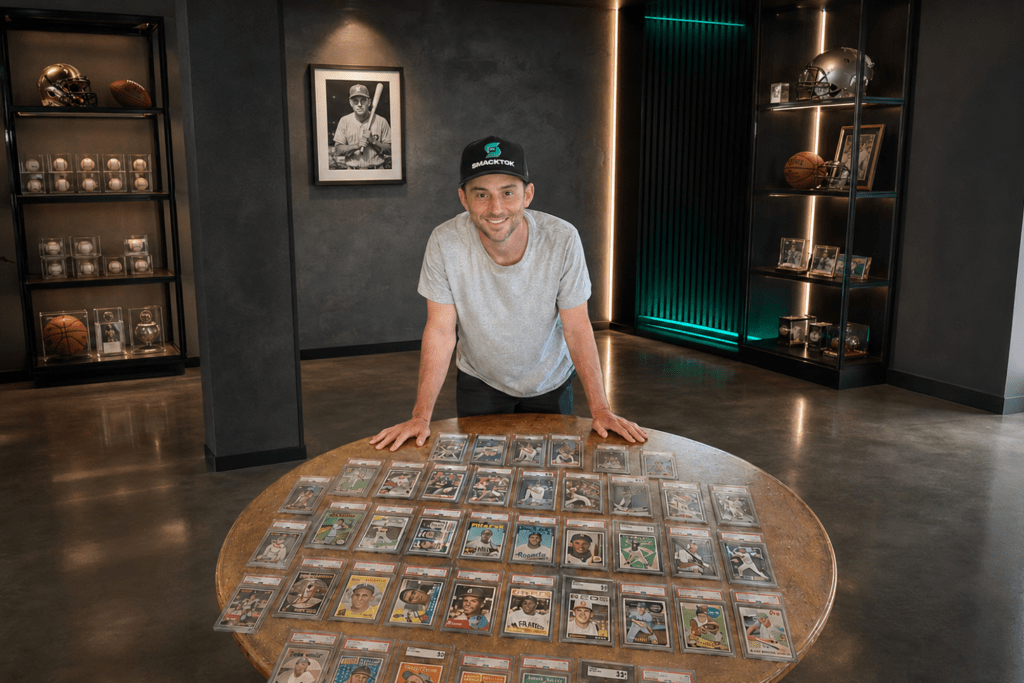
“People read about the Computer Group and see this huge piece of betting history,” said Rothstein, CEO of SmackTok. “For me, it was family history. I grew up hearing how my grandfather saw technology changing sports long before most people did. It made me curious about what the next shift would look like.”
Photo credit: SmackTok
That curiosity eventually led him into product design.
Before SmackTok, Rothstein had spent much of his career building products from the outside in. He founded King Tide, a Los Angeles venture studio and product-development firm that helped turn early ideas into consumer products across ecommerce, financial technology and real estate. His work touched companies including Price.com, Eco and Findigs, but sports gaming hit differently.
It was a category he understood first as a fan. But as a product builder, what stood out to him was how much of the experience had been designed around the transaction.
“Most fantasy products are built around the moment someone makes a pick,” Rothstein explained. “That moment matters, but it’s not the full experience. Roughly 70% of new users are gone within 90 days, and it’s not because they stopped liking sports. A lot of them just weren’t given enough reasons to open the app again. The game starts before the pick and keeps going long after it — we wanted SmackTok to live in that window.”
SmackTok is a social sports ecosystem built around team communities, creators, pick’em contests, free-to-play contests and rewards. Inside its team-specific huddles, users can see how other people are playing and decide whether to tail or fade their lineups. They can talk trash, subscribe to creators for exclusive content, compete for real money where eligible and earn Smacks — their in-app rewards program — redeemable for rare sports cards, collectibles, merchandise and live experiences.
The approach appears to be catching on. “We’ve reached 30,000 downloads, and monthly active users are growing 40% month over month,” Rothstein said. “Over the trailing nine months, users have put more than $2.5 million into play through the app, and that volume is up 39% a month.”
That growth has helped SmackTok cross into gaming, talent and entertainment circles. The company has raised $3.2 million in pre-seed funding, with backers and advisers including former DraftKings and PrizePicks investors, UTA founder Jeremy Zimmer and former Marvel Animation and Television president Eric Rollman.
What comes next is prediction markets. “We’re launching with Polymarket in August through one of their first ISV partnerships,” Rothstein said. “Fans are already arguing about outcomes all week — who’s going to win, what’s going to happen next, what a play means in real time. This gives them another way to act on those opinions inside the same place they’re already talking.”
SmackTok is also looking for more ways to meet fans where sports culture already happens. Rothstein says a marketing partnership with Hooters will launch around NFL kickoff, and the company is set to sponsor a celebrity-athlete golf tour scheduled to stream on Prime Video in 2027.
It all comes back to his grandfather, though.
“My grandfather’s edge was information nobody else had,” Rothstein said. “That took years, a mathematician and a computer model. Now anyone can pull up the same numbers in seconds. So the real question is whether people want to spend their Sunday with you. That’s what we’re building with SmackTok. A place where making the pick is only the start of the game.”
Sports fans don’t make picks or play fantasy sports in a vacuum.
They text the group chat, argue through halftime, send screenshots when they win and go a little quiet when they’re wrong. Open most daily fantasy apps, though, and that energy disappears. What’s left is a user, a line and a transaction.
Jordan Rothstein thinks that’s where the industry lost the plot. And when he talks about where sports gaming is headed, he tends to start somewhere unexpected: a Las Vegas surgeon and an FBI raid.