

The epic results in New York confirmed it: Support for Palestinian rights is driving an unprecedented political transformation—and there’s no going back.
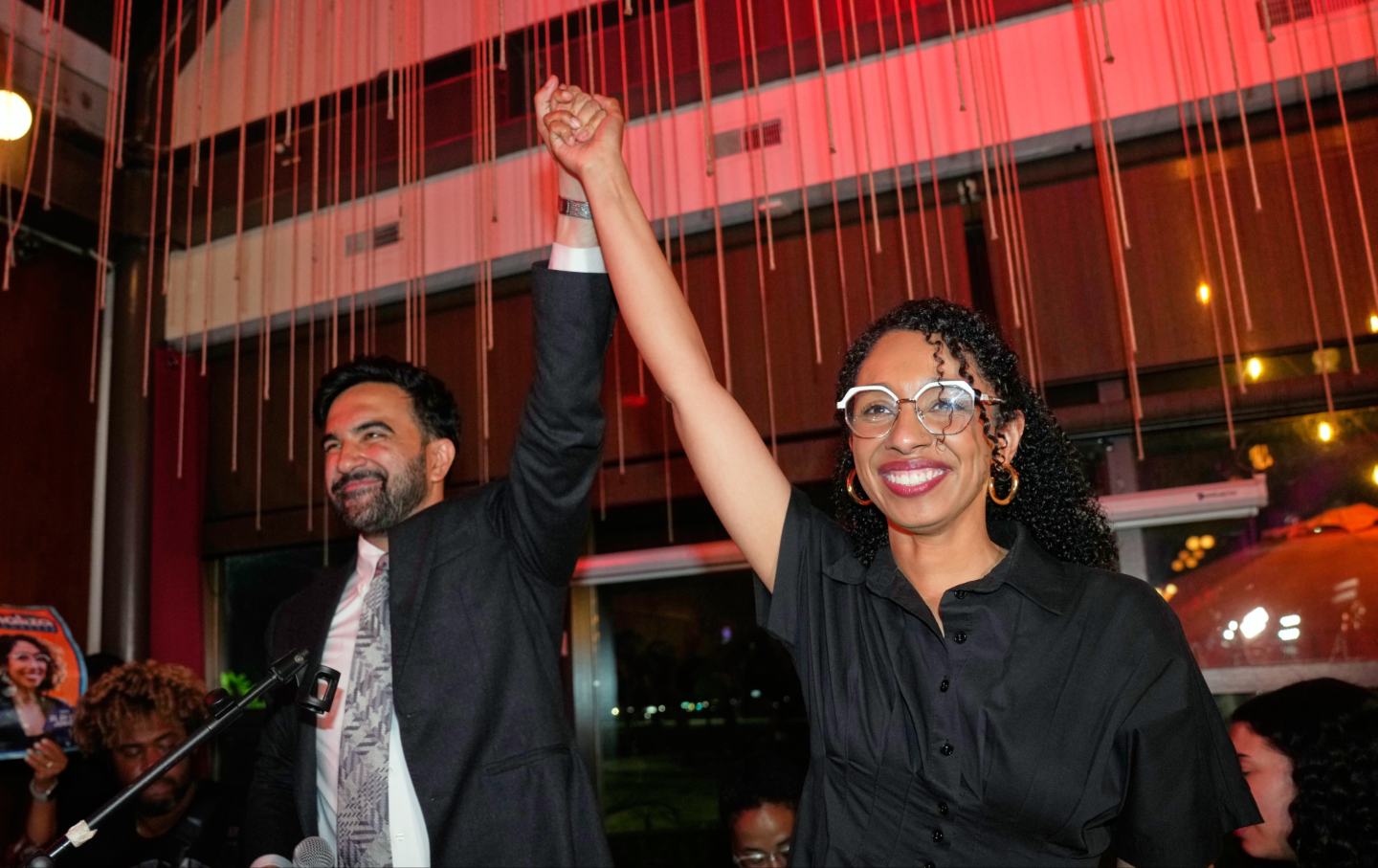
Congressional candidates Claire Valdez, Brad Lander, and Darializa Avila Chevalier join Mayor Zohran Mamdani at a rally in Brooklyn on June 18, 2026.
(Anthony Behar / SipaUSA via AP)
As a Palestinian and Lebanese American, I have had to watch for decades as our nation’s Congress, with barely any dissent, funded the Israeli military to the tune of billions of dollars per year. The idea that supporting Israel no matter what was all but necessary if you wanted to hold national office in this country was perhaps the most enduring rule in politics, even as that support resulted in the continued killing, displacement, and oppression of millions of people, including my relatives.
But the days of blank checks and blanket immunity for Israel are over. They’re never coming back. Anyone who doubted that undeniable reality need only look at Tuesday night’s elections in New York City, which saw pro-Palestinian candidates sweep to victory across the five boroughs. There were many factors behind these historic results, but one thing they confirmed without question is that support for Palestinian rights is driving unprecedented political change—and that nothing in American politics will ever be the same.
From almost the minute the polls closed at 9 pm on Tuesday, it was clear that a pro-Palestinian wave was crashing over New York City. The first person to experience the scale of this juggernaut was incumbent Representative Dan Goldman, who was trying to fend off a challenge to his left from former New York City comptroller Brad Lander. Goldman has been a vocal supporter of Israel’s oppression of Palestinians his entire political career, a position he maintained up to the end of this campaign. He refused to recognize Israel’s occupation of Palestinian land, denied the genocide in Gaza, and even admitted to not voting for New York City’s Democratic nominee for mayor, Zohran Mamdani, in last year’s city elections—undoubtedly because Mamdani was willing to reflect the views of the vast majority of New York City residents by standing up for Palestinian rights. When Goldman’s constituents were demanding relief from rising prices, their representative in Washington was unapologetically sending billions of dollars to fund Israel’s military, and even voted for Republican-led legislation to sanction the International Criminal Court to shield Israeli Prime Minister Benjamin Netanyahu from arrest.
In years past, those votes might have solidified his reelection. This year, they became the top attack line against him—one that no amount of big-dollar donations could overcome. It took all of four minutes after the polls closed for the race to be called. Goldman lost to Lander by 30 points—as much of a clobbering as any incumbent member of Congress can be dealt, outside of a criminal scandal—and became the first-ever member of Congress to unambiguously lose their seat because of their strong backing of Israel.
An hour later, it happened again. Months ago, very few people would have believed that Darializa Avila Chevalier, a longtime advocate for Palestinian rights who put her support for Palestinian liberation at the heart of her campaign, could unseat a five-term incumbent like Representative Adriano Espaillat. AIPAC and its allies threw millions of dollars into the race, relentlessly attacking Avila Chevalier and trying to save Espaillat, who refused to break with the Israel lobby. It didn’t work. In the most stunning upset of the night, Avila Chevalier ousted Espaillat. The crowd at her victory rally celebrated with thunderous chants of “Free Palestine!” as Mamdani looked on.
What’s clear now is that Avila Chevalier’s clear-eyed moral stance against Israel’s genocide was an asset to her campaign—just as it was for Lander, and for Claire Valdez, who easily beat Brooklyn Borough President Antonio Reynoso in her congressional primary while running on a pro-Palestine platform.
Current Issue

So, in one night, two members of Congress, both of whom share AIPAC as their largest career donor, had lost in substantial part because they had received that support, and because of the strings that come attached to those donations: denying Israel’s genocide of Palestinians, and voting for billions to Israel while Americans struggle to get by. This is going to send shock waves through our nation’s capital, where the majority of members of Congress in both parties still take those same donations and cast those same votes. So, too, will the fact that Mamdani, a pro-Palestinian mayor, chose to unambiguously back Lander, Avila Chevalier, and Valdez despite huge pressure from the Democratic establishment—and was rewarded handsomely by the voters.
Certainly, there will be some who want to keep their heads in the sand and tell themselves that cities and traditionally blue states are not representative of the country. The polling says differently. Our survey of voters in Texas’s March Democratic primary for Senate found 76 percent of those voters believe Israel is committing genocide, as do 76 percent of Democrats in the key swing state of Arizona—figures that exceed the 70 percent of Democrats across New York State who said Israel is committing genocide in our polling released this month.
And it’s not just a matter of public opinion, but voter mobilization. Taking a strong stand for Palestinian rights brings in energy like no other issue in politics today. The fact that it took a livestreamed genocide for this shift to occur is something we must always mourn. But the scale of Israel’s oppression of and brutality to Palestinians has turned this into a red-line issue for millions of voters who will simply not back anyone who remains complicit in such horror.
Though Democratic Party leadership may continue to deny it, it was that head-in-the-sand approach that clearly cost Kamala Harris key votes she needed to win in 2024. Keeping the same approach risks a repeat of that mistake in 2028. The demand from voters going forward is clear: Nationally, 71 percent of likely Democratic primary voters want their next presidential nominee to support cutting off weapons to Israel, and they support comprehensive sanctions against the Israeli government at similar levels.
In recent weeks, the Trump administration has escalated its public feud with the Israeli government over negotiations with Iran, a seeming recognition that conservative voters have also drifted away from supporting Israel. A May New York Times poll found that 63 percent of Republicans under age 45 support ending military support to Israel. It is far too soon to say, but the chance that Republicans will take the opportunity Democrats have so far passed on and claim the mantle of the “tough on Israel” party is no longer negligible.
Shifting toward where voters already are should not be a difficult question for the Democratic Party leadership. Continuing to fund Israel’s military is no more popular with Democratic voters than banning same-sex marriage, yet just one in three Democratic representatives have signed on to support the Block the Bombs Act in Congress. This level of a gap between party leaders and their voters is almost unheard of in recent history—and if it isn’t rectified quickly, Democrats in office will find that they once again were their own biggest obstacle to a governing majority.
It is not always the case in politics that the right and moral position aligns with the politically strategic position. Palestinian rights advocates like myself who have done this work for decades know it has been the result of incredible bravery, especially from Palestinians themselves, who have not been willing to be erased, brutalized, and slaughtered in silence, that has brought us to where we are today. Democrats have a chance now to stand hand in hand with them, and to live up to the values the party says it cares about most deeply. The time is now to do what is right, and what has always been right—and there are no excuses left not to.
With the midterm elections now firmly upon us, the question is whether Democratic candidates will do more than merely occupy ballot lines as mild alternatives to the red-hot crisis that is Donald Trump.
As Trump spends over $1 billion a day on a globally destabilizing war on Iran and admits that he doesn’t “think about Americans’ financial situation,” millions across the country are struggling with the surging costs of essentials. Democrats must seize this moment and advance bold, small-“d” populist ideas—not settle for cynical caution that once again snatches defeat from the jaws of victory.
The Nation elevates progressive ideas, movements, and elected officials achieving real change across the country into the national conversation. At the same time, our journalists are exposing how crypto and AI-funded super PACs are spending hundreds of millions of dollars to knock out candidates they oppose, reporting on the devastating impact of the Supreme Court’s evisceration of the Voting Rights Act, and sounding the alarm on attempts by red states to quickly redraw electoral maps, disenfranchising Southern Black voters.
We can play this critical role because of support from readers like you. This June, we’re raising $20,000 to power The Nation’s independent journalism in the run-up to November’s immensely consequential elections.
It’s in our power to build a more just society, and your support at this critical moment brings us closer to that bold vision. I hope you’ll donate today.
Onward,
Katrina vanden Heuvel
Editor and Publisher, The Nation
More from The Nation

A proposed new rule changing the way the federal government hands out money could be absolutely devastating for every single person in this country.
A stunning trio of congressional victories proved that the political earthquake the mayor and his allies ushered in was no fluke.

How a little-known investment vehicle became a major source of financing for Israel—and a flash point in New York State politics.

The vice president claims to have reached a new level of spiritual maturity, but the evidence is nowhere in the pages of Communion.