
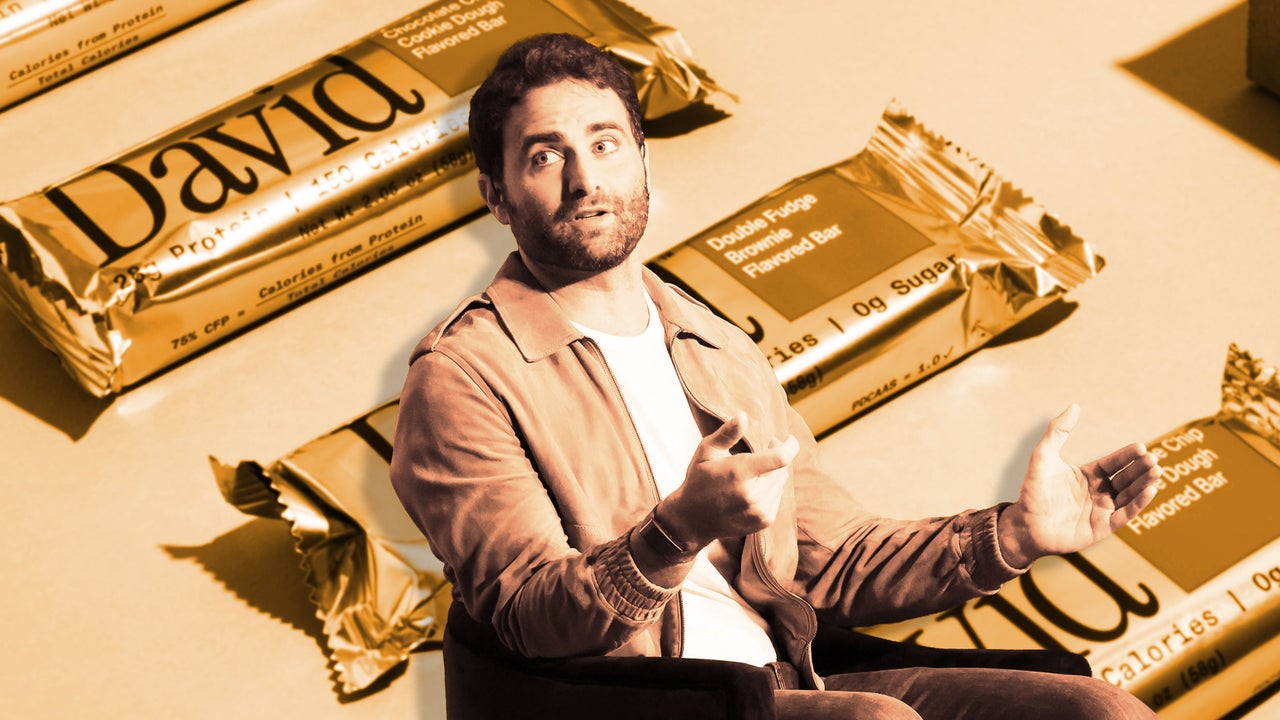
David protein bars went from startup to one of the hottest consumer products in America in under two years. But the ride has been anything but smooth. Founder and CEO Peter Rahal discusses building a breakout brand through lawsuits, a Jeffrey Epstein association, and the kind of social media heat most companies would run from. But can controversy—even the manufactured kind—be a net positive for a brand? Peter argues yes.
This is an abridged transcript of an interview from Rapid Response, hosted by former Fast Company editor-in-chief Robert Safian. From the team behind the Masters of Scale podcast, Rapid Response features candid conversations with today’s top business leaders navigating real-time challenges. Subscribe to Rapid Response wherever you get your podcasts to ensure you never miss an episode.
With David, it’s part of a new wave of bars with high protein and low fat. Few of them, though, pack the combination that David does. The package says 28 grams of protein, 150 calories, no sugar, which sounds impossible. And I guess it would be without the sort of special ingredient called EPG. If I understand it right, EPG is a kind of fat that’s hard for the human body to absorb.
It’s a hard fat, so it’s a high-melt-point fat, and it’s a modified triglyceride. Your body has an enzyme called lipase that breaks off the fatty acids from the glycerol backbone, and that’s where all the energy gets released. If you prevent lipase from doing that, your body can’t digest it. It’s really like a biohack. Your mouth experiences it as fat, but then your body isn’t able to break it down. And because it’s a 104-degree melt-point, it’s a hard fat similar to beef tallow or palm oil. It goes through your body in a solid state.
Were you already planning to do another protein bar, to do David, before you knew about EPG? Or was EPG like, “Oh, this enables me to do something,” and that made you think, “I’ll go back into this business”?
No, it was more that I was designing a protein bar from first principles. What do people want from a protein bar? They want the most protein, the least amount of calories, and obviously great taste and texture, and price, and some other factors. But really, you want a protein delivery system. Then there’s fat. You need fat for mouthfeel and texture, but with fat, you really don’t want any calories. In that search, I realized EPG [esterified propoxylated glycerol] was unequivocally the best fat to use. In that pursuit of the best fat system, it was pretty crystal clear that EPG was the one you want in a protein bar.
You wanted it enough that last year you bought the company that manufactured it, Epogee, that owns the patent. You were then sued by competitors for blocking their access to it, for terminating contracts. That suit was dismissed. But were you thinking from the beginning that you might want to use all the EPG yourself for David?
When we started to get traction, our demand was going to consume all the capacity Epogee could make. And if you’re on the Epogee side, it’s really hard to scale an ingredient company because you have this chicken-and-egg problem. You want people to adopt your ingredient. There’s not enough supply to service the demand. There’s not enough demand to justify the creation of more supply. So the Epogee team basically came to me and said, “We have a crazy idea.” And I was like, “Let’s hear it.” They said, “Let’s merge and you guys take it over, because you really kind of need to vertically integrate these businesses.” So it wasn’t just a straight acquisition. They’re on the cap table today.
I can imagine that when you then get lawsuits from competitors saying, “Oh, you did this to screw us,” it’s got to be like, “No, no, no, they came to me.”
Yeah, they came to me. And they would’ve been screwed even if the deal didn’t happen, because there was no supply, and we had a supply agreement that gave us the right to all the inventory that was available.
You faced some other controversy in the short, intense rise you’ve had. There was a class action lawsuit challenging your labeling, which was also withdrawn. But it claimed there was more fat and more calories than listed because of the way you calculate EPG.
Well, it wasn’t that. It was actually that they just didn’t know about EPG. And I think the thing is, anything that’s really innovative and new in our culture and the world gets misunderstood.
So you think of these as well-meaning concerns, as opposed to a stunt by competitors trying to slow you down.
It’s just part of the territory of innovation.
Are there any ways that controversy like this is good for a new brand? Like, the more people know you, the better?
Yeah, I think over time, it’s a net positive. It’s bringing attention to something innovative. It’s teaching people. It’s educating in a way. All things equal, you’d rather have people talking about you than not.
I have one more bumpy moment I have to ask about. Your chief science officer and initial investor was the author and wellness guru, Dr. Peter Attia. He stepped down after previous communications with Jeffrey Epstein surfaced in court documents. How did you and Peter connect, and how did you personally react when you heard about this Epstein connection?
Yeah, so I met Peter through a friend. Peter was America’s doctor. He was the voice of nutrition and really influential. I wanted someone to guide us on the science, so we agreed to have him as the chief science officer. Then I think it was February. I woke up on a Saturday morning, checked X, saw the Epstein files had been released, and Peter was in them. I was like, “Of course, he’s probably the best private-practice doctor in America. I’m not surprised he had patients in that world, whatever.” Then everyone was like, “Oh, shit, people are going after him. He’s a doctor. You can’t be hanging out with Epstein.” And then I was like, “Oh, this is bad.”
Peter came to the conclusion, like, “Hey, listen, I need to take a step back from my responsibilities, focus on my family most importantly, and focus on my practice.” As a company, we stand with the victims, and it’s obviously frustrating that the DOJ isn’t doing anything for the victims in all of this, and it’s quite gross. We stand with the victims and respect Peter, but yeah, we had to go separate ways.
David’s in 16,000-some retailers now, but you started selling via TikTok Shop. I’m curious: It’s tough to address challenges on social media platforms in general for a lot of brands, for a lot of people. How did you approach that kind of challenge, whether with the lawsuits or Attia or other detractors? Is there a philosophy you have about the way you communicate on social?
Yeah. The population consumes different media, and the generations consume different media, and that’s the tricky part. Boomers are watching TV, maybe on Facebook. Millennials are primarily on Instagram. Gen Z is on TikTok, and so is Gen Alpha. So you have to address all those information routes. I think the most important thing is speed and directness. If you don’t have a platform and audience, you just get lost. Thankfully, I have a good reputation, and if I post something on X, people will listen to it, and it gets exposure. So that’s really helpful. But on TikTok, what’s interesting is our strategy is, yes, we can say something, but if it’s not entertaining, it doesn’t get picked up.
And I was curious, the name David—did you worry at all about it appealing less to women?
No. Men will not consume feminine things. They just don’t. Women will consume masculine things if they’re aesthetic or beautiful. If anything, it’s cool for women to consume masculine things if they’re aesthetic, but the inverse does not happen. You would never have a pink protein bar. You’d be like, “That’s not for me.” But if you were to have a protein bar that was masculine yet had good design or aesthetic, you would consume that, and your wife would, too.
And when you look at who the customers are for David, that has been borne out, that it’s balanced?
No, it’s actually 60/40, female to male.
So you picked the male name so that you could appeal to the men, because you could have made it pink.
It’s not about appealing to men. It’s about not turning off men, really. We don’t have gender in language in English like other languages do, but if you were to give a gender to a protein bar, it would be a man.
Because?
It’s masculine.
I mean, because protein isn’t just masculine. Women have protein, plenty of protein in . . .
Yeah, of course. But it’s not about that. Something can be masculine, and masculine and feminine can live in both genders. It’s just about the energy of it. It has masculine traits. So therefore, if you’re going to give it a gender, you give it a man, a masculine thing.