Want more housing market stories from Lance Lambert’s ResiClub in your inbox? Subscribe to the ResiClub newsletter.
As federal policymakers push for restrictions on institutional ownership of single-family homes, many firms operating in the single-family rental (SFR) and build-to-rent (BTR) spaces are pulling back on future acquisitions and developing rental communities. One industry insider explained it this way to ResiClub: “The unknown is the hardest part. If you don’t know the rules of the game, what do you do?”
To better understand how institutional groups are responding, ResiClub surveyed 14 institutional SFR owner/operators, developers, and investors between April 28 and May 26.
Our final respondent pool only included institutional or large operators that own at least 100 single-family rentals and build-to-rent developers. Half of respondents reported portfolios of more than 1,000 SFR homes. We excluded respondents who either did not meet our criteria or whose eligibility we could not verify. Not every respondent answered every question in the survey, so response totals vary by question.
Here are our top-line findings:
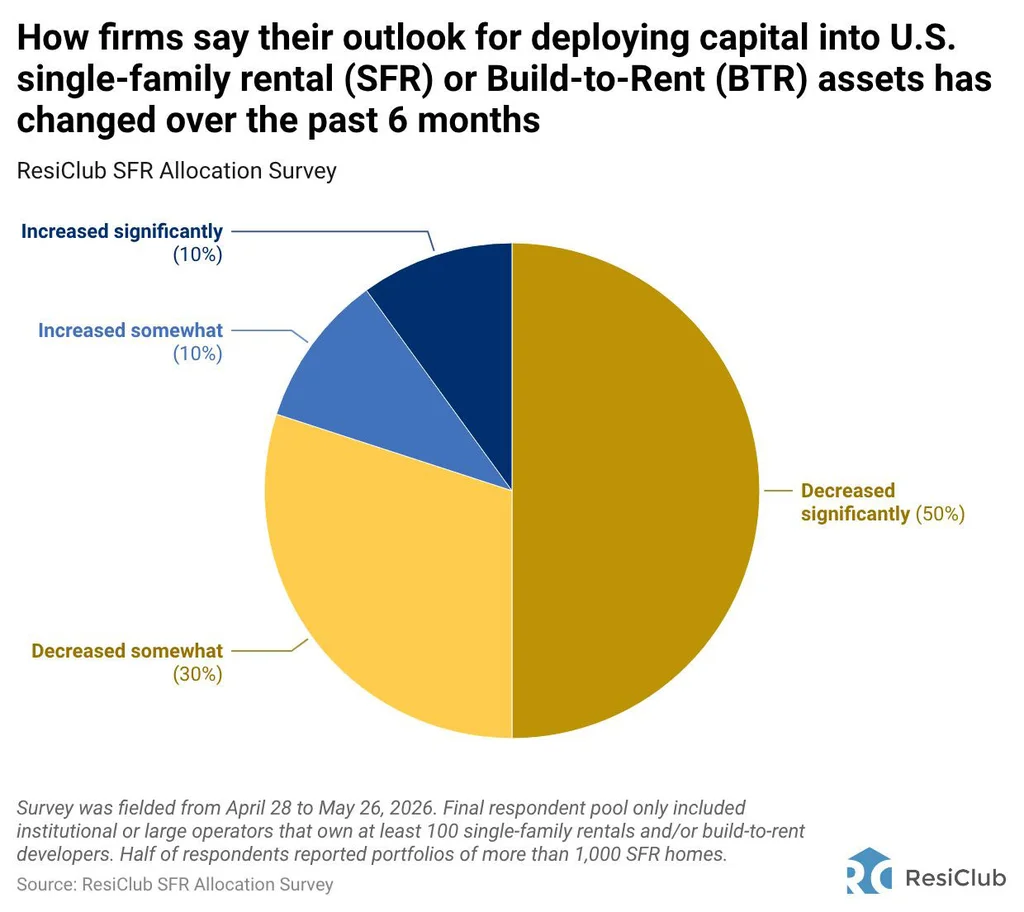
- Sentiment toward deploying capital into SFR/BTR has deteriorated sharply: 80% of firms said their outlook has worsened over the past six months, including 50% who said it has “decreased significantly.”
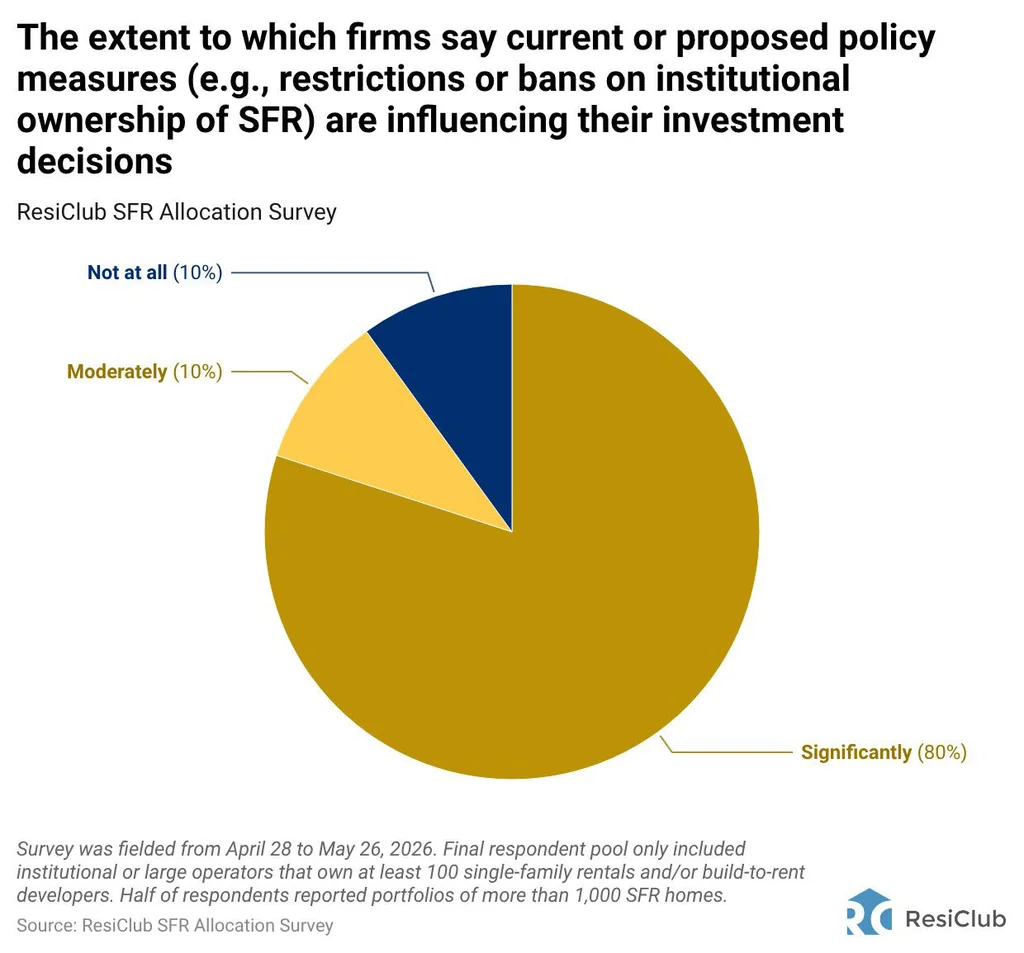
- Policy risk is now a major investment consideration for institutional SFR firms, with 80% saying current or proposed policy measures are “significantly” influencing investment decisions.
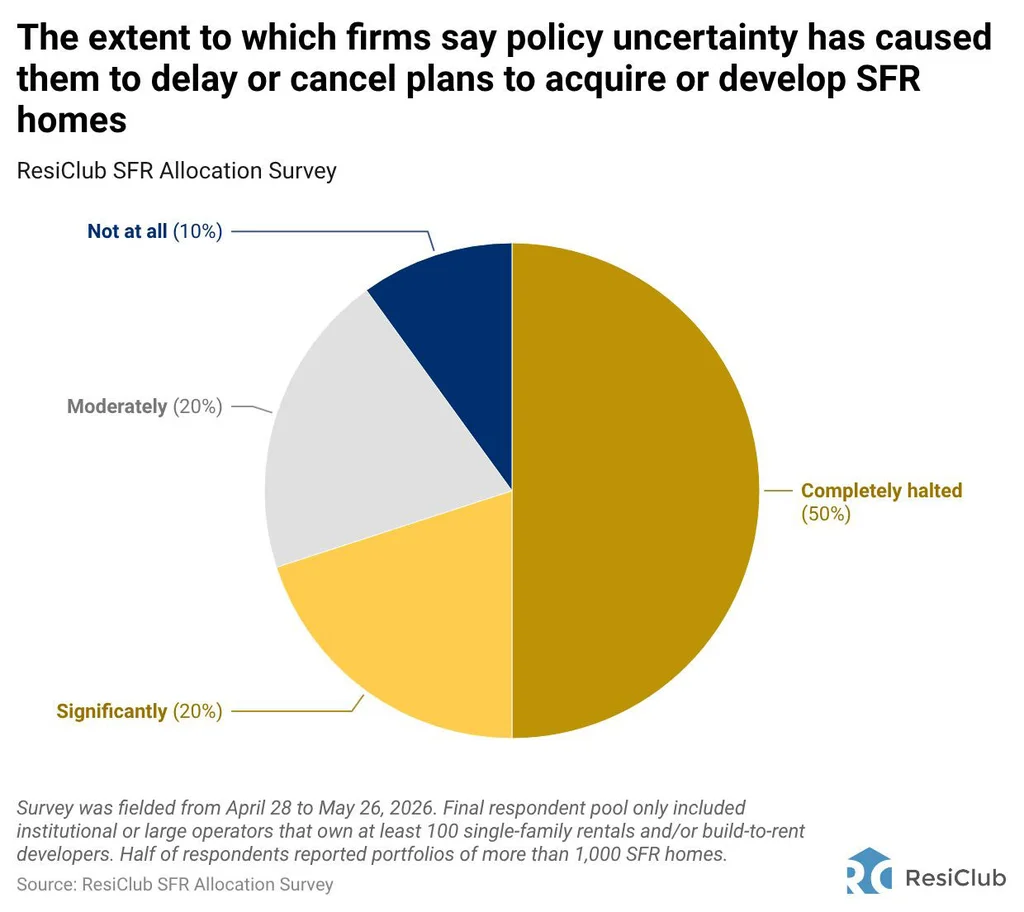
- Policy uncertainty is already affecting real-world housing activity: 70% of SFR and BTR firms said uncertainty has either significantly disrupted or completely halted acquisition or development plans.
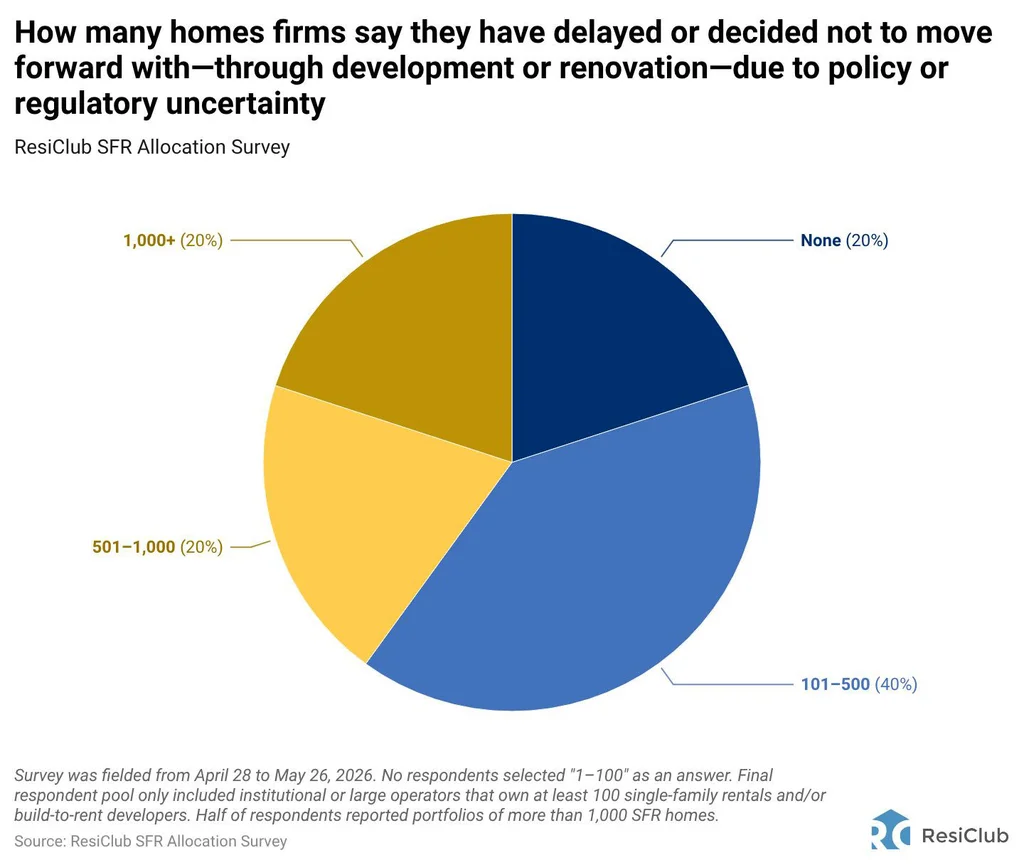
- 4 out of 5 surveyed firms reported delaying at least 100 homes due to policy or regulatory uncertainty.
- In aggregate, these firms said they have delayed or decided not to move forward with 6,000 single-family homes—whether through build-to-rent or fix-to-rent strategies—due to policy and regulatory uncertainty.
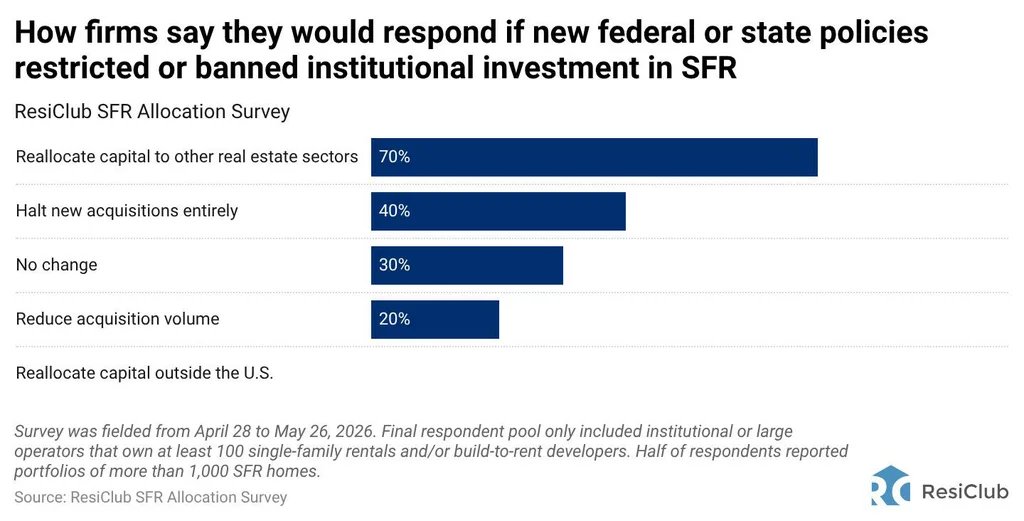
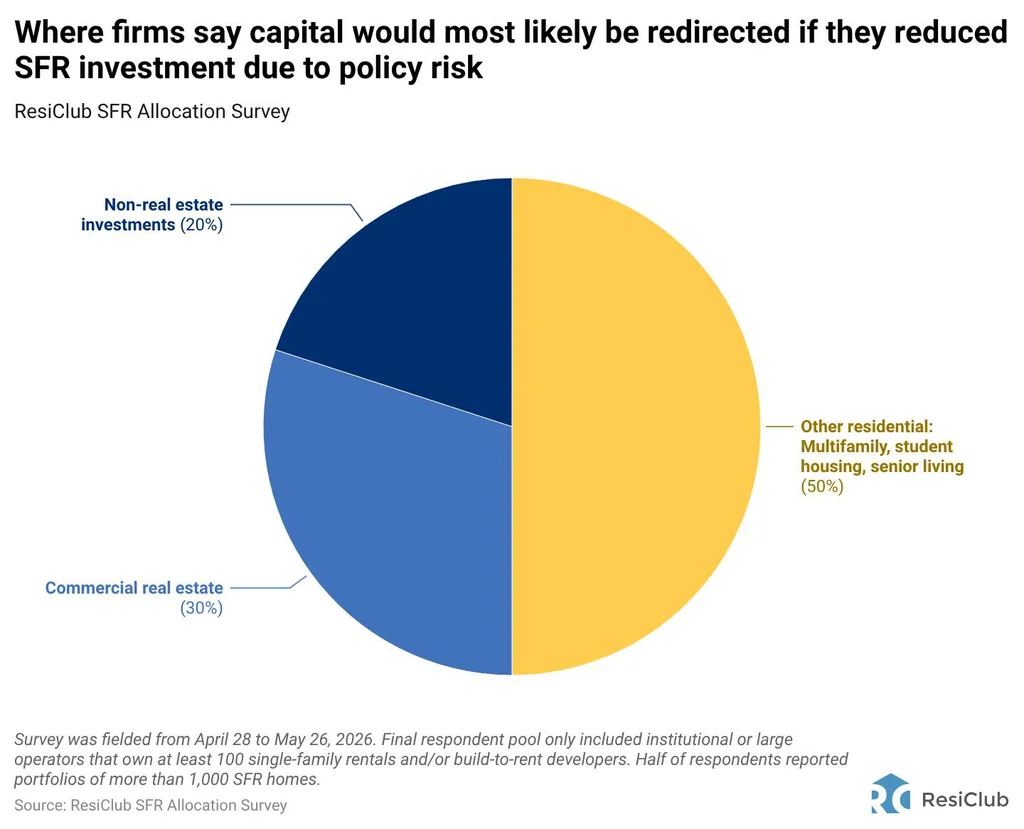
- 80% of firms said they would redirect capital into other real estate sectors (office, data centers, student housing, multifamily, etc.) if institutional SFR investment were restricted or banned—20% say they’d redirect capital to non-real estate sectors.
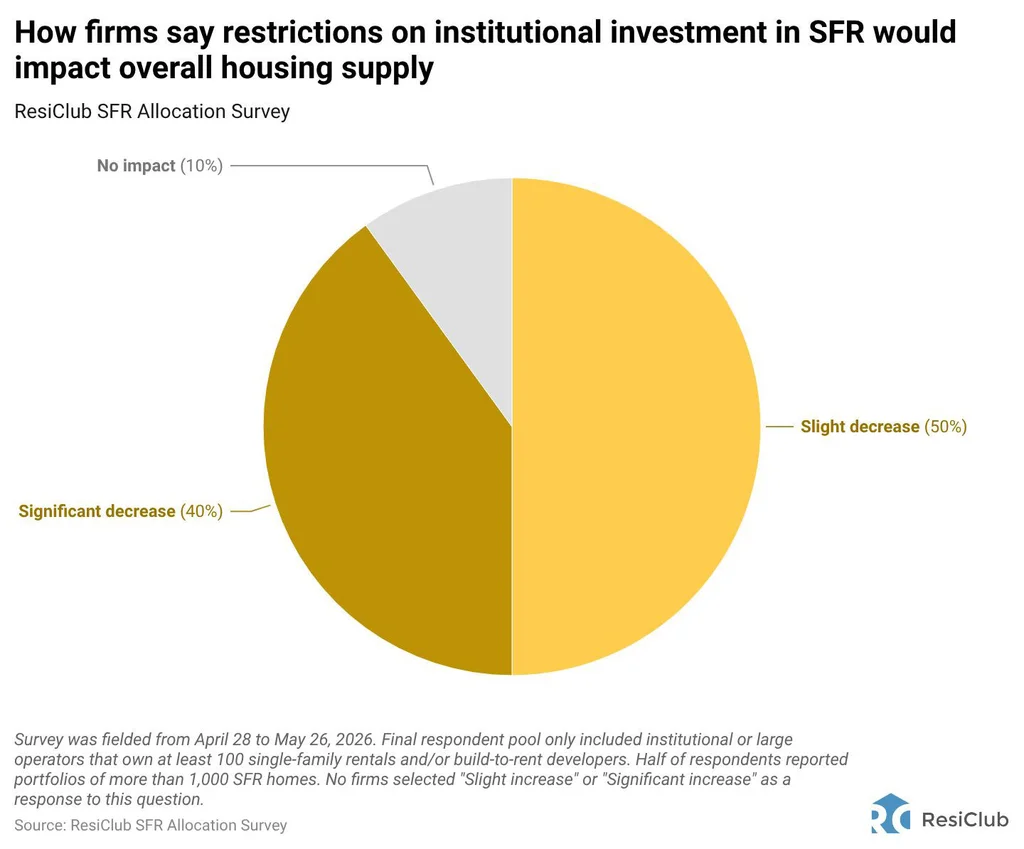
- Respondents overwhelmingly believe restrictions on institutional SFR investment would reduce housing supply, with 90% expecting either a slight or significant decrease in overall supply.
- 70% of respondents rated the current level of policy/regulatory risk for institutional SFR investment as high, including 60% who selected “very high.”
- Firms are increasingly cautious on future SFR expansion: 60% said they are unlikely to increase SFR exposure over the next 12 months, given the current policy environment.
Below are the full results from the survey:
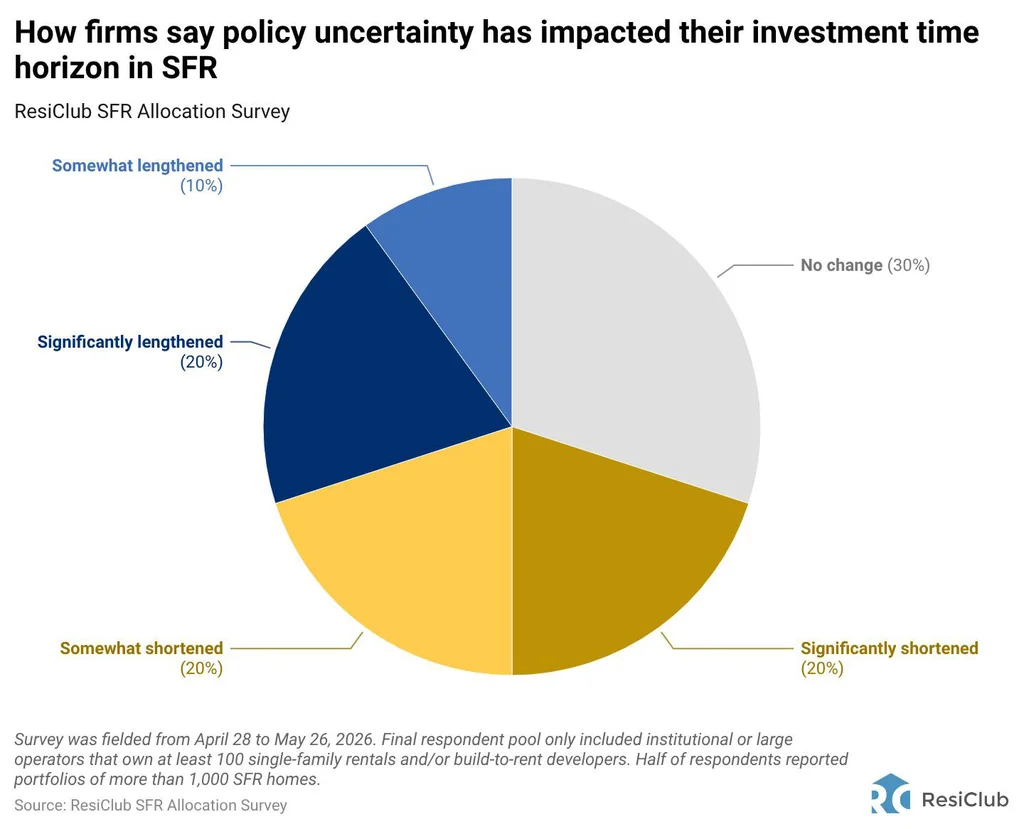
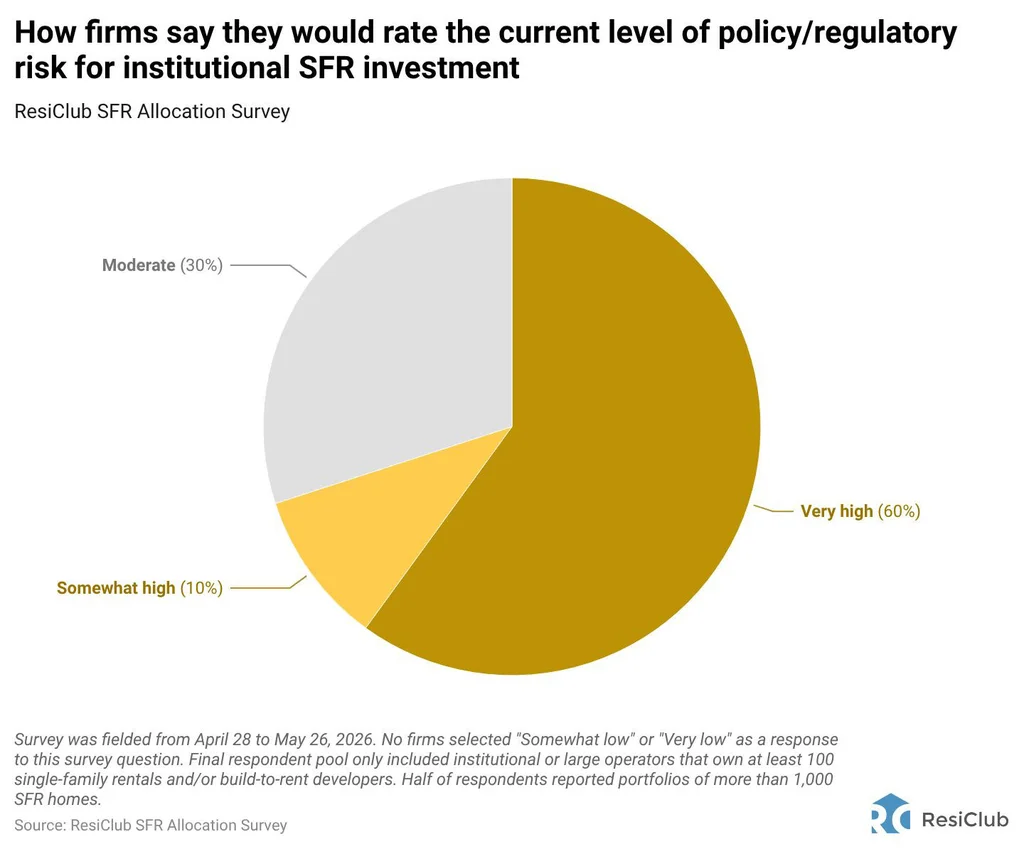
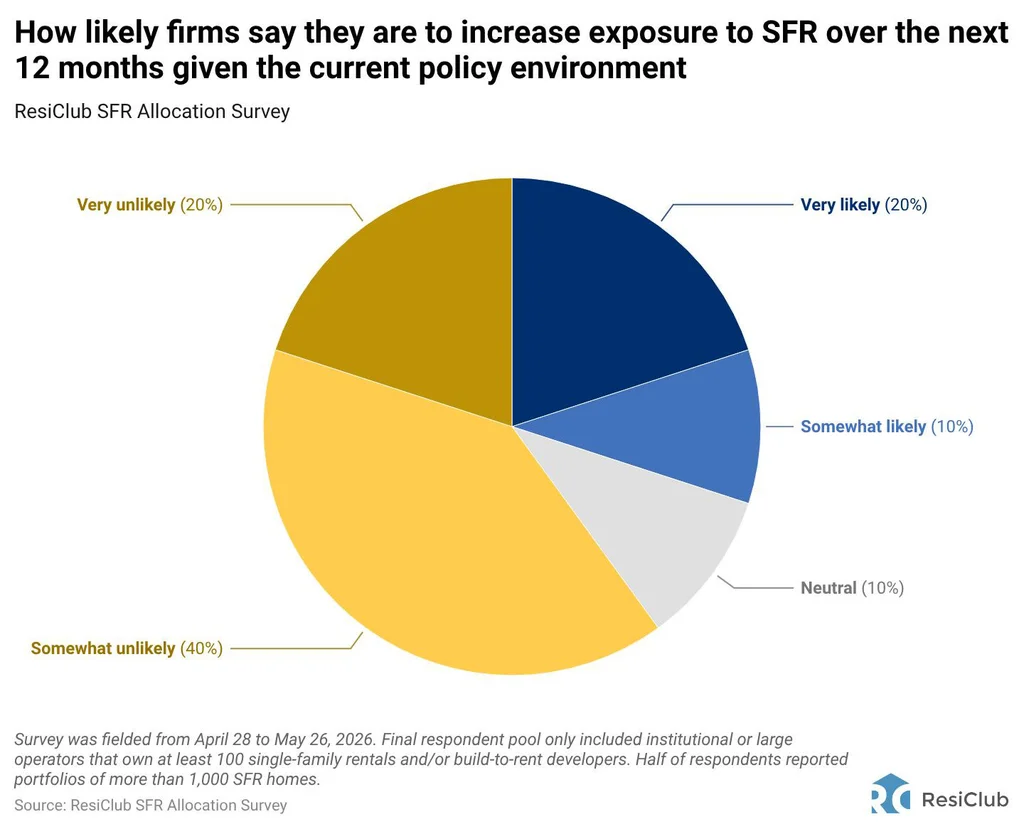
Where the political fight to ban institutional homebuying stands today
On January 7, President Trump announced he was taking steps to ban large institutional investors from buying more single-family homes and called on Congress to codify it. On January 20, he went further with an executive order directing Fannie Mae and Freddie Mac to stop backing purchases by large institutional investors—while explicitly promising a build-to-rent exemption in whatever ban Congress ultimately passed. By February 19, the White House had reportedly settled on defining “large investors” as entities owning 100 or more homes.
What Congress delivered was somewhat different. On March 2, Sen. Tim Scott (R-SC) and Sen. Elizabeth Warren (D-Mass.) released the 21st Century ROAD to Housing Act, setting the threshold at 350 homes. The Senate passed it, 89–10, in March. (ROAD stands for “Renewing Opportunity in the American Dream.”)
But the bill came with a catch that alarmed the housing industry: While build-to-rent properties were technically exempted (purchases of homes that require major repairs were also exempted), institutional landlords would be required to sell those homes acquired through the exemptions to individual buyers within seven years of purchase. The National Association of Home Builders withdrew support. A bipartisan group of 76 House members signed a letter calling the sell-off rule a measure that would “effectively halt the production of build-to-rent housing nationwide.”
What the House changed last month
In May, the House made several changes to the Senate version. The House bill, which passed the chamber, would still “ban” large institutional investors from purchasing additional single-family homes, except through designated exemption pathways. Institutional SFR landlords—defined by the bill as entities that control 350 or more single-family homes—would be allowed to keep the homes they already own.
What’s gone is the seven-year sell-off. Under the House version, BTR is a clean exemption: Institutional investors can build single-family rentals (i.e., build-to-rent homes) or buy newly constructed homes for rental and hold them indefinitely, with no forced disposition clock. Fix-to-rent/renovate-to-rent properties are similarly freed from the sell-off requirement.
The Senate bill required institutional investors to spend at least 15% of a home’s purchase price on renovations to qualify for the “renovate-to-rent” program. The House version drops that numerical floor. Instead, it simply requires that the home be in poor condition—meaning it fails local building codes or standard mortgage inspection requirements.
Where the policy fight heads from here
We’ll have to wait and see how the Senate reacts to the new bill. Some congressional insiders have told ResiClub that there’s a 70% chance the housing bill passes this year—and does so without the proposed seven-year sell-off requirement on homes acquired through the exemptions.
That said, those same insiders told ResiClub there’s roughly a 30% chance that nothing is signed into law at all this year. In the meantime, as today’s ResiClub survey shows, there’s a tremendous amount of uncertainty and paralysis running through the SFR and BTR industries right now.
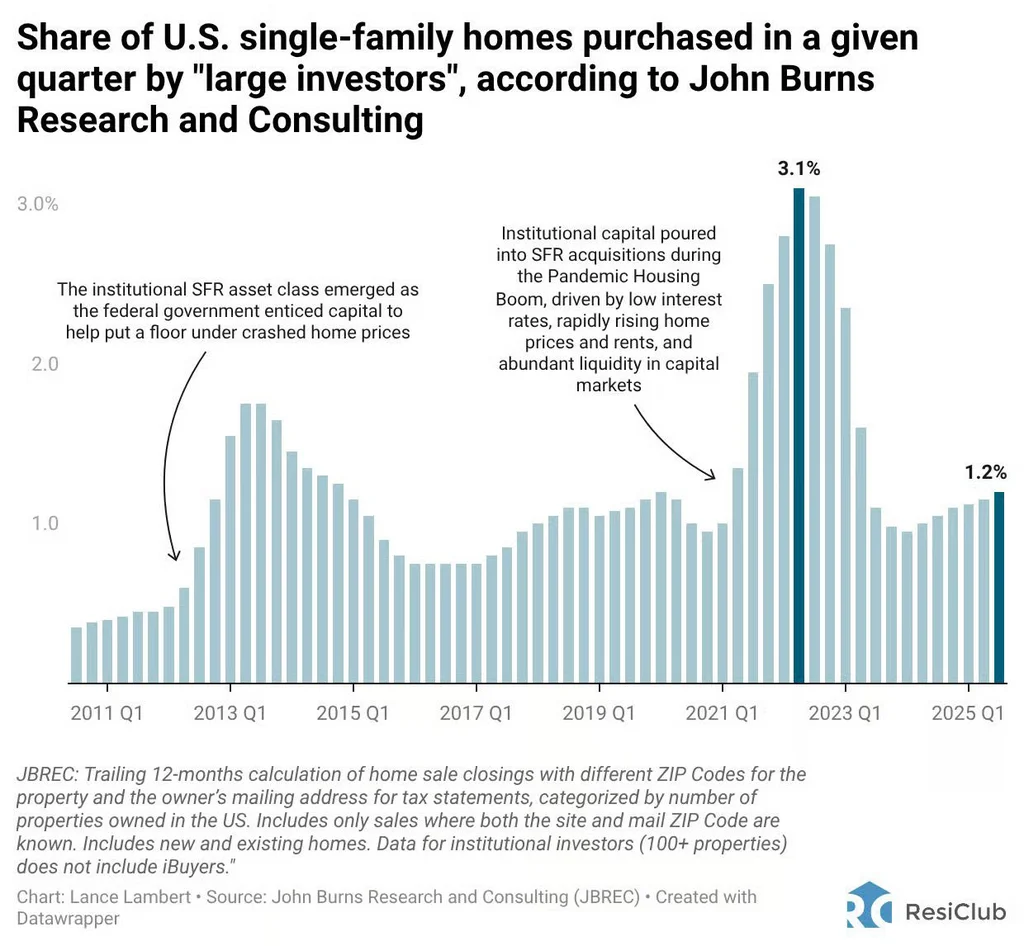
Institutional scatter-site homebuying in the resale market leveled off before talk of a federal institutional homebuying ban emerged
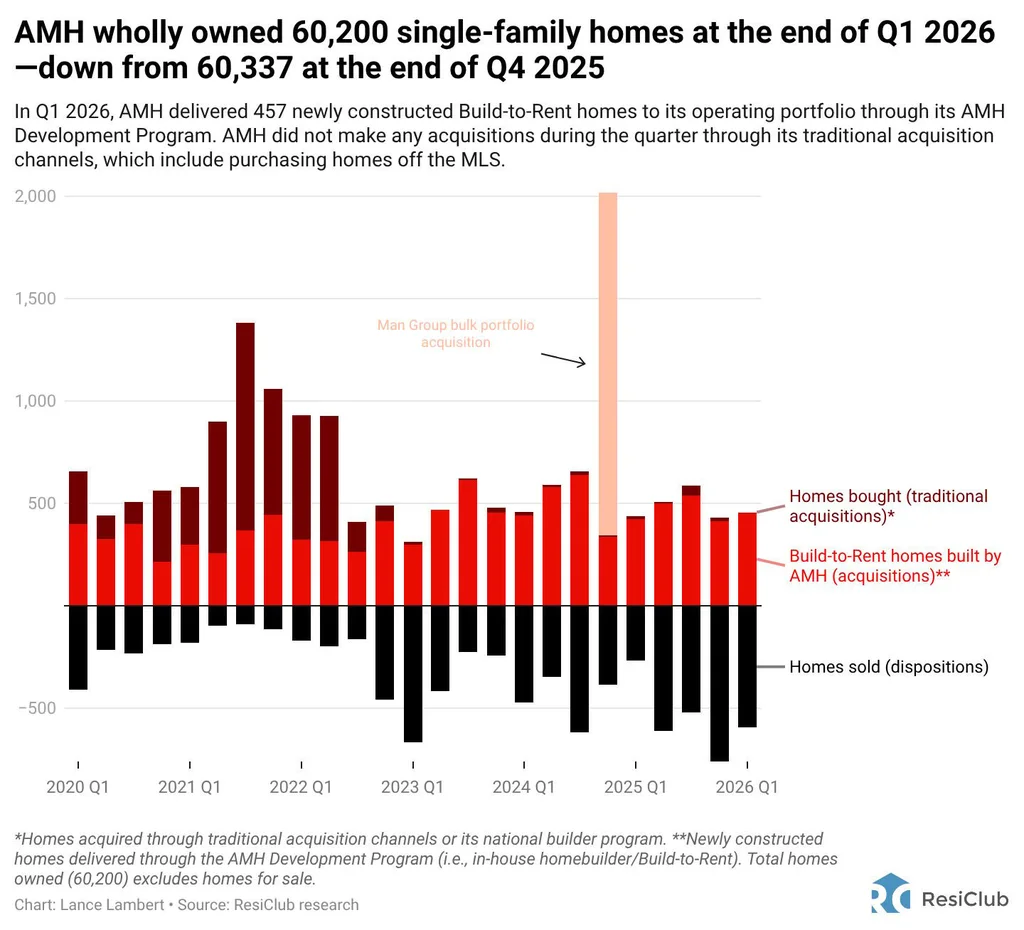
At the height of the pandemic housing boom, large investors—those owning at least 100 single-family homes—made up an all-time high of 3.1% of home purchases in Q2 2022, according to John Burns Research and Consulting.
That period, at the tail end of the boom, was when yields were particularly attractive as borrowing costs were ultra-low, home prices were soaring, and rents were climbing rapidly. However, since mortgage rates spiked and capital markets shifted, their share has fallen to around 1.0% of transactions over the past three years. The math isn’t as favorable since the market shifted and rates spiked in mid-2022.
Below are some bonus ResiClub charts
For the chart directly below, we don’t have the most recent results from John Burns Research & Consulting. However, we still shared it, given that it does a good job of showing the historical trend.
Institutional landlords are still a small piece of the single-family rental markets. Mom-and-pop landlords still dominate single-family rentals.
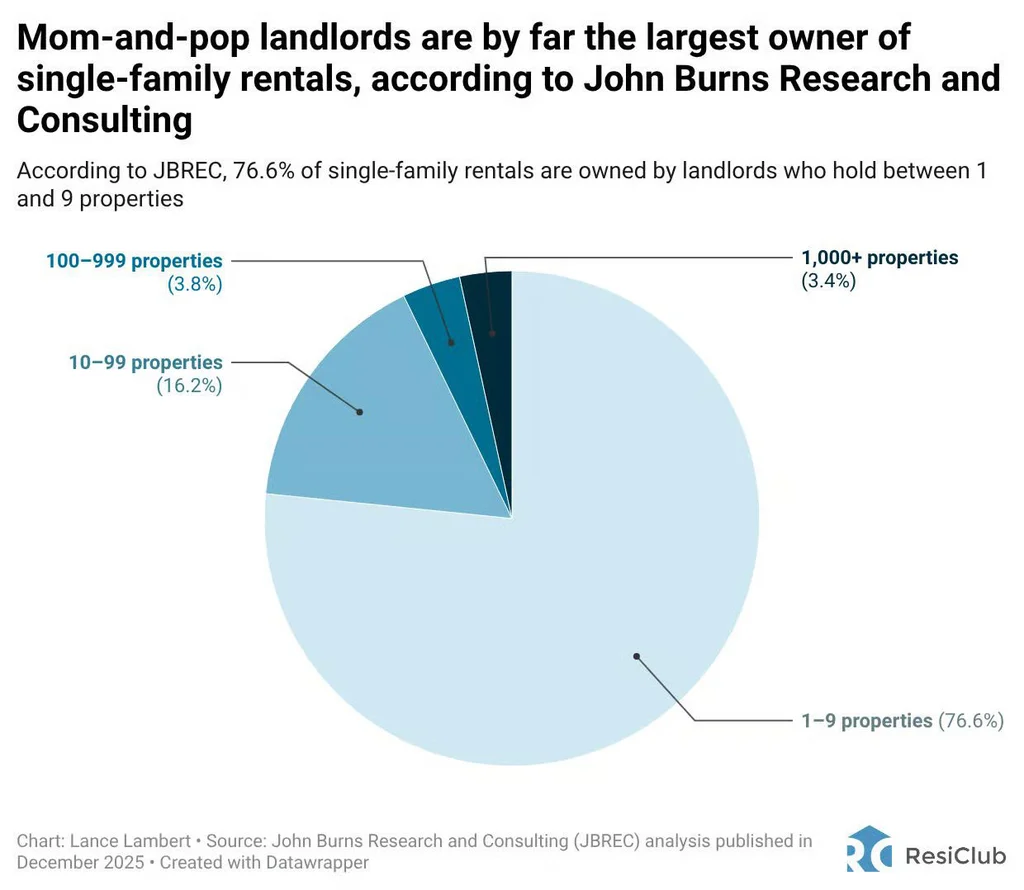
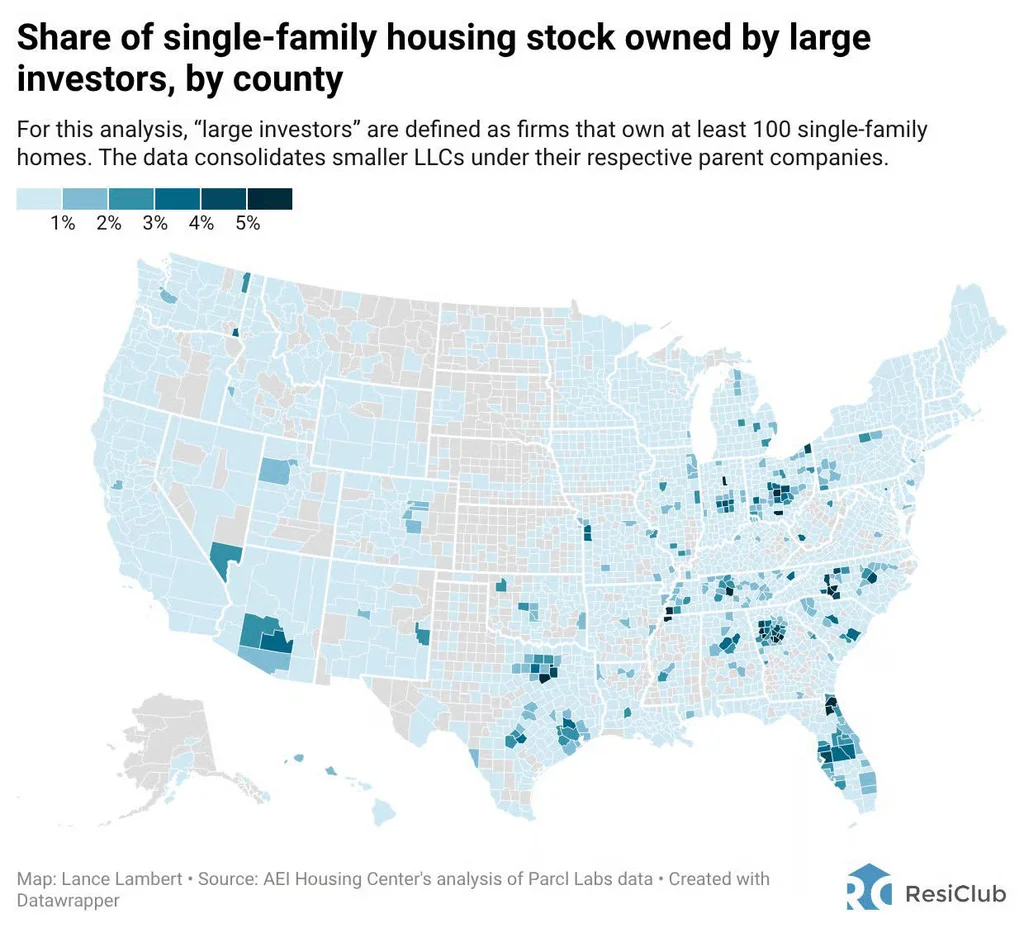
While institutional operators represent a tiny slice of the nationally aggregated single-family rental market, there are regional pockets—particularly in growth markets such as Atlanta; Dallas; Phoenix; Tampa and Jacksonville, Florida; and Charlotte, North Carolina—where their share is notably higher.