
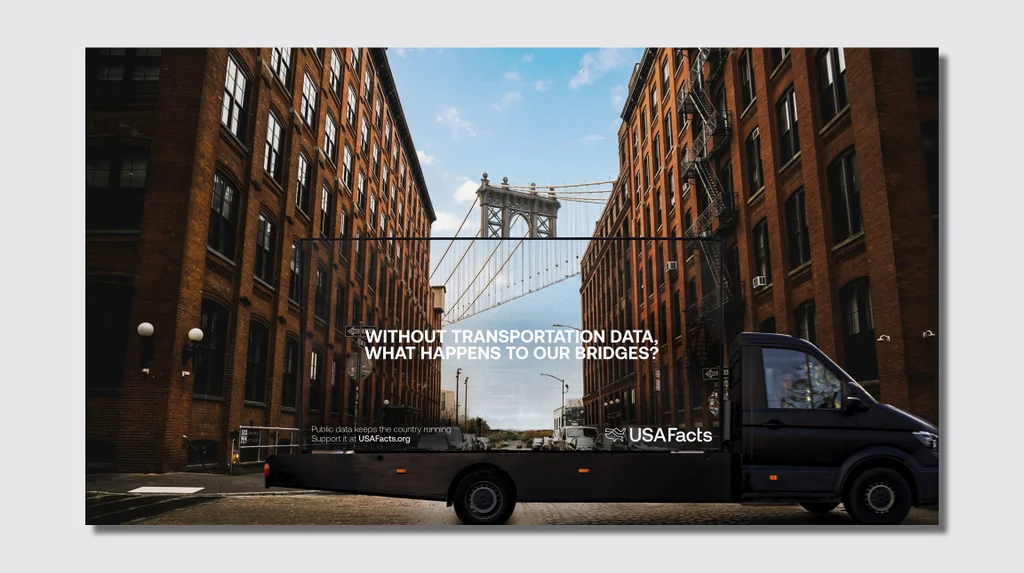
More than a year into President Donald Trump’s second term, the landscape of the country’s robust public data collection and publishing infrastructure has deteriorated. Federal reports on everything from billion-dollar climate disasters to food insecurity have been scrapped; thousands of workers involved in government data collection have lost their jobs.
USAFacts, the not-for-profit focused on making government data more accessible and understandable, has been reacting in real time. And now, its new president Lauren Woodman, who took the helm on April 20, is looking to empower voters ahead of the midterms to call for better data infrastructure to inform genuinely impactful legislation
It’s not only Trump putting all this information at risk. There’s also rise of AI, which highlights concerns about accuracy and data quality, and how people across the country access information. If federal data sets are difficult to access or not frequently updated, that means those AI systems aren’t surfacing the best information.
It can feel like a daunting moment. USAFacts, a nonpartisan organization founded by former Microsoft CEO Steve Ballmer, sees it as a unique opportunity—one that could shape how involved Americans are in civic life.
USAFacts is launching a campaign, called The Data We Depend On, to highlight the role data plays in everyday Americans’ lives and to call on Congress to invest in better public data infrastructure—and actually use that data in policymaking decisions.
“This is one of those moments [that] is really going to be transformational,” Woodman says. If USAFacts can help update that public data infrastructure so that “every citizen has access to information about the way their community works,” she says, “that gives us the opportunity to shape what the next 20, 30, 40, 50 years looks like.”
‘Government data affects everything we do’
Before joining USAFacts, Woodman was the CEO of Datakind, a nonprofit that brings data science to other nonprofits, and previously helmed NetHope, which improves digital services for humanitarian organizations.
She’s been aware of USAFacts since its launch in 2017, and recognizes its potential. While at NetHope, she says, the public perception that foreign aid was a massive part of the U.S. budget was always a challenge; in reality, it accounts for less than 2% of government spending. That figure is one kind of datapoint USAFacts has long aimed to make clear to the public.

But not every American is attuned to the importance of government data, or understands how it affects their own lives. Woodman gets this, too.
“I have two teenage daughters, and when I told them I was going to work for USAFacts, they were like, ‘What?’’ she says. “That’s actually one of the things we want to tap into—how is it that that government data gets used to make decisions that affect all of us in our daily lives, even though we may not understand it?”
Decisions like where new hospitals or schools should be built, or what public infrastructure like roads and bridges need the most urgent repairs. Farmers require accurate weather data. Insurance companies rely on climate, health, and demographic details.
“It’s an opportunity for us to explain and raise in the public awareness how many ways government data affects everything that we do,” Woodman says. “You name it, there is some underlying government data that is part of that process.”
The Data We Depend On campaign will illustrate such examples through mobile out-of-home visuals (throughout New York. Los Angeles, Washington, D.C., and Miami) of what we lose when we lose government data: broken roadways, disappearing hospitals, and so on. The nonprofit has dubbed these The Fact Fleet.
Though an aim of the campaign is to get lawmakers using more data, Woodman says the core goal of making data available in an “accessible, user-friendly, easily consumable way” helps everyone participate more in civic life.
Without facts and figures, regular Americans may not feel empowered to weigh in on policy decisions. Or they just might not understand how decisions get made.
If they see their lawmakers citing data, though, or can find information themselves, they may respond more—voicing support for certain political decisions, or bringing up something themselves at, say, a local town council meeting.
Calling on Congress
Because of the direct relationship between data and our day-to-day lives, the nonprofit is calling on Congress to hold government agencies responsible for collecting data, to make investments to update the national data infrastructure, and to point to data themselves when making public policies.
Actually holding Congress accountable for all that is tricky, Woodman admits. USAFacts has tried to do so previously by giving out its Federal Data Excellence Awards, suggesting questions for Congressional hearings, and tracking government data on its own dashboards. But USAFacts can also make it as easy as possible for Congress to take such steps.
“We do want them to point to how they’re using data and making decisions, and we help with that by making that data accessible and making it easy,” Woodman says. “We want constituents to know that their policymakers are using data, and so we can open up that conversation so the policymakers feel comfortable saying ‘This is what the data tells me, this is why I made the decision.’”
As part of The Data We Depend on campaign, the nonprofit is asking Americans to sign an open letter to Congress, alongside Ballmer, that asks lawmakers to use data to legislate and to fix the data when it falls short.
USAFacts hopes for 100,000 signatures by the end of July, and 1 million by the midterms. The letter form asks for signatories’ zip codes so that in D.C., Woodman can present a list of constituents to show lawmakers all the people in their district who want these actions.
Updating for the AI age
As for actually how to fix our data infrastructure, USA Facts has suggestions. The nonprofit has released a report, co-authored with the Center for Open Data Enterprise, that outlines a vision for the country’s national data ecosystem.
That includes studying data needs by sector (like “public health,” for example); maintaining critical datasets by fully implementing the Evidence Act, a 2019 law that requires federal agencies to have their data “open by default”; ensuring funding for data collection; and tech updates, predominantly around AI.
“Our data systems are not necessarily interoperable. They’re not AI machine-readable. They’re not easily understood to systems that want to go in and grab data and make sense of them,” Woodman says. Certain data sets require the information to be downloaded, for example.
If quality data isn’t accessible to LLMs, she adds, then those chatbots may pull data from outdated press releases or summaries that lack context. That leaves people ill-informed.
USAFacts has integrated a chatbot to answer questions on its own website—including for its annual Government 10-K report, which totals nearly 260 pages. But Woodman knows not everyone will go to USAFacts’s own website; all government data, she says, should be AI accessible.
“We’re starting to look at, How do we meet people where they are, the types of tools that people are using today?” Woodman says. “How do we make those able to access the data that we collect and provide?”
There’s a sense of urgency with how quickly AI is moving. By highlighting the tech updates our data infrastructure needs now, she also hopes that instills better data maintenance going forward.
“Data systems need constant care. They’re not ‘build it once and then let it sit and wither on the vine,” she says. “What we hope is that by highlighting the need to make systems ready for where we are right now from a technology perspective, ongoing maintenance in the future is not a big lift.”