
Jon Wiener: From The Nation magazine, this is Start Making Sense. I’m Jon Wiener. Later in the show, a segment from the archives: Elmore Leonard, who died in 2013 at age 87, was unpretentious about his massive accomplishments: 45 novels, more than a dozen turned into movies, and a reputation as one of the great writers of dialogue. We spoke in 2000, about where he got his bad guys, and about his movies “Get Shorty,” “Jackie Brown, ” and “Out of Sight.”
But first: our analysis of Tuesday’s primaries, with John Nichols – that’s in a minute.
[BREAK]
For today’s political update, we turn to John Nichols. Of course, he’s executive editor of The Nation. John, Welcome back.
JN: Jon, it’s an honor to be with you.
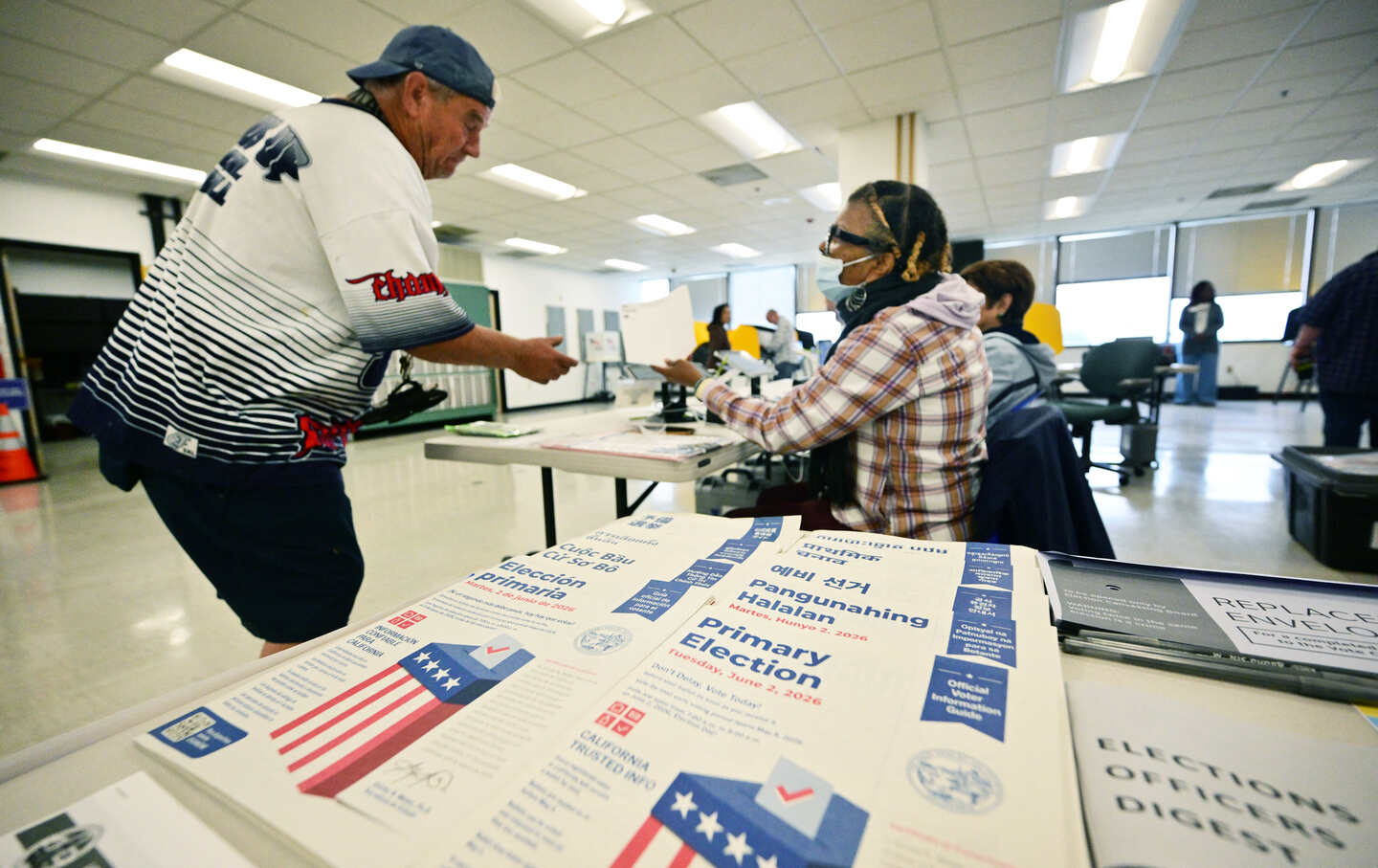
JW: The big primary this week, of course, was the California governor’s race. That’s the jungle primary, where two Republicans and eight Democrats all competed for the top two slots who go to the November final. California’s vote count is notoriously slow. We are speaking Wednesday at midday. The count as of this morning is 58% in. And the governor’s race is currently rated “too close to call.” Republican Steve Hilton is at 28%. Establishment Democratic candidate Xavier Becerra, 25, taking the lead among Dems. Tom Steyer, the billionaire climate activist supported by progressives, is at 20%, so it looks like Stier will be out. And Becerra seems likely to be the next governor of a blue state.
Gavin Newsom has been the California governor who has led the national resistance to Trump, especially on gerrymandering. Is that something that we are confident Xavier Becerra is going to be able to continue?
JN: I think the reason this was such a competitive race at the end is because a lot of people weren’t confident of that. And, you know, I’ve covered Becerra for a long time and I’ve seen him do some really good things along the way. He is a, a mixed bag politically. I think it’s fair to say he’s been around politics for an incredibly long time.
JW: Yeah. Let me just say he was elected to Congress in the old, old days from Los Angeles and was active in the Progressive Caucus.
JN: Absolutely. And then he you know, he’s run some winning races, some not winning races along the way. But I think his history, you know, has been one of being a pretty mainstream Democrat with some some reasonably progressive tendencies, but also not a firebrand, not somebody who’s thought of as, you know, doing this sort of thing that Newsom did, right, which is just, you know, kind of take over social media, appear on every TV show, etc.. I think of Becerra more as a managerial Democrat and one who frankly has a lot more ties to corporate interests and to business interests. Now, I want to slow us down though a little bit here, John, because I am I’m not a Californian as you are, so I’ve of course defer to you if I get anything wrong here, but I am something of an aficionado of the long California count. And I have watched it do amazing things in American politics. It’s something that that California probably should figure out at some point how to how to get the count done, say, within a week. But it’s not the case. Sometimes these counts go on for weeks. Ballots that have arrived late are still, you know, added in. You know, as long as they arrive in the prescribed time period, they are added into the count. And, and that can take quite a long time. I have seen as an example, instances where the presidential race nationally was close on election night and then because of the California count, expanded into, in the case of Joe Biden in 2020, something of a landslide. Similarly, in 2016 and in 2020, for what looked like a big, much bigger Trump win collapsed down to something, you know, in the case of of 2016, it was actually Hillary Clinton got more votes in the case of 2024. It was a much closer race. Why do I say all this? Because I would caution against assuming that everything is settled in the California.
JW: Excellent point. This is why they say “too close to call.”
JN: It’s exactly why. Now, this is the where you get into the minutia of it all because. And we don’t have to do all that today, but let’s just explain this subtlety. Generally in the long California count, the pattern has been that, you know, liberal Democrats often do better once everything’s counted because a lot of their supporters for their mobilizing people, they’re trying to get a turnout, grassroots turnout and a lot of their supporters vote late, right?
JW: Let’s put it this way: The more progressive voters seem to wait to the deadline before they put their ballots in the mail.
JN: That’s a very good way to say it. So by that model, Steyr should tick upward. Yeah. He’s down, you know, a decent number of votes here. So that’s, you know, be honest about it. But I would imagine that he ticks rather steadily upward. I’m going to also suggest that Hilton ticks downward.
JW: Yeah.
JN: And so we could end up in a week or so. We’ll see. I’m not guaranteeing we could end up in a week or so with a situation where Steyr, Becerra and Hilton are all in a very narrow zone. And and at that point, I’d be glad to come on again and we can discuss what happened.
JW: Words to the wise. It’s not over yet, given the long California count. Of course, the other big race in California this week was for LA mayor. They’ve declared Karen Bass, incumbent, the winner. She will have to go into a runoff in November with the Republican Spencer Pratt. But it’s a blue city, so she’s she’s pretty much assured of getting another term. She faced an electorate preoccupied with–and that in part blamed her for–the fire department’s inadequate response to those devastating fires in the Palisades. And also the persistence of homelessness. To me, Karen Bass has not been appreciated enough by by Los Angeles voters for the for the for the important, brave, leading role she played in resisting Trump. You may remember L.A. was the first city that Trump targeted for an ICE onslaught, because L.A. has more immigrants than any place else. And she set an example for other mayors of how to stand up to Trump. And that seems to me to be one of the most important things anybody can do in America.
JN: Well, she’s in a race. And let me, you know, a put on my hat and remind folks that a couple of months ago we did a cover ish, a whole issue on LA because of its incredible resistance. And, and, and there are many people that have been a part of that many, many forces that were engaged. And let me also do one last council. I hate to be the long count guru here, but la also faces a long count and it’ll be interesting to see kind of what sort of numbers you get. There is a third candidate in that race who’s run as a very, as a very progressive contender.
JW: Nithya Raman, DSA member.
JN: And so let’s see where it all shakes out. And and when you get there, my sense is that, yes, you’re right, LA is probably going to have a Democratic mayor. And it’s probably going to be bass, but again, my, I just do the long count Council. Because there’s, there’s a lot more votes to be counted in l a.
JW: Word to the wise from John Nichols. Elsewhere, there’s more to the United States than California. The national picture here is: it seems pretty likely Democrats will win control of the House. And the real battle is going to be over control of the Senate, where the Democrats need at least four seats. Five would be a lot better than four. Iowa has emerged as one possibility for Democrats to gain a seat that they can take away from Republicans in the Senate, because Republican Joni Ernst decided not to run for reelection. Their primary was Tuesday.
Let me just remind us that Iowa, not long ago was a swing state. It went for Obama twice. But in recent election cycles, it’s become solid Red: voted for Trump all three times. Trump won two years ago by 13 points. There’s been Republican governors of Iowa for the last 15 years. Right now, all six of the state’s congressional representatives are Republicans.
But this year seems to be the time that all that could come to an end. Iowa voters have been suffering because of Trump’s economic policies. The winner of the Democratic primary, the Democratic primary for the Senate is Josh Turek. He’s kind of an amazing guy. Why don’t you tell us about Josh Turek?
JN: He’s a remarkable figure. In fact probably the Senate candidate in the whole country. Most worthy of a profile or maybe even a made for TV movie. He is a Paralympic gold medalist. He is a remarkable athlete who has really shown incredible courage and incredible strength for many, many years in his personal life, but he is also a very capable politician. He got into a state Senate race that wasn’t easy and he won it through, you know, just sheer grit, going to doors doing, you know, all the things that are necessary. He’s been a very active member of the Ohio or of the Iowa legislature. And at a point when Joni Ernst, the incumbent senator, got herself into a lot of trouble by saying some things that weren’t were not popular with Iowans and eventually decided not to run for reelection. He stepped up early as an alternative. So this is a guy who has shown a lot of political skills and a lot of of, you know, courage, which you don’t always see in Democrats. And so my sense is that he is going to be a, a remarkable candidate for this seat going to get a lot of attention. And while we’ll talk about other states where the Senate race is really important. I think that Iowa could easily emerge this year because of Josh Turek as the state that that ultimately Democrats see as the one not just getting them even in the Senate, but potentially putting them over the top so that they have a majority.
And it won’t be an easy race. You’re right that Iowa has become more red in recent years. However the thing to understand about it is that even in these recent years, when it’s become more Republican, Democrats have still held their own. In many instances. They’ve they’ve won and lost congressional seats. They they had a Senate seat until that U.S. Senate seat until not that long ago. And they they currently have one statewide elected official that’s Rob sand, who is now the Democratic nominee for governor. And so this is a guy who won even when the Republicans were doing well. That’s important because now that he’s the gubernatorial candidate, he’s got a lot of skills for running in Iowa. Iowans know him. He also is a remarkably talented kind of coalition builder, for lack of a better term. From the start of his campaign, he’s run on a number of very populist issues. But at the same time, he has reached out to Republicans throughout this process. And that has turned out to be a genius move because the Republicans have come out of their primary very, very divided.
JW: Yeah. I wanted to ask you about the Republican candidate who will be running against Rob Sand for governor of Iowa. The Trump-backed candidate, Randy Feenstra, lost to an even further right guy who I don’t know anything about: Zach Linn. How did this happen?
JN: Well, Zach had he had some money. I mean, he was not a he had enough money to run a mount, a serious campaign. But certainly Feenstra was the candidate that that Trump and everybody had settled on to be their nominee. Here’s the subtleties. Iowa Republican politics has always been a knock down, drag out battle between, you know, kind of mainstream conservatives, really, you know, people that we would think of as very, very conservative. And then a a much more extreme right that often strays outside the boundaries of even the Republican Party. And they have been viable over the years. They’re not, you know, this is, they’re, they’re real. This isn’t the first time that you’ve seen a primary winner come from outside the mainstream of the Republican Party. This candidate who pulled it off, though, is interesting because he’s Maha make America healthy again and very close to the kind of Robert F Kennedy message. He had a lot of support from that community as well as from, you know, a lot of religious, right, social right wing groupings. And he ran a remarkable campaign, John, because his campaign wasn’t just about saying that he is, you know, more conservative or something like that. He actually had a critique of corporate agriculture and of pesticides and things like that, which in Iowa was controversial.
But it’s also fascinating because he sort of mixed up a lot of, he undid a lot of the boundaries of politics. To be honest, I think in some ways he might be a very strong candidate in the fall because he, like Rob sand has a message that is not just down a narrow lane. However, some of his stands are so extreme and that they’re going to unsettle some of the mainstream Republicans. And then beneath all this is a whole bunch of personality fights. People who don’t like each other. And it’s going to be a real challenge to unite the Republican Party going into into November. So you end up in a situation. No guarantees, but you end up with a situation where it is within the realm of possibility that Iowa could elect a Democratic governor, a Democratic senator, at least two Democratic members of the U.S. House of Representatives, substantial gains in the legislature. And suddenly the state, which, you know, we should remember, voted for Barack Obama could be very much back into the purple lane of American politics and even potentially start to be talked about as a competitive state for president in 2028.
JW: I want to talk just for a minute about those House candidates in Iowa, because that’s one of the most remarkable things going on now. There’s two or maybe three Republican seats that the Democrats look like they have a very good chance of flipping in Iowa, three seats flipped in one state.
The candidate in Iowa, third district, Des Moines, Southern and central Iowa: Sara Trone Garriott–describes herself as, she says, “I’m a Lutheran minister who defeats Republican men.” She’s defeated three different Republican men in her campaigns for the state legislature.
Around Iowa City and Davenport, Iowa One: Christine Bohannan. She grew up in a in a mobile home, and now she’s a law professor at the University of Iowa. She lost that race two years ago, I think, by 800 votes. Something like that looks like a winner this time. And in Iowa two, that’s Cedar Rapids and Dubuque: Lindsay James–she is a Presbyterian pastor who served in the Iowa House for several times and is a very appealing candidate. What do you think of the three women running in those districts in Iowa?
JN: I think they could win. And I think that’s a really big deal because Iowa, as I said, it’s elected Democrats to Congress in recent years. This is not some radical concept. It’s not beyond what can happen there. And the key is to have good candidates in a good year, right? Yeah. These candidates who are running in these districts are not folks who just said, oh, I think I’m going to run for Congress. These are folks who’ve been at it in Iowa for a while. There are no one in their districts. As you point out, one of them almost won the last time. They have run ahead of their own ticket repeatedly, or at least, you know, those who’ve been on the ballot. And, and so I think there’s a real chance that you’re going to see some wins here. The other thing to put in the mix, and I know, you know, this is not surprising as regards Iowa, but it’s really important to understand that this farm policy of the Trump administration built around tariffs and frankly, with a disregard for rural hospitals and for a lot of other concerns of rural America, has the potential to really shift a lot of the voting in areas where Trump did very, very well. And Republicans have done very well in recent years. And if the Democrats have candidates who can effectively reach out to rural areas in Iowa they may establish a model that isn’t just relevant to that state, but is relevant to the whole country.
JW: There’s one other state had a primary yesterday with a fascinating case of a Democrat flipping a Republican seat: New Jersey seven. The Democratic candidate, Rebecca Bennett, will be running against Republican Tom Kean. Tell us why she has a chance of beating Tom Kean.
JN: Well, it’s a super competitive district, right? New Jersey is is trending Democratic up and down the ballot as last year’s gubernatorial election showed where you had a huge win there for the Democrat. And. And so right off the bat, it was competitive. The other thing is that that Congressman King has been kind of off radar for months and. Is this a big story in new Jersey? He not only doesn’t do town meetings and Republicans don’t do town meetings, but he’s generally just been not seen. And there’s, there are reports, assumptions about, you know, whether he’s got a personal challenge or whatever. Whatever. And that’s that’s certainly hope he’s doing okay. But at this point, I think it has become such an issue that there is a very real possibility that voters in that district will simply say, you know, maybe we even appreciated our congressman in the past, our Republican congressman, but we’d like somebody who’s active and engaged and, and showing up for town meetings and present in the district and things of that nature. The one final thing is that the incumbent, the Republican incumbent, was historically a very moderate Republican. And that was one of the reasons that he did well. Even when other Republicans didn’t, the Trump era has done tremendous damage to moderate Republicans because they’ve essentially been forced to, you know, go along with the Trump agenda. The Trump agenda is very unpopular in new Jersey. And so I think you have a real chance for a flip there. And if I might note, John, we have now talked about a lot of flipped congressional seats. It’s a very different states.
JW: Yes. One last thing I want to talk about was not an election this week, but Maine, the Senate race in Maine: Democrats cannot take control of the Senate without defeating Susan Collins in Maine–the only state that voted for Kamala Harris that has a Republican incumbent. And our candidate in Maine is Democrat Graham Plattner. He’s this anti-establishment, working class oyster farmer, Progressive, who has never run for anything before. He’s been in and out of various kinds of trouble during the campaign. And this week there was a new burst of trouble for Graham Platner. Over the weekend, The Wall Street Journal revealed what they described as “sexually explicit texts with several women” who weren’t his wife.
Some of our friends are saying, well, this is disqualifying. This is another case where the Democrats are going to have to turn against this candidate.
I don’t think that’s right. I think, because there’s no hint that any of the women who received these texts said they felt threatened or abused or taken advantage of or victimized–And if there’s no victims here, if nobody is complaining about receiving these emails–His wife has come out as a strong supporter of his campaign despite the discovery of these texts–So I think he’s still okay. I think he can still win. What do you think?
JN: I’ve been up to Maine. I’ve seen Graham Platner campaigning along with Troy Jackson, who’s running a very populist campaign for governor up there. And I’ve seen him in, in, in different settings and in fact, I’ll be up there again this weekend looking at the, at the campaign up there. And what I can tell you is that whatever you think about Graham Platner he has brought something to this race that, that maybe more powerful than traditional models for what happens in politics. And that is that he has meticulously gone to pretty much every town in Maine and held evening long town hall meetings, which are packed sometimes have, you know, very measurable portions, proportions of the number of people in the whole town at the meeting. And they’re wide open. He speaks, he takes questions. There’s a back and forth. Questions about his past have come up. And, you know, he’s he’s addressed them. And so my sense is with Platner that he has established a relationship with the voters that goes beyond what The New York Times or The Wall Street Journal may report, or what we may be discussing right now. You know, it goes beyond folks from outside Maine, and I don’t know how you know, I don’t know what will come or how complex things will get. Susan Collins is desperate to retain her seat.
I am certain she and her supporters will run a brutal campaign. I have no doubt of that. But I also have no doubt that they would have run a brutal campaign against any opponent. And so my sense is that Plattner will, you know, come easily through next Tuesday’s primary in Maine and and be the nominee. He now has Chuck Schumer, who was not a fan for quite a long time, saying that he’s supportive of him. And the polling, although it’s it’s early to say. The polling seems to suggest that Plattner remains something of a favorite with a lot of Maine voters. And so I think we’re going to look I think we’re going to hear a lot from Maine throughout this year. It’s going to be, you know, a premier race. There’s going to be an awfully lot of attention to it. But my sense is that if Plattner keeps doing what he’s doing, which is literally going out and talking to Maine voters in person a lot that we’re going to get a lesson about what’s more powerful TV or face to face. And Maine is a small enough state where face to face and real communication can still, you know, perhaps make the difference. So I think Plattner is very much still in the race.
JW: John Nichols—read him at thenation.com. John, thanks for talking with us today.
JN: Thank you. Jon, it is an honor to be with you.
[BREAK]
JW: And now, a segment from the archives: Elmore Leonard has been described by The New York Times as “our greatest living writer of crime fiction.” He spent a couple of decades writing westerns and thrillers before critics took notice of him in the 1980s. Today, he’s known for his tight prose, perfect dialog, and intriguing characters. Three of his recent books have been made into movies. His newest novel has just been published. It’s titled Pagan Babies. Elmore Leonard, welcome to the program.
Elmore Leonard: Jon, thank you.
JW: Pagan Babies opens in Rwanda in the wake of the genocide that took place there a couple of years ago. The story of Rwanda is a horrible one, but it’s not very well known. How did you get interested in it, and how did you decide to place your central character there?
EL: Originally, I was going to tell a story about a missionary Catholic priest in Africa who decides after about 25 years that he really doesn’t have a vocation and he should get out. And he comes home, and he finds the world different than it had been when he went in. Then I began reading Rwanda, principally Philip Gourevitch, his book, We Wish to Inform You that Tomorrow We Will Be Killed with Our Families. And that hooked me on Rwanda, that this was a place where if I could drop my character into the midst of that, of this genocide that was going on when upwards of 800,000 people were murdered by their neighbors, by friends, and also by thugs, too. And I decided to use Rwanda. And I found a news photographer there who through my researcher, my researcher, would email him once he agreed to take pictures for us, he would tell him, the photographer, exactly what we needed, and then we would get the close shots, that of village life and what they ate and what they wore and what they drank, banana beer, for example, figuring into the story itself.
JW: Now, this is a gutsy move on your part. Your readers basically enjoy the locales of Detroit and Florida. They’re not used to finding let’s say, genocide in your stories. How did you decide to take this step?
EL: Well, I don’t want them to become complacent, but really when I had a book. I’m the only one I have to please. That’s the beauty of writing a book as opposed to a screenplay. And so, I just wanted to use Rwanda, and I wanted to use it for the, for the woman in the story. I wanted to use an ex-con stand-up comic. How does that work? The priest, or is he a priest character and the stand-up comic come together and get along beautifully.
JW: You know, the Rwanda section seemed to me to be a step into Graham Greene territory, which is also a new, new terrain for you. Did this occur to you?
EL: Yes, it did. It did occur to me because I loved Graham Greene and I was possibly influenced by him, at least to a certain extent. The idea of characters who were Catholic and that their religion meant something to them and figured into the plot. Yeah.
JW: Pagan Babies features Father Terry Dunn, an unorthodox priest who hears confessions but for some reason doesn’t celebrate mass. As you mentioned, there’s Debbie Dewey, the ex-con whose goal in life is to be a comic. And there’s this unlikely assassin called Mutt. Where do you get these characters?
EL: Well, they present themselves, I suppose. Mutt. I needed a character, and I didn’t think of Mutt until I got there, and to that particular part of the book where I needed the fellow who’s running a restaurant needs a bodyguard, or at least his silent partners, the mob tells him he needs this bodyguard. All right, he could be a very vicious guy with a record, a real cold hearted killer. Or he could be a hick. Or he could be anything. You know, Let’s see what’s fun. If he’s if he’s too vicious, is he entertaining? or is he just bad? And I don’t I never see my bad guys as simply bad. They’re human first. They want pretty much the same thing that you and I want. They want to be happy. I know it sounds funny, but you know, they get up in the morning and they get dressed and they wonder what they’re going to wear when they pull a job just like anyone else.
JW: Tell us about the title Pagan Babies. What does it mean?
EL: It’s a reference to ways that money was raised for the missions back when I was in grade school. Where there’s a can in the in or someone comes around through the classroom with a can that says “help save the pagan babies.”
JW: This is in Catholic school.
EL: Of course, in Catholic schools. That’s, I don’t think there are any pagans over there now, I think they’re all Seventh Day Adventists.
JW: I think you’re right. All of your books feature guys who are talkers. Your dialog is famous for being lively and funny and revealing. Are you a talker or do you envy your characters?
EL: Well, I talk through them, of course. They have to talk or they’re out. They have to talk sort of in auditions, in early scenes, or else they’re given less to do or they’re thrown out altogether or they’re shot.
JW: And do you do research to develop your dialog? Or do you know all of this dialog already?
EL: Well, I don’t go out and sit and listen to people. I don’t do that.
JW: Did you ever do that?
EL: No, I don’t think I did. It’s just that I’ve, I’ve been involved with all kinds of people. I was an enlisted man in the Navy for two and a half years, I’ve worked construction, and I’ve just been in – maybe I do listen more than the average person.
JW: So, do you use dialog from your own life conversations in your books.
EL: I suppose, yeah. But it’s I begin with a type of person. And then, as I get to know that person, he takes on a personality. He becomes real to me. I know him better than I know, say, most of my friends. And yet, I don’t know everything about him. But I like the kind of guy as a lead who is sort of on the fence. Maybe he’s done time and then he comes out and you think, well, he’s going to go straight now, but you don’t know. You’re never sure.
JW: You know, part of your writing style in dealing with dialog is that you don’t describe how they sound. There’s no adverbs in your in your books.
EL: No.
JW: There’s just the words. You seem confident that that the words are enough.
EL: My feeling is that if I have described the character well enough, if I have presented the character accurately enough, the adverbs are unnecessary, and I only use the verb “said” in dialog. I never use the adverb to modify. Another rule is I don’t believe you should ever use a semicolon in dialog.
JW: Where’d you get this rule?
EL: I made that up. I make up all my rules. The semicolon may look maybe grammatically correct, but it doesn’t sound right. We don’t speak with semicolons. You know, another one is never begin a book with weather. And one there was one that was in the US.
JW: You mean “it was a dark and stormy night.”
EL: That would be an extreme example. And one that was in USA Today crossword puzzle last week. And I couldn’t believe it when I was doing the puzzle. And I came across it and it said, “start out,” and I had no idea what it was going to be. It was like 15 across, and it was one of those that went down through the puzzle itself.
JW: A fan.
EL: With some of the downs I got to, “I try to.” So then I knew what the quote was, but it still not word for word because I’ve said it different ways and what it was, was “I try to leave out those parts that people skip.”
JW: Amazing.
EL: Now that’s pretty obscure.
JW: That is pretty – hey, if you didn’t get it, I don’t feel so bad. Now, Elmore Leonard, in addition to your characters who were, you know, defined by their dialog, you also have these intricate and fascinating plots. Where do you get your criminal ideas?
EL: That’s funny you should ask, because I’ve heard from convicts who say, “we’d like to know a little bit more about you, how you seem to understand the criminal mentality. Have you…” What they want to know is if I’ve done time. And I was talking to a guy in Telluride at the film festival, he said, “it’s amazing.” He said, “I did a little time, three years and I talked to guys who I would swear could have been in your book.” I said, “what was the three years for?” He says, “oh, possession of marijuana.” I said, “three years. How much did you have?” He said, “oh, 400 pounds.” And he couldn’t he couldn’t convince the court that it was for personal use. See, now, that’s the kind of character to have.
JW: You started your fiction career writing westerns, and you witnessed pretty much the end of the western as a central part of our popular culture. What happened?
EL: Television. More than 30 Westerns on prime time during the week. By the end of the 50s, and I had chosen Westerns as the genre because it was so fantastic. I mean, there were probably 25 magazines you could aim at from the better slick magazines down through a bunch of pulps. And so, I thought, this is a place to learn to write. So, I did some research on the Westerns and on Arizona in the 1880s and started selling them right away.
JW: And what was involved in, in your research for Westerns?
EL: Apaches and cavalry, they were very big in the 50s. “She Wore a Yellow Ribbon,” “Fort Apache.” Those were John Ford movies.
JW: Did you live in the West? Did you know the Western landscape?
EL: No. I subscribed to Arizona Highways Magazine, and it was all there.
JW: I think we need to talk about the movies a little bit. Recently you’ve had three fantastic movies made from your books, Get Shorty in 1995, which I read made $200 million. Congratulations. Jackie Brown in ‘97 and Out of Sight in 1998. What was your role in those movies? Did you write the screenplays? Did you work on the screenplays?
EL: No, they would ask me, “who do you see” in a particular role. I would, I would name an actress, say they would say, “oh, that’s interesting.” And would be in it, see. But Scott Frank, who wrote Get Shorty, he and I became friends on the set. I was there for days watching him shoot. So that then when he wrote, got into writing Out of Sight, he would call me up every once in a while and say, “what do you think of this” changes that he wanted to make. The thing was the ending where it’s all focused on George Clooney with the upbeat possibility that he might escape again. And we disagreed on that. And I said, “it’s her book. I mean, it’s her story.” And Scott said, “it’s her book, but it’s his movie.”
JW: And why was that?
EL: Because he sells more tickets than Jennifer Lopez. And he was right about the Albert Brooks. He was actually he was right in both instances. So, this is not my business writing screenplays. I’ve written probably a dozen. Some have been made, maybe half have been made. But it was never a satisfying experience because it was just work and because you’re an employee.
JW: And you would get comments from studio execs, I suppose.
EL: You would be told what to do. The studio execs crossing out my dialog and putting in their dialog—or their wife’s dialog.
JW: And you didn’t like this?
EL: No, I don’t think that’s much fun — because the movies were terrible.
JW: Of course, when studio execs give you comments, does it ever happen that these are things you’ve actually thought of before?
EL: Oh, sure. The obvious things the. Especially when actors ad lib, they ad lib all the cliches you threw out immediately when you were writing the screenplay.
JW: Let’s talk about Jackie Brown. Quentin Tarantino wrote and directed, adapted from Rum Punch. Quentin Tarantino, of course, every kid in film school wants to be Quentin Tarantino now. Do you know why he was interested in Rum Punch as opposed for other novels you’d written at that point.
EL: When he was a kid? Well, when he was a teenager, he stole a book of mine from a bookstore, The Switch and three of the characters show up again in Rum Punch just at the end, which came out just at the time of Reservoir Dogs. And he wanted to buy it, but he didn’t have backing. He didn’t have money. And my agent said, we’ll save it for you when you get ready, you can have it. Well, after Rum Punch, he was ready and we offered him five different titles, the ones that were available, and Miramax optioned four of them for him.
JW: I thought Jackie Brown was in some ways the truest to your work because so much of the film time is devoted to sketching the characters rather than the plot. Am I right about this?
EL: You are indeed. The first half of the movie is development of the characters in situations. Until finally, then the plot that is the action of the plot gets going and then right to the end.
JW: And the other thing in Jackie Brown is that the leads, Robert Forster and Pam Grier, are really over the hill by Hollywood standards, but they’re your kind of people.
EL: And Quentin made something out of that, that they are older. But it worked. He said he was afraid — just before he went into production, he said, “I was afraid to call you–excuse me–for the last year. Because…” I said, “because what? You changed the title and you’re starring a Black woman in the lead?” And he says, “yeah.” And I said, “well, I love Pam Grier. Go, go to work,” you know.
JW: And you also have the magnificent Samuel L Jackson.
EL: Samuel L Jackson. Yeah. He was perfect for the part.
JW: We have a little bit of Samuel L Jackson dialog here from a scene from Jackie Brown. Let’s listen just for a minute.
[SOUNDBITE FROM FILM “JACKIE BROWN”]
Actor: [staring at corpse in trunk of car] Who’s that?
Samuel L Jackson: That’s Beaumont.
Actor: Who’s Beaumont?
Samuel L Jackson: My employee. I had to let go.
Actor: What did he do?
Samuel L Jackson: He put himself in a position where he was going to have to do ten years in prison. That’s what he did. If you know Beaumont, you know ain’t no goddamn way he can do ten years. If you know that, and you know Beaumont’s gonna do anything Beaumont can to keep from doing them ten years, including telling the federal government any and every motherf**king thing about my black ass. Now that, my friend, is a clear-cut case of him or me. And you best believe it ain’t gonna be me.
[END OF CLIP]
JW: Samuel L Jackson from Jackie Brown. Elmore Leonard, how does that sound to you today?
EL: It sounds like it’s right out of the book, and I love it.
JW: Yeah, it’s pretty great.
EL: He hits the right words, you know? He knows because he’s an actor.
JW: Last question: You’re 75 years old. You are working at peak form. What’s your secret?
EL: Well, I remember Lefty Gomez said his secret was “clean living and a fast outfield.”
JW: Elmore Leonard, thanks so much for talking to us today.
EL: Thanks, Jon.
JW: Elmore Leonard’s newest novel is titled Pagan Babies. We recorded that in October 2000. Elmore Leonard died in 2013.