
When Bob’s Red Mill began in 1978, it was a flour company operated out of a literal red mill by one dedicated married couple. Since then, it’s grown into a grocery store staple with more than 200 products—and, along the way, its fascinating brand story has gotten lost amidst a sea of colorful, overwhelming packaging. To fix that, the company has spent three years on a full branding overhaul to bring all of its products back under one mill roof.
Bob’s Red Mill began as the passion project of the late Bob and Charlee Moore, a husband and wife duo who started their own flour milling business as a way to introduce more whole grains into their family’s diet. And, according to Margret Brown, Bob’s Red Mill’s creative director, that core goal of seeking out high-quality base ingredients is a mission that’s become even more relevant today, when many shoppers are seeking healthier alternatives to ultra-processed foods.
The company had the backstory and the products it needed to meet consumers—but its branding was holding it back. As dozens of new Bob’s Red Mill products were introduced over time, many were given their own packaging treatments, making product lines like cereal and beans look divorced from oats or breakfast items.
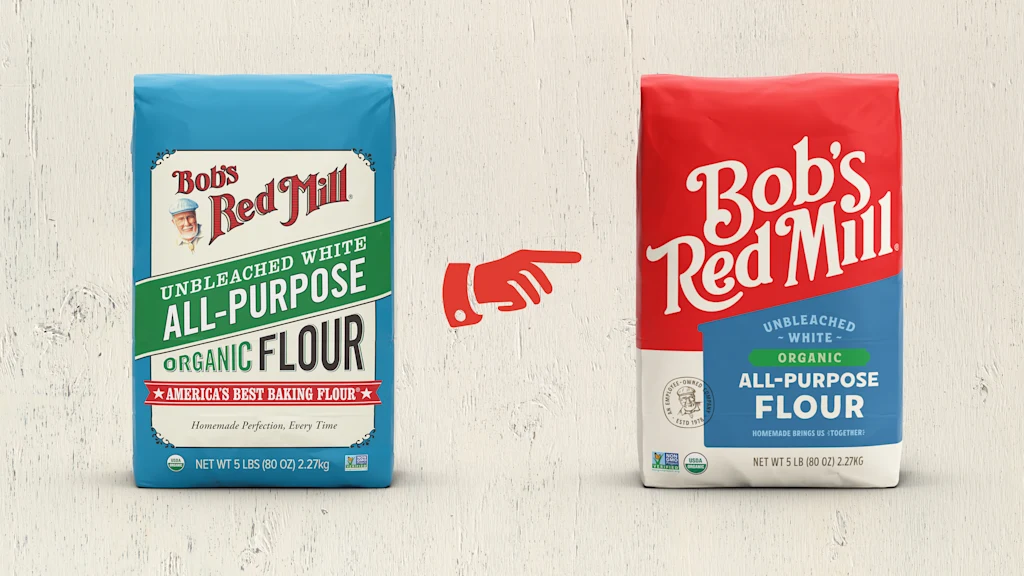
And the company’s core SKU—its five-pound flour bag—sported a design that, while quaint, looked more like a bottle of Dr. Bronner’s soap than a baking ingredient. In totality, the designs were cluttered, difficult to read, and hard to see on grocery shelves.
“People weren’t remembering our name,” Brown says. “They might say that our name was Bob’s Red Mill Road, or Barb’s Red Mill, for example.”
The new branding includes a more modern, legible logo; a streamlined color palette; a custom font family; and a new hero image of the mill itself, which has not previously featured on the brand’s packaging. While in recent years countless brands have simplified their identities to fit a minimalist aesthetic trend, Bob’s Red Mill’s rebrand is one example of an overhaul wherein less is truly more.
Brand lore for the history books
The idea for Bob’s Red Mill was spawned in 1968. The Moores were living in Redding, California, when Bob picked up a book called John Goffe’s Mill, which followed a man who resurrected his family’s ancestral mill with no prior experience. The book planted the seed for Bob to leave his job as the manager of a JCPenney Auto Center and open Moore’s Flour Mill, where he spent several years perfecting the art of flour milling.
Some years later, Bob and Charlee decided to retire to Milwaukie, Oregon, leaving Moore’s Flour Mill with their adult sons. While on a long walk in their new town, though, they came across an old feed mill for sale. The opportunity was too good to pass up. They bought the mill, painted it bright red, and named it Bob’s Red Mill. In the following decades, it ballooned from a small, local business to a national operation that sells its wares at giants including Whole Foods, Sprouts, and Target.
While the company was initially privately owned, Bob decided to transition it to an employee-owned model in order to fend off larger companies looking to acquire the brand. He introduced the Employee Stock Ownership Plan on his 81st birthday in 2010, and 10 years later, Bob’s Red Mill became 100% employee owned, one of only a few thousand companies in the U.S. to hold the status.
Bob’s Red Mill has the kind of rich lore and employee loyalty that other brands can only dream of. But, looking at its former packaging, customers were likely to miss the forest for the trees.
From Dr. Bronner’s to brownie-baking-ready
If there was a single word to describe Bob’s Red Mill’s old packaging, it would be unorganized.
Each bag is packed with different sized fonts, full sentences of tiny text, and an amalgamation of colors. The actual brand name shows up at the top of each package in a small red serif font covered in horizontal black lines, which makes it look blurry and indistinct.
Across the entire brand, there’s almost no consistent treatment for different product lines. And, according to Bob’s Red Mill’s head of marketing, Daniel Barba, these details had a noticeable impact on the business. Not only did customers struggle to remember the brand’s name, but they also had trouble finding it in stores.
To solve these problems, Barba and Brown, the creative director, set about launching a three-year-long rebrand project led by the creative agency Turner Duckworth. While the entire package system has been overhauled, the most obvious change is the wordmark.
The new version of the mark retains some of the serif flourishes of the original (which was inspired by hand-painted signage hung on the actual first red mill), but the edges have been rounded, the black lines have been cut, and the whole thing has been scaled up so that it runs across the entire upper half of the packaging. Now, the word “Bob” rests on its own line.
Turner Duckworth also helped to simplify the brand system by creating a core type family called Red Mill, which includes a serif font and a sans serif. These are used sparingly on the front of each package to denote the product name, call out qualities like organic, gluten-free, and unbleached, and provide a bit more information on the back of the pack.
The most clever detail of the rebrand is a new core symbol that combines brand history with practical organization. Every pack now includes a large, stylized illustration of a mill, which serves both as a container for key text and a kind of road map for customers; the color of the mill changes based on product type, like yellow for oats and light blue for gluten free flour. The hues themselves were inspired by barn quilts, which are painted geometric patterns often applied to the sides of barns as a decoration.
As a final touch, the team added an illustration of Bob to every pack in the form of a stylized stamp. Around his face, a line of text reads, “An employee-owned company established 1978.”
“Bob is at the core of our brand and really inspires our approach to food making,” Brown says. “To have this as a symbol for us to get behind as employee owners is really special.”
The new packaging will begin rolling out on a staggered schedule this fall in order to ensure that older product doesn’t go to waste. In the meantime, Barba and Brown say consumer testing of the new product is already showing strong results; for the five-pound flour bag, tests showed an over-30% jump in brand name visibility, and time to find the packaging in stores was cut by up to 50%.
Brown says that eye-tracking software even showed that the new packaging helped consumers to identify the most important information on the pack.
“People want simple, quality, and homemade, and that’s what we’re all about,” Brown says. “I think it’s a really good time for our brand to be getting our products to look as high-quality on the outside as they are on the inside.”