
The mayor’s new budget finds him making deals—while trying to keep his promises.
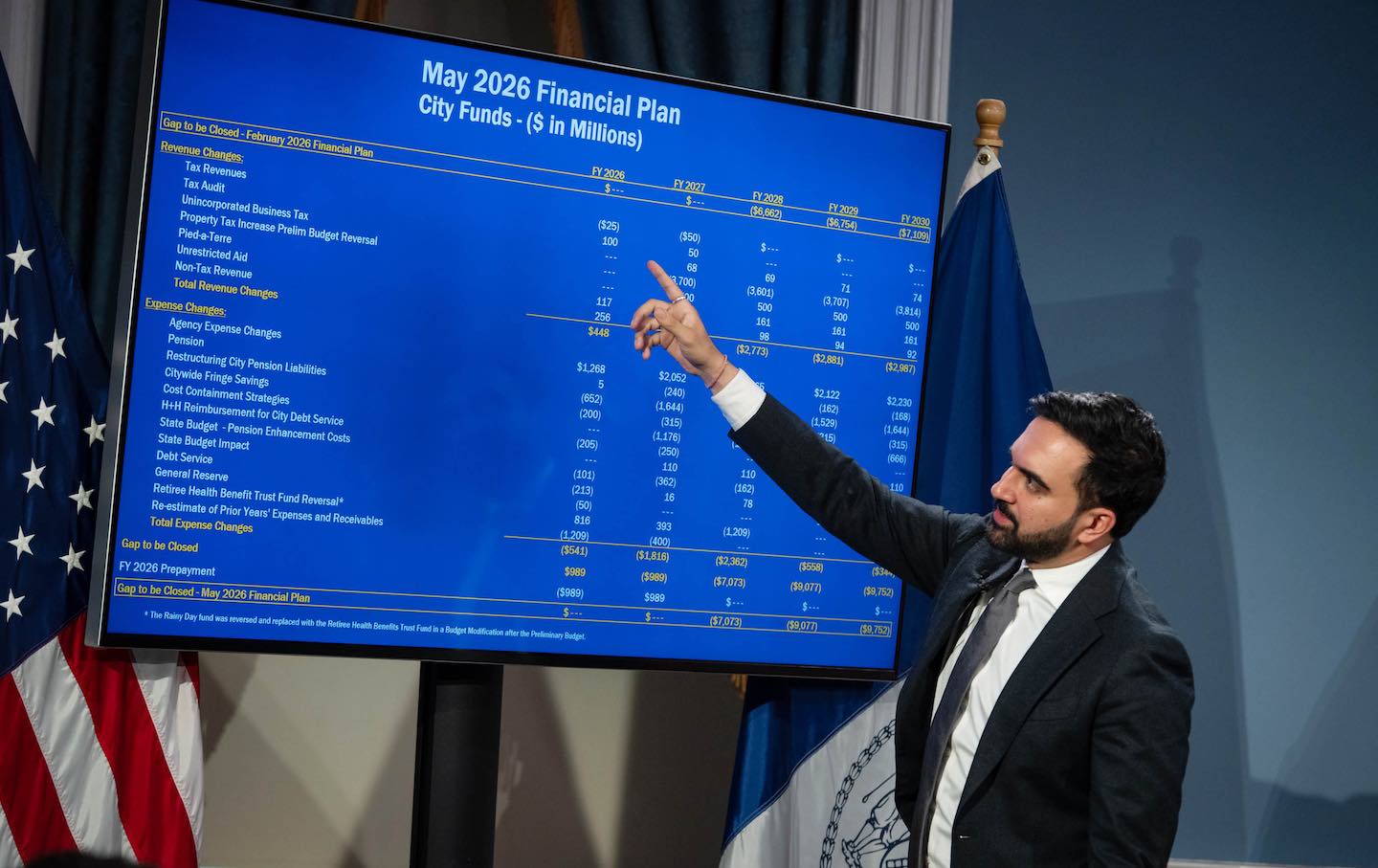
Mayor Mamdani presents his FY27 Executive Budget at City Hall in May 2026.
(Ed Reed / Mayoral Photography Office)
When we last checked in with our young mayor, New York City was still $5.4 billion away from the balanced budget the city is required by law to come up with by the end of June.
Even getting to that point, from the $12 billion fiscal cliff he found on taking office would—or so the mayor claimed in March—require a raid on the funds the city is supposed to set aside for a “rainy day.” And in the preliminary budget released in February, the mayor had also threatened that if Governor Kathy Hochul and the state legislature didn’t let the city raise income taxes on the wealthiest New Yorkers (which would require permission from the state), the city would be forced to raise property taxes (which is the only major tax the city can raise without Albany’s permission). As the mayor soon learned, threatening to raise taxes on the city’s 1.1 million homeowners—many of whom are Black and brown, and almost all of whom are regular voters—was even more of a political nonstarter than expecting the governor to back a tax increase while she’s running for reelection.
And yet there we were in City Hall’s ornate Blue Room on Wednesday, watching as Mayor Mamdani, first deputy mayor Dean Fuleihan, and budget director Sherif Soliman took a victory lap in front of the assembled members of the press. The mayor and his team unveiled a $124.7 billion budget that they had managed to balance without raising income taxes on the rich or increasing taxes on the most profitable corporations—and without raising property taxes either. Was this some kind of secular—or, dare I say, socialist—miracle?
Not exactly. Most of the heavy lifting was done by the governor and legislators in Albany, who, though still unable to come to a final agreement on their own budget, did include $4 billion worth of policy changes and extra funding for the city. Most of those funds are actually savings from delaying payments the city owes to fully fund municipal workers’ pensions—the kind of under-the-radar creative accounting politicians denounce when done by their opponents but routinely resort to when in office. But what made headlines—and yielded a very snappy YouTube video—was the governor’s announcement last month that she was instituting a pied-à-terre tax (on New York city homes and apartments worth more than $5 million whose owners are not city residents) expected to add $500 million a year to the city’s coffers. The mayor, wisely, both embraced the measure and declared at least a provisional ceasefire in his campaign to tax the rich.
Wednesday’s announcement was also evidence that, despite some initial missteps in their budget debut, the mayor and his team are quickly learning how to play this game. Not only did the mayor recognize that he would get much further by working with the governor than he was ever likely to achieve via confrontation, he was also eager to credit his sometime sparring partner City Council Speaker Julie Menin for the Council’s “proposal to reduce the Unincorporated Business Tax credit,” which, as the mayor noted, overwhelmingly benefits millionaires. The reduction, as Budget Director Soliman pointed out in a technical briefing to reporters Wednesday afternoon, can be made without Albany’s permission, and is expected to generate an extra $68 million in revenue.
Also under the heading of political fence-mending is the allocation of $26 million for the Mayor’s Office for the Prevention of Hate Crimes—a relatively small sum, but, as Mamdani noted in his remarks, a fulfilment of his “campaign pledge to increase hate crime prevention funding by more than 800 percent.” The office, as The Forward approvingly reminded its readers, was created in 2019 to combat rising antisemitism. “Jewish New Yorkers constitute a minority of New Yorkers across the five boroughs,” said the mayor, “and yet constitute a majority of New Yorkers who face hate crimes in this city.”
Current Issue

Not every line of the revised budget is cause for celebration. Although the mayor promised that the cap on spending for the CityFHEPS housing voucher program “will not cut” the number of vouchers, the budget still represents a retreat from his campaign promise to expand the program. Similarly, while the skyrocketing costs of what are known as “Due Process cases” or “Carter cases”—payments to cover private school tuition for children whose special needs are not adequately met by the public school system—has become a significant burden on the city’s finances, the mayor’s confidence that, going forward, the city’s Board of Education will be able to accommodate those children may turn out to be misplaced.
Still, if you think of the city’s budget process as a drama in three acts—the first being the preliminary budget, and the second featuring the mayor’s dealings with the governor—at the end of Act II all the protagonists are in remarkably good shape. Of course the third act, which runs from now until the final budget is enacted by the City Council at the end of June, may well introduce additional plot twists—or, even, perhaps, a deus ex machina.
Because plenty can still go wrong. President Trump could order ICE to occupy Brooklyn and Queens. The NYPD could shoot the wrong civilian. The Knicks could lose the playoffs. More to the point, the budget set aside funds for only 1.5 percent raises for city workers—in a city where the headline rate of annual inflation is up to 4.6 percent. With contracts for the 100,000 members of District Council 37 , the city’s largest public-sector union, due to expire this fall, along with contracts covering a host of other workers ranging from sewer and building inspectors to park rangers and traffic agents, the mayor’s political mettle is bound to be tested.
But a happy ending to this particular piece of political theater, though far from certain, seems within reach—not a prediction anyone could have confidently made a few months ago. As for really raising taxes on the richest New Yorkers, or making the city’s buses fast or free, or offering residents of food deserts city-subsidized oases to buy groceries, or providing day care to every working parent in the city who needs it—well, as they say used in Brooklyn back when the borough had a major-league baseball club: “Wait ’till next year.”
From illegal war on Iran to an inhumane fuel blockade of Cuba, from AI weapons to crypto corruption, this is a time of staggering chaos, cruelty, and violence.
Unlike other publications that parrot the views of authoritarians, billionaires, and corporations, The Nation publishes stories that hold the powerful to account and center the communities too often denied a voice in the national media—stories like the one you’ve just read.
Each day, our journalism cuts through lies and distortions, contextualizes the developments reshaping politics around the globe, and advances progressive ideas that oxygenate our movements and instigate change in the halls of power.
This independent journalism is only possible with the support of our readers. If you want to see more urgent coverage like this, please donate to The Nation today.