
When SpaceX filed an FCC application earlier this year proposing to launch a million satellite data centers into orbit, the company argued the project would have no meaningful environmental impact. On SpaceX’s website, Elon Musk made the case for space-based AI infrastructure in simpler terms: “It’s always sunny in space,” he wrote, arguing that orbital data centers are “obviously the only way to scale.”
When SpaceX filed an FCC application earlier this year to launch a million satellite data centers into space, the company said that the plan wouldn’t have any environmental impact.
But researchers say the climate calculus is far more complicated than that.
Yes, orbital data centers could theoretically run around the clock on solar power. But the tradeoffs extend far beyond electricity consumption. “The social and environmental consequences are far greater than what we’re currently looking at with Earth-based alternatives,” says Peter Howson, a researcher at Northumbria University who recently authored a paper examining the risks and challenges of space-based computing infrastructure.
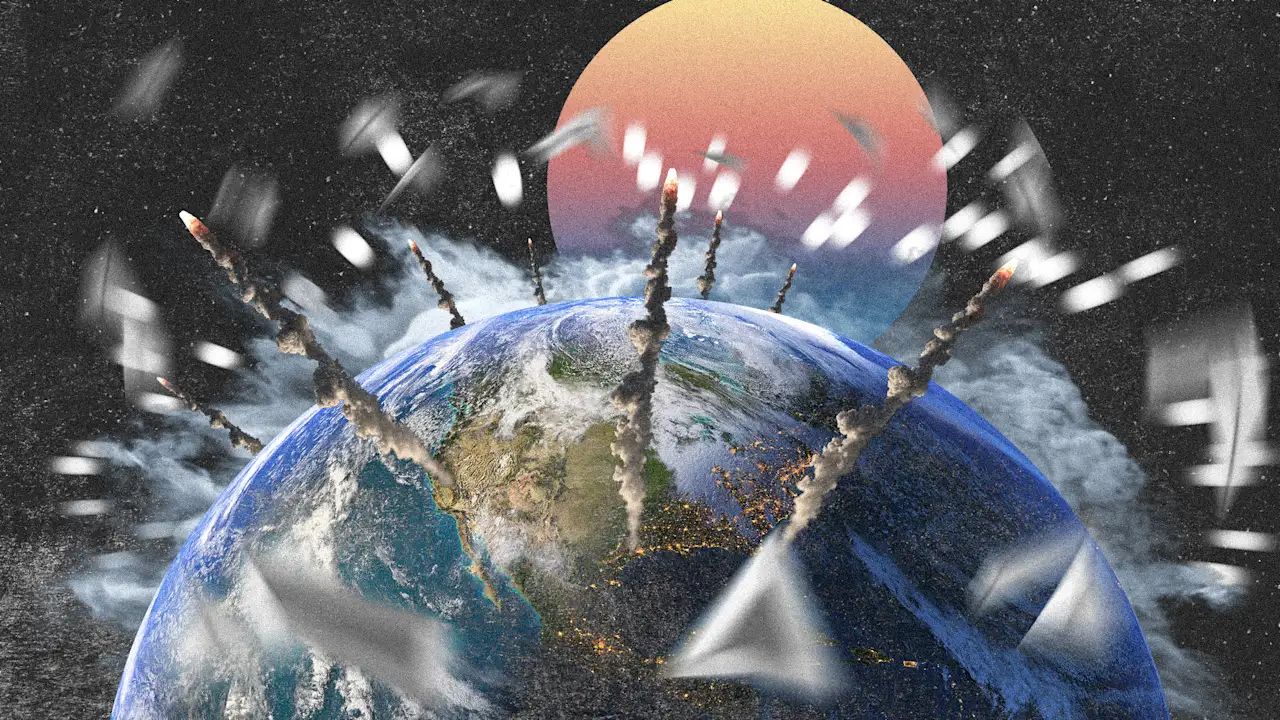
First, the emissions from each rocket launch are large—a single SpaceX Starship launch burns around a kiloton of liquid methane and produces as much climate pollution as a small city does in a year. Black soot emitted from rockets is long-lasting in the upper atmosphere and can cause significantly more global warming than the same pollution on the ground. “Soot that comes out of the tailpipe in a car normally lasts maybe a few weeks in the lower atmosphere,” Howson says. “But when you put it into the upper atmosphere, it could stay there for years.” Water vapor emissions also act as a potent greenhouse gas.
Around 2 million liters of water are also used to protect launch pads at every launch, and that process can wash toxic dust and debris into local ecosystems. In Texas, the state’s Commission on Environmental Quality and the EPA previously found that SpaceX repeatedly violated the Clean Water Act.
Launches can go wrong. In 2023, when the first Starship test flight lost control and was destroyed after a few minutes, the wreckage covered the nearby Boca Chica State Park, home to endangered species, and started a fire. Five Starships have exploded on their flight paths since then.
The launch and satellite equipment uses toxic chemicals, including hydrazine-based propellants for maneuvering, lead solder, and ammonia for thermal control. Accidents or “rapid unscheduled disassemblies” can release hazardous substances—and in some cases, rather than staying in orbit, those materials can reenter the atmosphere and potentially rain down on people on Earth.
Once in space, the equipment wouldn’t last long, and then would create e-waste. “The environmental impacts of satellite ablation (atmospheric burning) are not well understood,” Howson writes in the paper, which was published in the journal Energy Research & Social Science. “However, materials and gases released are likely to contribute to ozone depletion while potentially affecting the Earth’s ability to regulate solar radiation.”
Space is already crowded with satellites—and the number is quickly growing as tech companies race to add more space-based internet access and private weather satellites, among other things. But the tech company vision for data centers could dwarf that. SpaceX’s Starlink network has around 10,000 satellites now. Starcloud, one startup working on orbital data centers that raised $170 million in a Series A round of funding in March, wants to have 88,000. SpaceX, as noted above, wants to have as many as a million orbital data centers. Many other companies are working on similar technology, including Google, which wants to deploy its “Project Suncatcher” in space by 2027, and is now also reportedly in talks with SpaceX on a new rocket launch deal. Jeff Bezos’s Blue Origin and others are also working on the technology.
With more satellites in orbit—including cheap satellites that are more likely to malfunction—it’s also increasingly likely that there could be a crash that triggers “Kesler Syndrome,” a chain reaction of collisions that creates a huge debris field that blocks satellites from some regions.
Space data centers are still an unproven idea, with major technical challenges and the possibility that it may not ever be economically viable. But their promise is accelerating an industry that’s already causing real-world damage, including social impacts. In Indonesia, the government plans to let SpaceX build a spaceport on the island of Biak, Papua, where dozens of indigenous people have been killed after protesting the project. In Texas, the Carrizo-Comecrudo tribe says that SpaceX’s Starbase sits on a sacred site. In northern Sweden, where the Swedish Space Corporation has a spaceport, Sámi herders now have to dodge falling rocket parts.
Orbital data centers are also unlikely to replace the massive fossil-fueled data centers that are already under construction on Earth. But Howson argues that companies are pursuing orbital data centers because they need to answer shareholder questions about how to source the energy needed to maintain growth. And perhaps investors are attracted to wild ideas.
“They’re doing it, I think, just to maintain investor excitement,” he says. “Because the cost involved is 10 times more when you put it into space. So it doesn’t make a lot of economic sense. And it certainly doesn’t make any environmental sense.”