

It’s more obvious than ever why recording encounters with federal agents matters: without bystander videos, it would be much harder to disprove the government’s Orwellian lies about how Alex Pretti was killed last Saturday.
But there are also risks when you pull out your phone to take a video at a protest or if you see an ICE agent abducting, say, a 5-year-old child. Here’s what to know about how to protect your technology and yourself.
The First Amendment gives you a right to record
“It’s really important to start with the fact that individuals have a First Amendment right to record police officers and law enforcement,” says Maria Villegas Bravo, counsel at the nonprofit Electronic Privacy Information Center. “If you’re lawfully allowed to be somewhere, you are legally allowed to record law enforcement in the course of their duty.”
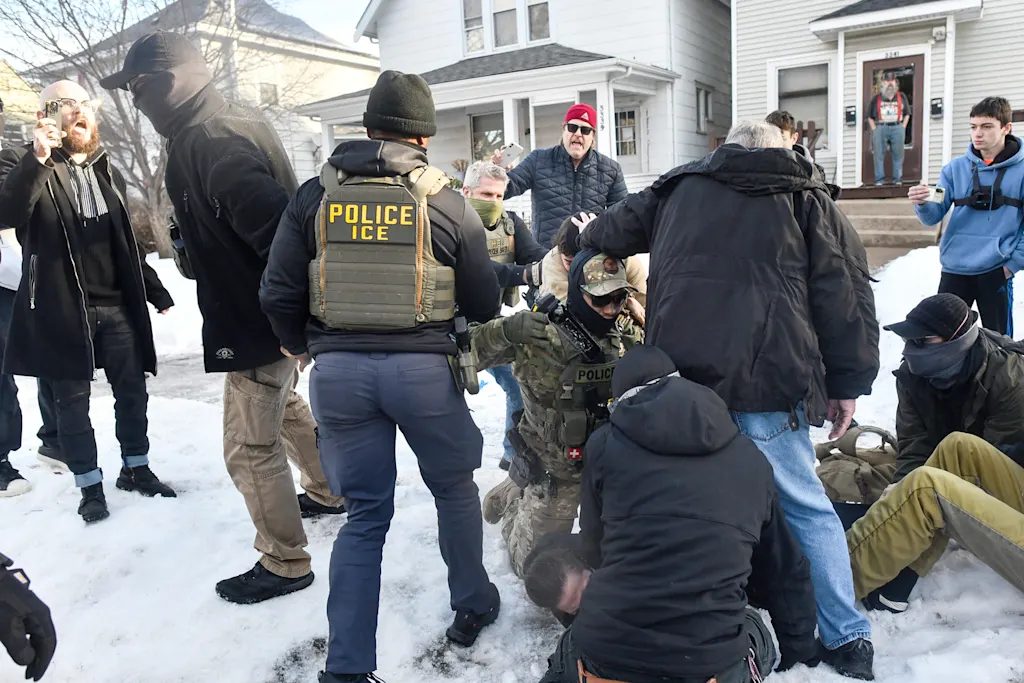
Some ICE agents seem to have missed that in their training. A recent video from Maine shows an agent telling a legal observer that now she’s considered a “domestic terrorist” for filming him. Then he took a photo of her license plate and told her that she would be added to a database. Federal agents have targeted people taking photos at protests, including a professional photographer who was tackled and pepper-sprayed and tossed his camera to another photographer to save it.
Everyone has to judge the risks for themselves, but the more people who record, the harder it is for authorities to erase what actually happened.
Consider leaving your phone at home
Your phone is obviously filled with data about you—not just all of your photos and messages and apps, but location data for everywhere you’ve been. Google, for example, “can track you really granularly,” says Villegas Bravo. “Their location tracking can get you within three meters and it can also pinpoint what floor of a building that you’re on.”
If you’re arrested and your phone is confiscated, law enforcement needs a warrant before it can legally look at the contents. But after there’s a warrant, forensic extraction technology can make a complete copy of your phone’s contents, Villegas Bravo says. Then agents can search through it, either manually or with AI.
If you’re going to a protest, consider leaving your phone at home (leave your smartwatch and other digital devices at home, too). “You can’t have data extracted from a phone that you don’t have on you,” says Bill Budington, a senior staff technologist at the Electronic Frontier Foundation. “Bringing a secondary device, one that can capture footage in high quality, for instance, is a good suggestion.”
Consider bringing a burner phone to take video. An old-school digital camera with no internet connection could also be an option. (In theory, you could quickly pop an SD card out of a camera if you think the camera’s about to be taken away.) There are trade-offs with different choices: a camera doesn’t give you the option to upload a video after taking it, and the videos and photos can’t be encrypted like they could be on a phone.
Burner phones can also have trade-offs, since you probably won’t have a new model with the best security and updates. “There’s an arms race of forensic extraction devices versus the Apples and device manufacturers in the world that are trying to protect against [extraction],” Budington says, and the newest phones have the most protection. But you should have little data on a burner to steal.
To avoid being targeted for filming, some observers are using less obvious technology, like smart glasses or very tiny cameras. One downside: they’re often expensive. The data isn’t always secure; small cameras may have an SD card and lack encryption. Some smart glasses and cameras can stream to a phone in your pocket, so the video will be as secure as the phone is.
Make your phone more secure
Of course, you might not have the chance to plan in advance if you suddenly need to document something happening in your neighborhood. Or you may decide to take the risk of bringing it to a demonstration. In either case, it’s possible to take steps to make your phone more secure.
First, change your settings so that your phone can’t be unlocked with biometrics like your fingerprint or facial recognition. Right now, courts have said that law enforcement can force you to unlock your phone this way. Traditional passcodes have more protection.
Keep your phone locked. You can access your camera without unlocking the phone; on an iPhone, for example, just swipe left from the home screen. You can also temporarily change the settings on your phone so it’s only possible to access one app. (On an iPhone, this is called guided access; on Android devices, you can turn on “app pinning” in your settings.)
Make sure that your phone is encrypted. On an iPhone, check under the settings for Face ID and password to make sure that it says data protection is enabled. On Android phones, look under security settings for encryption and encrypt your phone. Android phones also have the option to add the Graphene operating system, which is designed to make the devices more secure.
To stop your phone from tracking you, turn off location services and keep it in airplane mode. And when you text friends about anything sensitive, it’s better to use an app like Signal with end-to-end encryption.
Sharing videos
When you share videos, consider the privacy of others. Immigration nonprofits don’t recommend livestreaming immigrants’ encounters with ICE. If you upload a video after a protest, the best practice is to blur out the faces of fellow protesters. Law enforcement agencies sometimes use facial recognition on images to arrest protesters after the fact.
The ACLU previously offered an app called Mobile Justice that automatically uploaded videos of encounters with law enforcement in real time, but took the app down last year, citing that it wanted to “ensure compliance with a growing number of consumer privacy laws and the ACLU’s own privacy policies.” While it’s possible to upload a video to store it in the cloud yourself while you’re at an event—as a backup in case your phone is confiscated or damaged in a scuffle—it may be difficult if there’s a crowd and limited bandwidth. The best option may be to make your phone as secure as possible.
Despite the challenges, it’s critical to get the footage. “This is a really dangerous time,” says Villegas Bravo. “And I think it’s really important to continue recording law enforcement and creating this chain of evidence to keep the government transparent and accountable.”