
Shares in Arm Holdings are soaring today after Nvidia CEO Jensen Huang announced a fresh foray into the personal computer market with a new AI chip designed to power Windows PCs later this year. Here’s what you need to know.
Nvidia announces RTX Spark superchip and N1X processor
Nvidia has never been a stranger to the personal computer market, despite now being best known as the maker of chips that power AI servers. Its enterprise AI chips and associated products are what have driven Nvidia to become the most valuable publicly traded company ever in the last several years.
But before the AI boom, a large majority of Nvidia’s business came from making graphic processing units (GPUs) for personal computers, especially PCs designed for gaming, which required processors that could render advanced graphics.
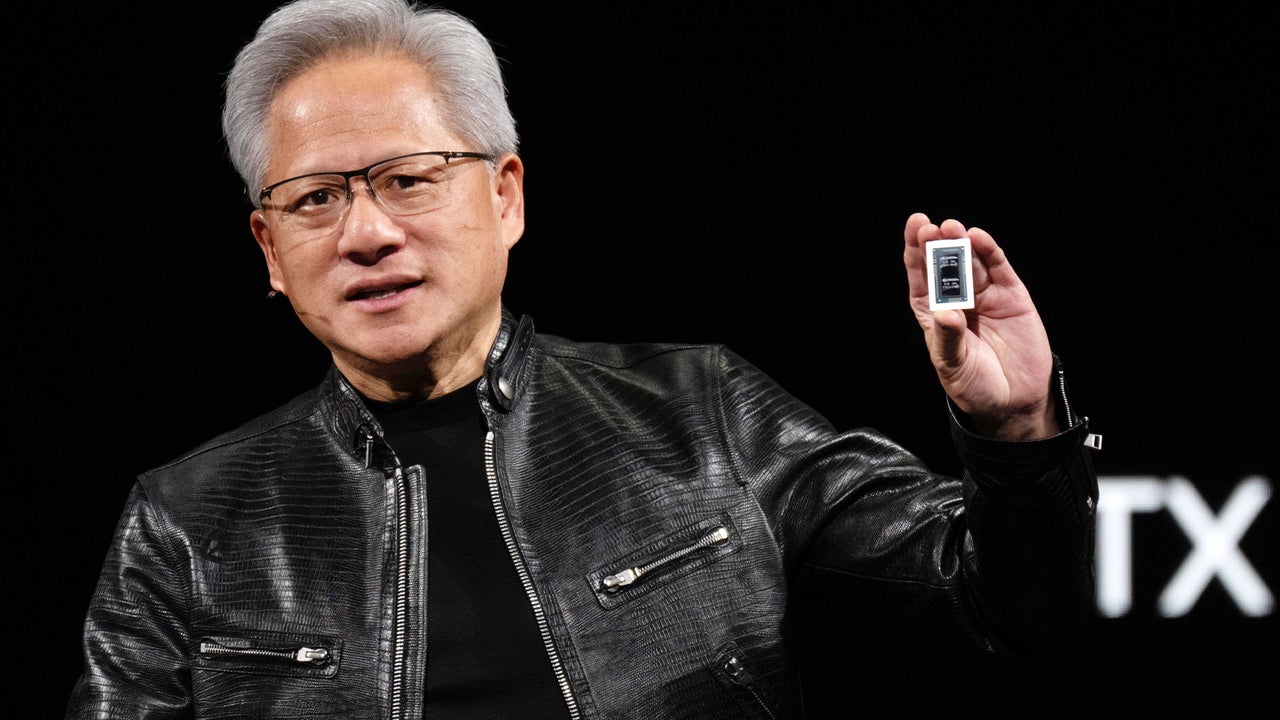
Today, Huang announced that, in addition to its enterprise AI business, Nvidia will launch a new AI chip for personal computers, designed for Windows laptops and desktops.
The chip is called the “RTX Spark” superchip. It’s a “superchip” because it is composed of a new AI-focused N1X processor, designed by both Nvidia and Microsoft, and a Nvidia Blackwell graphics processing unit.
The chip is based on Arm Holdings’ architecture instead of the x86 architecture found in traditional Intel PC chips.
In consumer devices, Arm’s architecture is generally superior for running AI tasks on-device compared to x86-based chips. As a result, devices such as laptops and smartphones with Arm-based chips should be better able to perform AI tasks locally rather than relying on cloud-based AI processing.
The new RTX Spark chip will be made by Taiwan Semiconductor Manufacturing Company (TSMC).
As noted by CNBC, announcing the new chip at Taiwan’s Computex conference on Monday, Huang said that “Microsoft and Nvidia are going to reinvent the PC. This is the first completely re-engineered, reinvented line of PCs that has happened in 40 years.”
ARM shares surge, while Intel and AMD drop
After Huang’s announcement, the share prices of several related companies rose, while competitors dropped.
The biggest winner, of course, was Arm Holdings (Nasdaq: ARM). As of the time of this writing ARM stock is currently up more than 15% to $407.58 in premarket trading.
Though Arm won’t actually be making these new RTX Spark superchips, the chips are based on its architecture. This means that for every RTX Spark chip made, ARM will be paid a royalty for the IP used in the chip.
Until recently, nearly all of Arm’s profits came from licensing fees it charged to chipmakers for using its blueprints.
But that business model changed in March, when Arm announced for the first time in its history that it would begin making its own AI chips, putting it in competition with its customers.
But Arm’s own AI chips aren’t related to the new RTX Spark superchip announced today.
In addition to ARM stock, shares in Microsoft Corporation (Nasdaq: MSFT) and Nvidia Corporation (Nasdaq: NVDA) are both up modestly on the news, with MSFT shares up almost 4% in premarket as of the time of this writing, and NVDA shares up a little more than 2%.
However, other chipmaker stocks are down on news of Nvidia’s new RTX Spark superchip.
Affected companies include Intel Corporation (Nasdaq: INTC) and Advanced Micro Devices, Inc. (Nasdaq: AMD). Both make chips for Windows personal computers.
Currently, INTC shares are down about 6.2% in premarket trading, and AMD shares are down about 4.1%.
Do consumers want AI PCs?
Yet despite Arm, Microsoft, and Nvidia getting a boost on the news of the new AI chip coming to personal computers, there is one big question that remains:
Will consumers care?
While the tech industry has been singing the praises of AI for years now, there is a growing backlash to artificial intelligence in general.
And according to PC makers themselves, consumers seeking out new computers don’t seem to care much about those computers’ AI capabilities.
Back in early January, personal computer giant Dell essentially spoke the quiet part out loud when the company’s head of product, Kevin Terwilliger, conceded at CES 2026 that customers didn’t seem to be buying PCs based on their AI capabilities.
“We’re very focused on delivering upon the AI capabilities of a device . . . but what we’ve learned over the course of this year, especially from a consumer perspective, is they’re not buying based on AI,” PCGamer quoted Terwilliger as saying. “In fact I think AI probably confuses them more than it helps them understand a specific outcome.”
Another major player in the PC space, Intel, admitted something similar. As Fast Company reported in late January, at CES, Intel’s vice president of its PC client segment, David Feng, admitted, “There’s this disconnect between people in the industry who are looking a couple generations or a couple years ahead, versus the general public.”
When Intel asked retailers if consumers were seeking out AI PCs, the answer was usually no. Instead, consumers looking for a laptop typically care about two main things: price and battery life.
And that first point doesn’t bode well for the first RTX Spark-powered PCs that are set to ship this fall.
As CNBC reported, the first PC to carry the new chips will also carry “a premium price tag” before the chips trickle down into cheaper laptop models at some point in the future.
Yet even when they do that, it remains to be seen how big a factor chips designed for AI tasks will be in the purchasing decisions of computer buyers.