
Business leaders are scrambling to understand the fast-moving world of artificial intelligence. But if companies are struggling to keep up, can today’s business schools really prepare students for a new landscape that’s unfolding in real time out in the real world?
Stanford University thinks it might have the answer.
At its Graduate School of Business, a new student-led initiative aims to arm students for a future where AI is upending in ways that are still unfolding. The program, called AI@GSB, includes hands-on workshops with new AI tools and a speaker series with industry experts. The school also introduced new courses around AI—including one called “AI for Human Flourishing,” which aims to shift the focus from what AI can do, to what it should do.
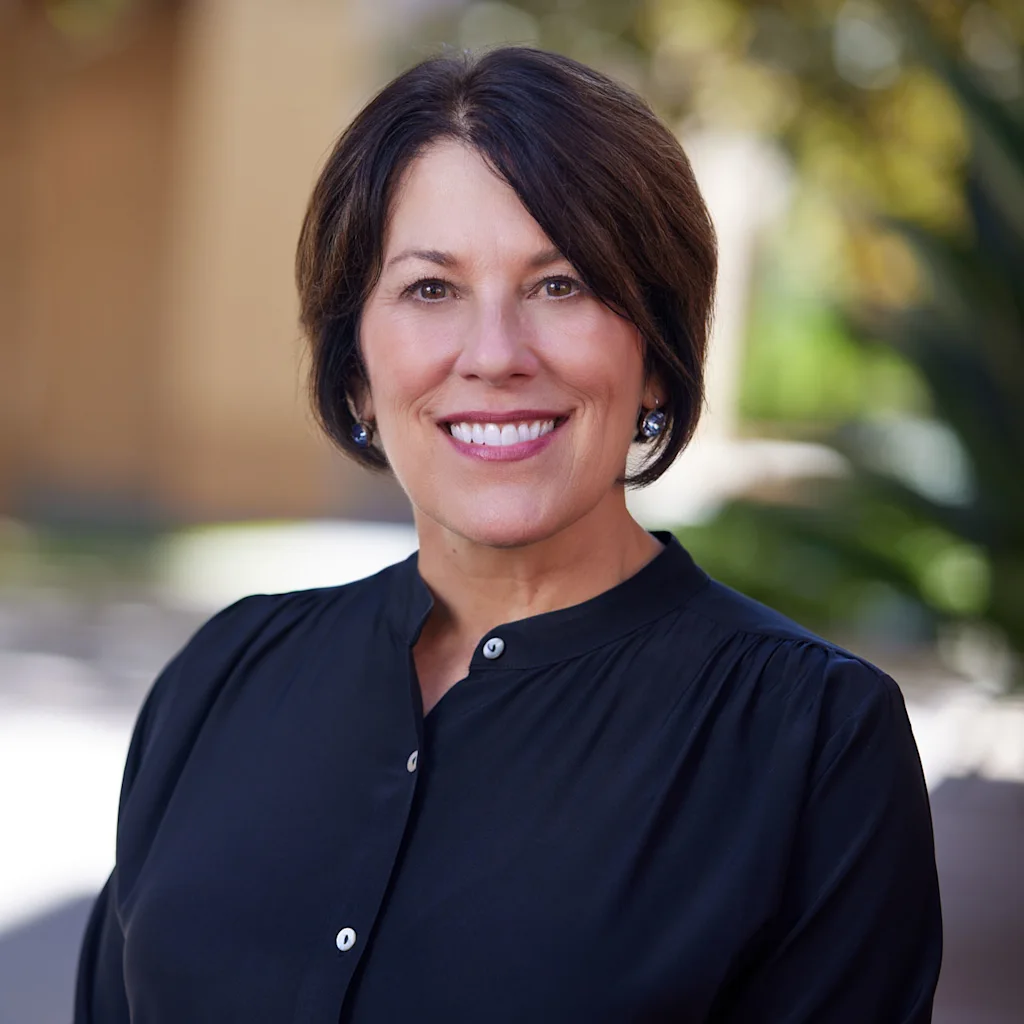
But Sarah Soule, a longtime organizational behavior professor who became dean of the business school this year, told Fast Company that preparing students for this brand-new work environment is easy to say, harder to do. Especially given how quickly AI is changing “every function of every organization,” she says.
So the school hopes to lean on its network of well-connected alumni, as well as its location in Silicon Valley, the heart of the AI boom, to lead business schools not just into a future where AI knowledge will be necessary—but in the present, where it already is.
“It would not be easy for me as the new dean to just come in and mandate that everybody begin teaching AI in whatever their subject matter is,” Soule said, explaining that that approach likely would fail.
In a conversation with Fast Company, the dean shared more about what she hopes will work, and how she plans to train the next generation of leaders for an AI-powered world.
This interview has been lightly edited for clarity.
Many business schools are adding AI courses. But it sounds like you’re thinking of AI as less of an add-on, and more like a core part of the school’s DNA going forward. How do you make that distinction?
I think it has to be [a core part]. Developing a very holistic leadership model, alongside all the offerings in AI, is going to allow us—I hope—to think about the questions of ethics and responsibility, and the importance of human beings and human connection, especially in an AI-powered organization.
AI is going to change the future of work completely. So having those two parallel themes at the same time is going to be critical.
What does ethical, responsible AI mean to you?
HR comes to mind right away. I’m thinking about privacy concerns: What do we need to be worried about? If we’re outsourcing scans of résumés and so on to algorithms and agents, do we need to worry about privacy?
I also think about: What does the world look like if a lot of entry-level jobs begin to disappear? How do we think responsibly about reskilling individuals for work that will enable AI?
I don’t think we have the answers to these questions, but I’m really glad that we as a business school are going to be—and have been—asking these questions.
The new AI initiative is student-led. But what is the school doing to train faculty to better understand how they can, or should, teach about AI—or use AI in their classes? Implementing this has been a mixed bag for a lot of universities.
We have a teaching and learning hub here that has very talented staff [members] who are pedagogical experts and who are offering different kinds of sessions on AI. So that’s of course been helpful.
But one of the most gratifying things to see is how faculty are talking to one another about their research—to see them really jazzed about how they’re using AI in the classroom, and sharing speakers that they’re going to bring in, and thinking about new case studies to write together. It’s really fun to see the buzz amongst the faculty as they navigate this.
Many, if not most, of our faculty are using AI in their research. I think because they’re becoming so comfortable with AI, they’re genuinely excited about teaching AI now—either teaching content about AI, or bringing AI into the pedagogy. I’ll give you an example.
In one particular class, the faculty member essentially created a GPT to search all of the management journals and to help answer common managerial questions and dilemmas. So it’s an evidence-based management tool that the students can use. They could say, “What’s the optimal way to set up a high-functioning team?” And it will search through the journals and give an evidence-based answer.
One of Stanford GSB’s most popular courses is Interpersonal Dynamics, known as the “Touchy Feely” class. Do you think teaching skills like emotional intelligence as an aspect of leadership becomes even more important in an AI-dominated world?
Absolutely. “Touchy Feely” is an iconic class. Even though it’s an elective, nearly every student takes it; it transforms people’s lives, and they love this course.
It focuses on an important facet of leadership: self-awareness. But that’s only one piece. We also have courses that get students to think about a second facet of leadership, which is perspective-taking: the ability to ask very good questions, and to listen really well to others to understand where they’re coming from.
So, self-awareness and perspective-taking are part of the leadership model. The third thing: We have a wonderful set of classes on communications, not just about executive presence and executive communications, but classes that focus on nonverbal communication and written communication.
The last two facets of our leadership model are: critical and analytical decision making—having the judgment and wisdom to make the kinds of decisions that leaders always have to make—and contextual awareness to think about the system in which they’re embedded. Not just to understand it, but to navigate it, and to have the will to try to change it if it needs to be changed.
All of those dimensions of leadership are going to be more and more important in the coming years with AI.
So many of the rote tasks and analysis will be being done pretty well—maybe better than humans—by AI.
But we are going to need people who can lead others—and lead them well, and lead them in a principled and purposeful fashion.