
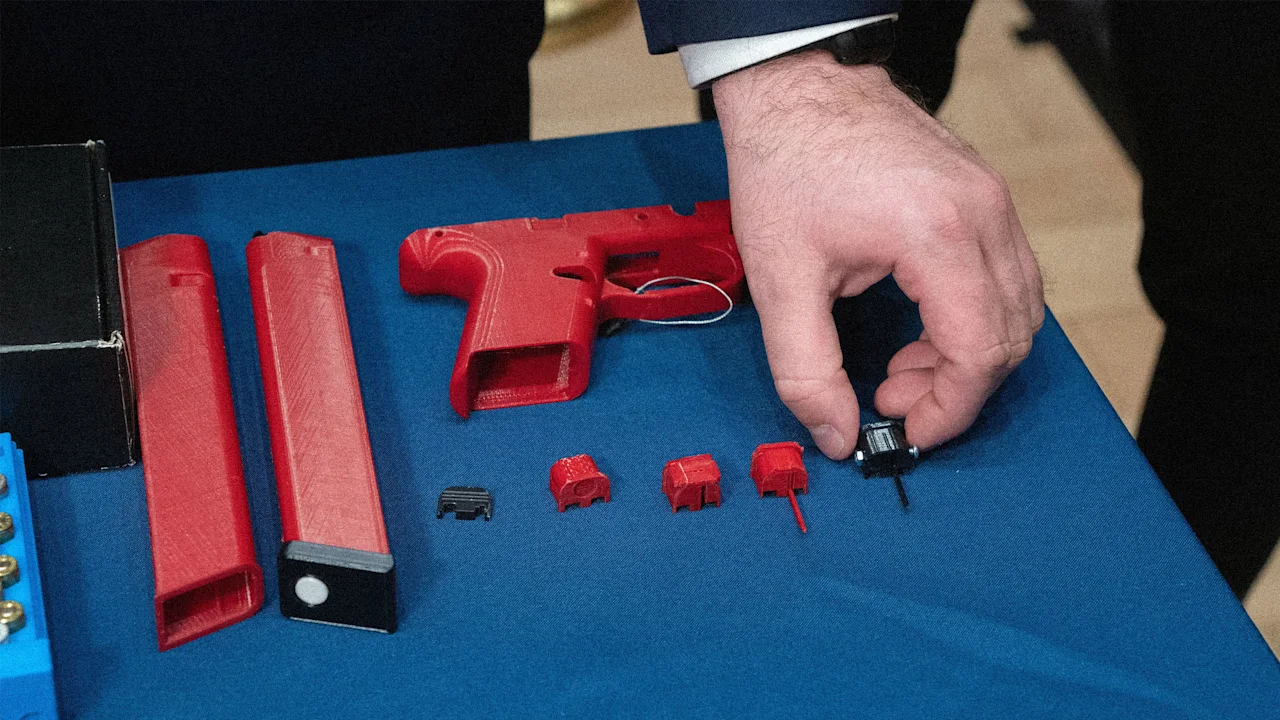
America’s stance on gun rights has always been complicated. On the one hand, people fight vociferously for their Second Amendment rights. On the other, 47,000 people died due to gun-related injuries in 2023 alone.
That uneasiness reaches beyond the right to bear arms. It’s increasingly affecting people’s ability to pursue a seemingly unrelated hobby: 3D printing.
State lawmakers across the United States are debating—and in some cases nearing passage of—rules that would require 3D printers to include mandatory “print blocker” software. These systems would scan files and refuse jobs they think might produce firearm parts. Washington’s HB 2321 would require printers or slicers to screen files and reject potential printouts that could be used in a weapon. California’s AB 2047 would require manufacturers to attest that each model sold in the state includes a certified firearm blueprint detection algorithm. New York lawmakers are now pushing similar printer-side blocking requirements.
The stated aim is to stop 3D-printed ghost guns. But in doing so, legislators are trying to solve a crime problem by redesigning a general-purpose manufacturing tool. “What they’re talking about doing is banning certain kinds of shapes,” says Kyle Wiens of iFixit, an outspoken opponent of the proposals. “We are starting to really dangerously undermine a lot of assumptions that go into how we make and use technology,” says Wiens, who describes it as “a little bit of an imaginary problem.”
He’s not alone. The Electronic Frontier Foundation (EFF), a digital rights group, has made clear its opposition to print blocking. It calls the idea “wishful thinking” that wouldn’t deter people from printing firearms or their parts, and instead would make it far more difficult for law-abiding users to take advantage of a growing technology. Today, 3D printing is widely used not just by hobbyists but for parts prototyping, small-batch manufacturing, and in medicine for anatomical structures, surgical templates, and implants. Around one million 3D printers were sold worldwide in the first three months of 2025.
Just 325 3D-printed guns were recovered at crime scenes in 2024, out of roughly 350,000 firearms used in crimes across more than 50 U.S. cities between 2020 and 2024, according to the gun control advocacy group Everytown For Gun Safety. That disparity, says Michel Weinberg, executive director of New York University’s Engelberg Center on Innovation Law and Policy, means any action will be “incredibly small, if existent at all” in addressing the use of 3D printing for gun manufacture.
The proposed rules would place a broad, general-purpose tool under suspicion by default. Critics argue this approach treats every user as a potential criminal and every file as something to be checked, flagged, or refused—chilling legitimate experimentation while doing little to stop determined bad actors. “There must be dozens of more effective interventions than this,” argues Weinberg, “before you even get to the downsides.”
And those downsides are significant. Beyond questions of effectiveness, there are broader rights concerns. The EFF notes that many printers lack the computational power to analyze files locally, which could push enforcement toward cloud-based scanning. (To grasp the scale of the potential overreach, imagine having to hand over information about whatever you want to print on a standard paper printer to an unknown authority.)
Cloud-based checks would also introduce privacy risks and vendor lock-in, tying users to proprietary software, making open-source alternatives harder to use, and potentially criminalizing workarounds or the thriving secondhand market for 3D printers.
Despite those concerns, lawmakers appear to be moving ahead. The reason, Weinberg suggests, is that many believe something must be done to address gun violence—and 3D printing, while a small contributor, is visible enough to act on. “The people who are advocating for this, on balance, think that any incremental step to reduce the ability of a 3D printer to make a firearm is worth taking,” he says (never mind that the policy would impose on the privacy of tens of thousands of users of 3D printers).
iFixit’s Wiens hopes policymakers pause to consider both the implications and the underlying rationale. “We should not be regulating based on our imaginations,” he says. “We should do it based on the actual threat model.”