
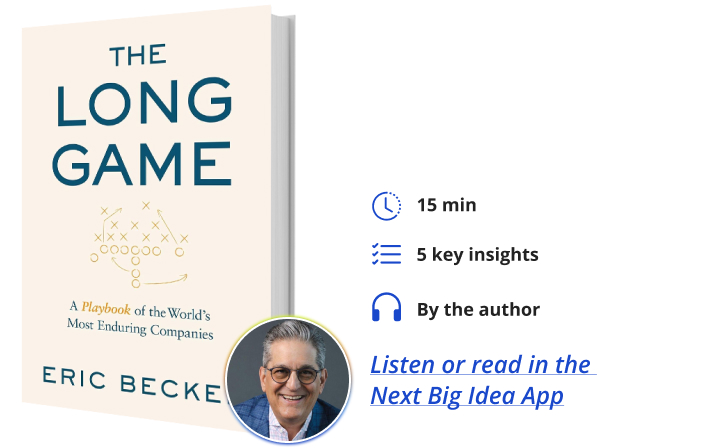
Below, Eric Becker shares five key insights from his new book, The Long Game: A Playbook of the World’s Most Enduring Companies.
Eric is the founder and chairman at Cresset, an award-winning multi-family office with billions in assets under management. He also co-founded Sterling Partners, a value-added, growth private equity firm. With his long history of starting, backing, and nurturing companies, Eric advises founders, entrepreneurs, private equity partners, and ultra-high worth families.
What’s the big idea?
Companies that last not one generation, not two, but for a hundred years and beyond share certain things in common. It is no accident when a company ends up lasting, rather than being sold. What it takes is setting your business up intentionally for the long game.
1. Recognize a moment of truth
Businesses don’t fail for a lack of vision. They usually fail because of a lack of great execution. It’s knowing what to do and when to do it that makes all the difference. That’s a moment of truth.
I’m fascinated with moments of truth. In a lifetime, how many moments of truth might there be? It’s probably less than 20, or maybe less than a dozen. There’s just not that many of them. Learning to identify a moment of truth is an incredibly important skill—whether it’s deciding where to live, who to marry, choosing a career, or what kind of company to start.
Every leader faces critical moments of truth, but recognizing when you are faced with that decision is essential. The ability to not only see and accept that you must act but also recognize when you shouldn’t. A moment of truth is what follows.
A Centurion has this special talent of recognizing moments of truth and making the necessary pivots. They learn who they can trust in these moments and make critical, tough decisions. If you make the right decision in a moment of truth, it can change everything.
2. Adopt a myth-busting mindset
Centuries-old businesses are often seen as dusty, bureaucratic, or slow and resistant to change. But I’ve found it’s the complete opposite. Centurions are some of the most agile, adaptive, and forward-thinking organizations in the world. They’ve mastered the art of adaptation because their very existence depends on it. Companies today that will likely outlive the next century share the same qualities.
This is the idea of embracing resiliency, adaptability, and vision. Legacy organizations have a great sense of urgency. They don’t tolerate poor performance, and they don’t sit on their laurels. They have a sense of priority, importance, and timing.
“Centurions are some of the most agile, adaptive, and forward-thinking organizations in the world.”
Take a business like Ferragamo, or families like the Vanderbilts who have operated the historic 130-year-old Biltmore Estate since 1895, and even the famous Smuckers Family. On the surface, they might seem like echoes of the past, rooted in history and resistant to change. But dig a little deeper and you’ll see they’ve survived through war, the Great Depression, the Great Recession, the Pandemic, natural disasters, competition, technology—you name it, they’ve seen it all. A myth-busting mindset helped them survive.
Think about what stereotype you are working against. How can you break the myth? How can you hone that survival instinct to do whatever it takes to change perception and move your company forward?
3. Be a super steward
Embracing stewardship supersedes any other mission-critical priority. Very few leaders or families truly understand what this means when we say it.
Stewardship is recognizing that the enterprise is greater than any one individual in the organization, including you. Every decision you make is made with the understanding that this move will protect and preserve the company for generations to come. That’s not how most entrepreneurs and even many family businesses operate. As a result, there is a crisis happening in America right now involving succession.
But when you consistently demonstrate that stewardship supersedes everything else within your organization, that ethos ripples into every facet of your organization and becomes ingrained within your business or family and onto the next generation. It’s a big mindset shift, but stewardship has the power to become the protective shield for everything you love most. That’s how you start to build your legacy.
I’ve seen it time and again: when employees understand and are included in their company’s mission and principles, and believe in it themselves, they’re proven to be more committed. You’re essentially building a dedicated army of stewards, passionately carrying out the founders’ vision.
4. Have a succession plan
The best CEOs and leaders realize it’s not about them. It’s about everyone else. They look at the organization or the family and realize that they are responsible for bringing this business into the future.
“Only one-third of family-owned businesses make it to the second generation, and just 12 percent survive to the third.”
I had grown up in a family business. My father started a company that lasted for 53 years, which was amazing. But he didn’t have a succession plan. Ultimately, the company had to be sold. What had been missing? What had my dad needed to pass his business on?
Ethical succession is seen in these 100-year-plus businesses. Having a viable, thoughtful, and ethical long-term succession plan is a critical part of being a steward. Only one-third of family-owned businesses make it to the second generation, and just 12 percent survive to the third. There is nothing that matters more to me than my own family and business knowing and trusting that the value I’ve placed on the plan ahead will carry them forward for generations. The family office has to evolve in order to survive.
5. Build centurion culture from day one
To break through and to get ahead, culture is critical. Centurions were the commanders that led 100 soldiers in the Roman army, and they didn’t lead from behind. They led from up front. They were the strong leaders who set the culture for that group and took them forward into victory.
When Avy Stein and I started Cresset, we put culture first and told people to act like owners. Now, 65 percent of Cresset is actually employee-owned. Our 100-year horizon shapes every decision, from technology to talent.
From day one, we focused on questions like:
- What kind of company will we become?
- How will we treat each other?
- How will we treat customers and clients?
We also told the first 10 team members that we were on a 100-year journey together, which is what The Long Game is all about. When you build a company with that kind of long-term focus, you don’t need an exit. Ironically, that’s what makes it even more attractive, because it’s built to last, not to sell.
We developed what we now call the culture card. We took all the principles and practices around great culture and put them all together on one card. Having a culture card is something that almost no business seems to do. And yet, it is the most important tool that we’ve used in building an organization in less than eight years to over $70 billion in assets under management.
Enjoy our full library of Book Bites—read by the authors!—in the Next Big Idea App.
This article originally appeared in Next Big Idea Club magazine and is reprinted with permission.