

In the early days of the internet, collectors traded rare whiskey and wine on eBay alongside Beanie Babies and vintage sneakers. But then, in 1999, six months after closing down firearm sales, eBay announced they would ban the sale of alcohol and tobacco products as well.
“As a general rule, these laws are just so complex and contradictory, that we just decided that in the best interest of our users to prevent that situation from ever occurring,” then-spokesman Kevin Pursglove said.
More than 25 years later and almost a century after the end of Prohibition, the regulatory environment is no less forgiving, and the resale of spirits online has been scattered across niche forums, gray-market Facebook groups, and high-end houses like Christie’s, Sotheby’s and Bonham’s.
The patchwork of U.S. liquor laws
Domestic laws are complex. Six states still ban retail spirits sales on Sundays, to start. Seventeen operate as “control” states with a government monopoly on liquor sales. And while 47 states allow wineries to ship directly to consumers, only 11 extend that same privilege to distillers, according to the Distilled Spirits Council of the United States. Industry groups have shepherded a bill into Congress that would give the USPS authority to mail alcoholic beverages, but a final vote could take years.
Few competitors have cracked this market. BAXUS uses blockchain for tokenized bottle trading, while U.K.-based Whisky.auction, Whisky Auctioneer, and Whisky Hammer focus outside the U.S. Good Bottle Auctions, based in Connecticut, sticks to the Northeast with in-person delivery.
But since launching in 2020, a company called Unicorn has expanded to serve the continental U.S., logging over six million bids across half a million lots, totaling $125 million in sales. Its Chicago vault holds more than $100 million in inventory, with weekly and monthly auctions that ship purchases to pickup locations nationwide.
Sotheby’s vs. Unicorn
CEO Phil Mikhaylov, who previously worked at UberEats and delivery startup GoPuff, frames Unicorn’s speed and scale as a direct extension of that background. He says that most legacy auction houses top out at a few hundred lots per week, while Unicorn regularly clears thousands.
“I think what you see at other auction houses—say, a Sotheby’s—is they might have roughly 300 lots in an auction every single week. We’re doing, on a bad week, 3000 lots. On average, we’re doing 4000 to 5000 a week,” Mikhaylov says.
Sotheby’s, for the record, did $114 million in spirits and wine sales in 2024—a slump from their record of $159 million the year before.
“At this point, we sell $1–2 million of whiskey per week,” Mikhaylov said in an interview earlier this year with their newly acquired (and renamed) in-house magazine, the Unicorn Review.
“What’s happened is that we’ve become effectively a “redistribution platform.” A bottle that’s selling for $50 in Chicago might have $200 of value to someone in New Mexico.”
Unicorn has spent years—and millions of dollars—building the framework to do so. As of 2025, they have 12 dropoff points across the country, which then link out to a handful of vans that drive across the region, all eventually relaying bottles back to their Chicago processing facility. Sellers can hand off their bottles, and buyers can drive out to any of the facilities, or go through Unicorn for delivery.
For legal reasons, Unicorn (a licensed retailer) must take possession of every bottle and bring it to its central Chicago location. There, an authentication and appraisal team runs each one through what may be the most robust spirits-resale database in the industry, producing estimates that cover everything from a 1982 Chateau Lafite Rothschild Bordeaux to a jug of Jose Cuervo.
I tested the system by submitting four bottles for appraisal online. The sheet broke down batch numbers, year, and proof, and offered estimates within a few dollars of their eventual sale price. After handing the bottles off the next week in-person, they were on auction by Sunday: one sold $5 below estimate, another $5 above, and the other two squarely within range. Mikhaylov credits the accuracy to their in-house tracking software and the size of their data set.
A data-driven bar cart
Digitizing that many bottles was slow at first, but after five years (and some AI integration), the system has basically been perfected. Bottles are scanned, authenticated, photographed in 360 degrees, and logged into the vault. Customers using Unicorn for storage pay 25 cents per bottle per month and can check their inventory online at any time.
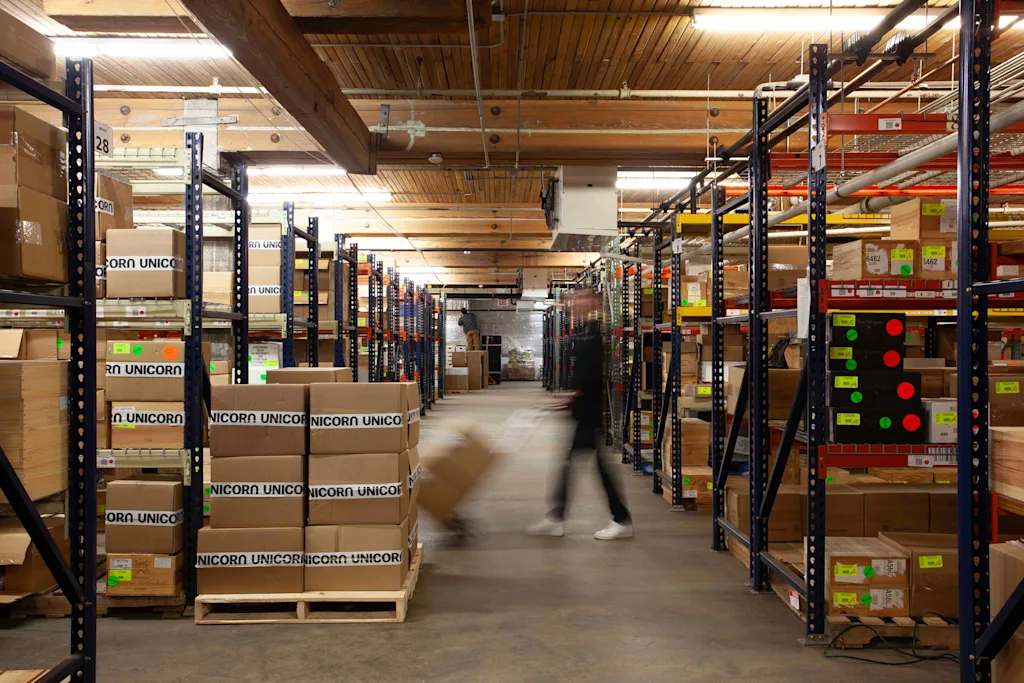
Storage complements sales: Mikhaylov says that many collectors were looking for a solution to manage their treasure troves, often resorting to home-brewed spreadsheets and lists. Now, whales might have their entire collection picked up, palletized, digitized, and tracked online—ready for observation, admiration, or sale at auction.
If they do decide to sell, payouts are delivered in 10 days or less, minus $5 per bottle and 5% commission (buyers pay a 15% premium). Compared to traditional auction houses, which often require weeks or even over a month to process consignments and payout sellers, that’s fast.
The idea began during the pandemic. Mikhaylov’s cofounder, Cody Modeer, found himself unable to auction bottles from his shuttered bar; traditional houses dismissed his inventory as too low-value. Meanwhile, Mikhaylov was searching for a way to digitize and manage spirits collections, allowing collectors to drop off bottles anywhere in the country and track them remotely.
“There wasn’t a modern platform that was meeting the demands of today’s consumer: something that made it easy to drop off, to sell, or to manage a collection,” Mikhaylov says.
“This is meeting the demands of that consumer. 70% of our clientele that signed up this year have been Gen Z and millennial. For the younger demographic, it’s all about transparency and speed . . . Think of us like Kelly Blue Book, but for your bar cart.”