
Dog owners have a lot of choices nowadays when it comes to picking out pet food for their pup. Dry kibble or wet? Beef or chicken? Frozen, fresh, or raw? Brands even boast “human-grade” ingredients and grain-free recipes.
If you have a dog, your decision may be focused on nutrients, or maybe price. But one vet-turned-environmental researcher wants you to also consider the climate impact.
And that impact could be huge—depending on the type of food, your dog’s diet could have a greater environmental impact than your own.
Calculating the carbon footprint of dog food
What we eat matters for the planet. Globally, food production is responsible for more than a quarter of all greenhouse gas emissions and has impacts on biodiversity, deforestation, and water use.
Climate experts agree that eating less meat and more plants is better for the environment.
What we feed our pets matters too, says John Harvey, a veterinary surgeon working on environmental sustainability at the University of Edinburgh.
In Harvey’s newest study, published in the Journal of Cleaner Production this week, researchers calculated the carbon footprint of nearly 1,000 types of dog food that are commercially available in the United Kingdom.
Though the study is U.K. focused, the dog food market there is similar to the United States: the sample included dry, wet, and raw foods, as well as grain-free and even plant-based options.
Harvey and his team found that in the U.K., the production of ingredients for dog food accounts for about 1% of the country’s total greenhouse gas emissions. Though 1% may seem small, it “does matter,” Harvey says. “That’s big.”
Scaled up, the impact is clearer: If all dogs around the world were fed like they are in the U.K., the emissions to produce that food would be equivalent to more than half of all jet fuel emissions from global commercial aviation. (Dog food emissions actually range enough that they could be 59% to 99% of jet fuel emissions, when scaled up.)
It’s not clear what share of U.S. emissions comes from dog food, but dog ownership here is even higher. About 36% of U.K. households own a dog, for some 13 million total pups. In the U.S., more than 45% of households own a dog, for a total closer to 90 million, according to the American Veterinary Medical Association.
What type of dog food is the most environmentally friendly?
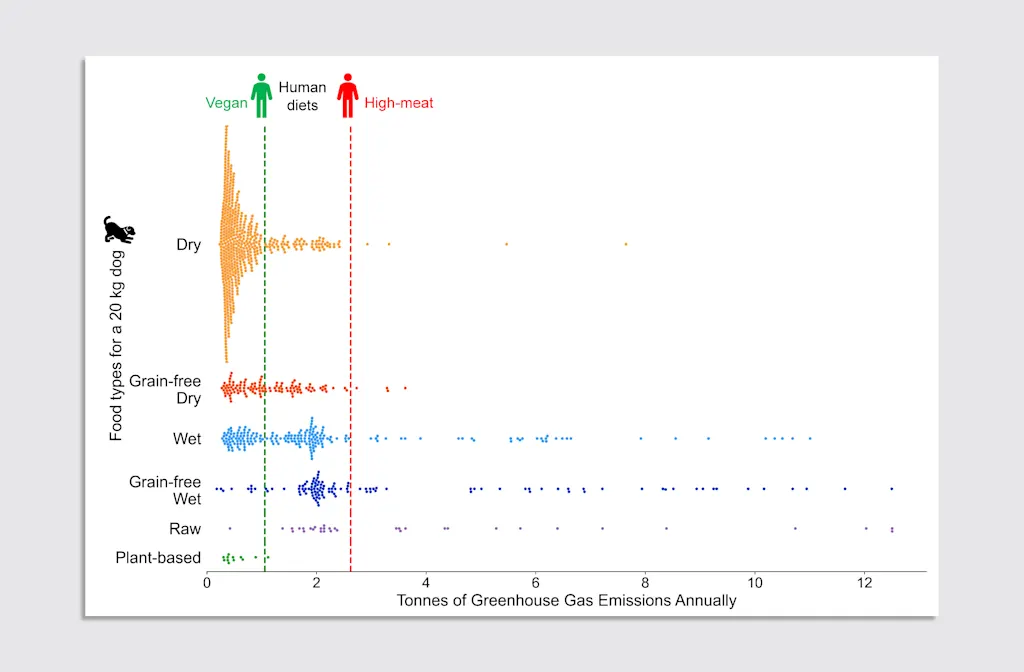
Your dog’s environmental pawprint depends on what exactly their food is made up of. And depending on the ingredients, that impact can change drastically: Over those nearly 1,000 different types of pet food, the researchers found a 65-fold difference between lower-impact feed options and higher-impact food.
For comparison, the difference between human diets is much smaller: an average high-meat human diet produces 2.5 times the emissions as an average vegan diet.
The dog foods with the highest greenhouse gas emissions were those that are meat-rich, wet, raw, or grain-free, the study found.
“When we look at feeding a 20-kilogram [44-pound] dog on raw food or wet food, many of those have a higher impact than a high meat human diet,” Harvey says. Wet grain-free and raw foods also come with about twice the emissions of a human vegan diet.
Terms like “grain free,” “fresh,” or “human grade” may sound appealing to pet owners, but studies have found that they don’t come with clear health benefits, or generally lack evidence that they’re superior.
“There are people who really believe in a particular type of feeling, for example, that dogs must be fed like wolves, only meat and raw bones,” Harvey says. “Well, I would say the veterinary profession I’m not sure is aligned with that, and the evidence isn’t necessarily aligned with those particular positions.”
Helping dog owners be more aware
Harvey doesn’t want to demonize any way an owner might feed their dog; he just wants pet owners to be a bit more aware.
“This is not about saying ‘You’re doing the wrong thing’ or blaming people,” he says. “There are opportunities within every single class of food that we looked at to pick a dramatically lower environmentally impactful formulation, and there’s opportunities for manufacturers to reformulate.”
Beef and lamb are the worst climate offenders when it comes to proteins, for example, so it makes sense that beef and lamb dog foods come with higher emissions. Switching to dog food with chicken would reduce your pup’s diet emissions.
Similarly, foods with “prime cuts,” similar to what humans eat, have a bigger environmental impact, while those that use meat byproducts are more sustainable. There are also plant-based dog foods, which come with some of the lowest emissions.
Pet owners can also be cognizant of managing portion sizes and waste to make their dog’s diets more environmentally friendly.
Harvey focused on food because it comes with a big impact, but also because it’s changeable. He even has a website with more information for pet owners.
He hopes pet owners do become more aware of the impact of their dogs’ diets, and that dog food manufacturers become more transparent and better about labeling their ingredients, so customers can make informed choices.
With his background as a vet, Harvey knows that pets matter to people. He also knows that we’re facing a climate crisis.
“I’d like people to still be able to have a pet as the climate changes,” he says. “I want those two things to be compatible.”